No. 43134
Burg Hausenbach
Austria
CastleRestored13th century
No. 56851
Palace · Austria
No. 56851 · 48.131 N, 15.634 E
For sale
Schloss Ochsenburg in Austria is marked with a public sale signal. Asking price, tenure, land area, floor area, and room counts are shown only after public verification.
Status: Public sale signal
Price: Price on application or not publicly verified
Property type: Palace
Notable features: Restored historic fabric, Residential use
Availability note: Submit an official public listing or register buying interest to complete the sale record.
Quick summary
Schloss Ochsenburg is a palace in Austria with origins associated with the 17th century.
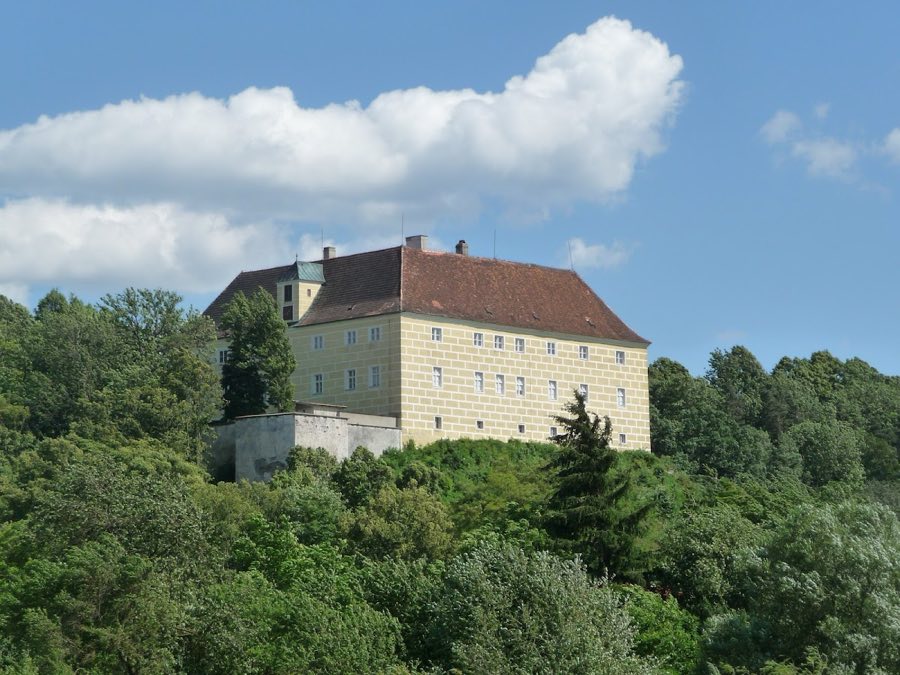
See all castles in AustriaSchloss Ochsenburg stands in the municipality of St. Pölten, Austria, and began as a medieval stronghold erected by the local noble family known as the Herren Ochsenburger. The original castle was adapted in the 1500s into a residence built in the Renaissance manner, replacing or reshaping the earlier medieval fabric as part of that transformation.
Control of the site changed several times in the early modern period. The canons’ chapter of St. Pölten held the property between 1383 and 1530. After that interval the Lassberger family owned the estate until 1675, when ownership passed to the Herren von Leisser. In 1699 the St. Pölten chapter purchased the property again during the tenure of Provost Christoph Müller.
At the end of the 17th century the complex saw new building activity. A Baroque wing on the south side was likely added around 1698 under the direction associated with Jakob Prandtauer. The castle’s Nikolaus chapel received a thorough 18th‑century refitting, with the painter Martin Johann Schmidt identified as a central figure in that redecorating campaign.
Administrative and institutional changes followed the imperial reforms of the late 18th century. The St. Pölten chapter was dissolved in 1784 under measures linked to the Josephinian reforms, and the castle was transferred to the Lower Austrian Religions Fund. In 1785 the newly established Diocese of St. Pölten obtained the right to use the property. During the Second World War the complex served as a military hospital and afterwards fell into disrepair. Later repair work restored the building and it became the bishops’ summer residence.
In 2010 the diocese offered Schloss Ochsenburg for sale for roughly three million euros. By the middle of 2011 no buyer had been confirmed and officials announced that the building would be renovated and made available for event rentals while the search for a purchaser continued. Visual records of the site include an engraving made in 1672 by Georg Matthäus Vischer and another image from 1750 by Aquilin Hacker. Today the castle together with the immediately adjacent manor farm to its east are placed under monument protection.
The castle complex occupies a prominent, roughly thirty‑metre high rock outcrop above the right bank of the Traisen River. This natural platform defines the site’s layout, with the main residence and associated buildings arranged on and immediately beside the rock. Archaeological and historic evidence shows a sequence of building phases, the medieval stronghold later converted into a Renaissance palace in the 1500s, and further enlarged in the Baroque period.
The south wing of the building is identified as a Baroque addition, dated to around 1698 and attributed to work associated with Jakob Prandtauer. That wing represents the late 17th‑century building phase and forms a clear structural element of the standing complex. The Nikolaus chapel inside the castle was newly furnished during the 18th century; its redecoration of that period is documented with Martin Johann Schmidt recorded as playing a major role in the chapel’s interior work.
Directly east of the main building lies a manor farm that stands immediately adjacent to the castle, forming an integrated estate group. A bridge that spans the approach in front of the castle is shown in historical engravings and is recorded as part of the immediate setting. After use as a wartime hospital in the Second World War the complex deteriorated, but subsequent renovation returned substantial parts to use, including service as the bishops’ summer residence. Both the castle and the neighboring manor farm are currently protected as monuments.
No. 43134
No. 24290
No. 50187
No. 33683
Comments
Comments for Schloss Ochsenburg will require a verified account before posting.
We'll send a verification link before your first comment is published.