No. 13651
Schloss Atzenbrugg
Austria
CastleRestoredFor events12th century
No. 24290
Castle · Austria
No. 24290 · 48.205 N, 15.811 E
For events
Schloss Totzenbach is marked as a château or castle venue lead. Capacity, indoor/outdoor spaces, catering rules, and accommodation options are published only after public verification.
Event types: Private events, Cultural gatherings, Filming and photography
Quick summary
Schloss Totzenbach is a castle in Austria with origins associated with the 12th century.
See all castles in AustriaSchloss Totzenbach in Totzenbach, Austria, is a moated castle established by a local medieval knightly family and with origins reaching back to the 12th century. The site acquired much of its present character during a late 16th-century renovation in the Renaissance style, when the medieval complex was expanded into a four-wing residence while older defensive elements were retained. Over the centuries the castle served as the centre of a local lordship and changed hands among several regional noble families, remaining a notable manorial seat in the surrounding countryside.
The site began with the Totzenbacher family, recorded in 1147, who held the local lordship through the medieval period. That male line ended in 1394, and ownership passed to the Polheimer family; later proprietors named at different times include Georg Steiner in 1438 and Mathias Graßer in 1465. In 1513 the property was transferred to David von Trauttmansdorff. A later member of that house, Job Hartmann von Trauttmansdorff, rebuilt and enlarged the complex between 1588 and 1594, creating a four-winged Renaissance residence while preserving the medieval keep (defensive tower) and the palas (great hall).
The castle survived regional conflict in the early modern era. It emerged unhurt from the First Austro‑Turkish War, a series of Habsburg–Ottoman clashes, and in 1683 it was spared the destruction that the surrounding village suffered during the Great Turkish War. Members of the Trauttmansdorff family seldom resided on the island; instead, a steward administered the estate and exercised the manorial rights on behalf of the owners.
In 1822–1823 the princely Liechtenstein family of Neulengbach acquired the property but made little direct use of it. The buildings provided housing for a forester and later for the village schoolmaster, and maintenance declined. The eastern wing was taken down in 1857 and some of its stone was reused in construction at the nearby Kirchstetten railway station. After the school relocated, the south wing was demolished in 1894. By the 1970s the complex had fallen into ruin. The municipality purchased the site in 1971 and then, in 1974, an antiquities dealer named Josef Figl bought the property and undertook an extensive rebuilding campaign from 1974 until 1979. That work repaired the collapsed curtain wall, reconstructed a largely lost gatehouse, re-excavated the silted moat and pond, and rebuilt a previously reduced round corner tower, while uncovering medieval foundations in the inner courtyard. The estate changed hands again in the early 21st century, passing to the Ruschitzka family in 2002 and then to the Berger family in 2003. The castle today is a private residence with some rooms available for private functions and occasional events held in the courtyard, festival hall, or cellar.
Schloss Totzenbach occupies an island set within a surrounding moat fed by the Totzenbach stream and follows a polygonal ground plan. The island is enclosed by a rubble-stone curtain wall whose wall crown is covered with tiles. The moat and the former castle pond were re-excavated in the 1970s restoration, restoring the water barrier that defines the island setting.
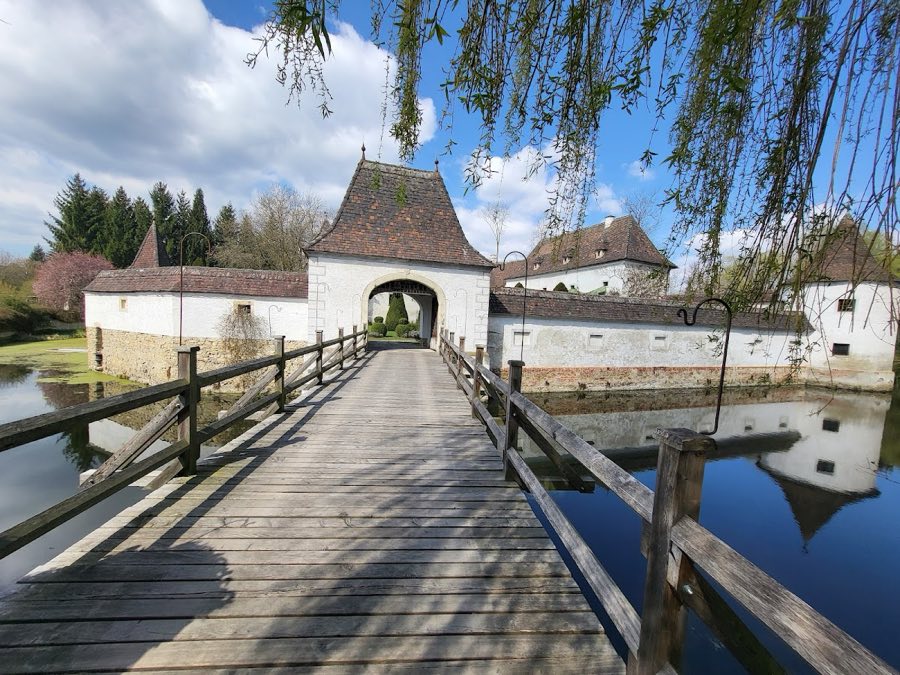
Access crosses the moat on a simple wooden bridge from the southeast, which leads to a massive gatehouse. The gatehouse rises beneath a high, kinked hipped roof and displays painted corner quoins. Its entrance is a basket-arched portal that opens onto the enclosed castle garden, which contains a central water basin and clipped, topiary-style bushes laid out within the courtyard.
Two plain wings occupy the northwest corner of the island and meet at right angles under high tile-covered hipped roofs. The west wing preserves a 16th-century core, confirmed by a firewall bearing the date 1592. The north wing contains a two-aisled cellar and its fabric dates to the 17th and 18th centuries; that wing replaced the earlier medieval keep and adjacent residential buildings between 1672 and 1836.
A massive round tower projects into the moat at the northeast corner. The tower’s present kinked conical roof was set in place after an earlier Baroque cap; the tower was already mentioned in 1756 and formerly contained keyhole loopholes for defence. The masonry of the tower and the other main buildings is finished in a light-coloured plaster, matching the restored external appearance.
The east and south wings were removed in separate phases, the eastern wing in 1857 and the south wing in 1894, so the surviving ensemble today combines original cores and later reconstructions. Major conservation and rebuilding carried out between 1974 and 1979 rebuilt the collapsed curtain wall, reconstructed the largely lost gatehouse, reinstated the round corner tower from its stump-like state, and cleared and refilled the moat and pond. Medieval building foundations were exposed in the courtyard during those works and remain visible as part of the restored inner area. Overall, the ensemble presents both preserved historic fabric, such as the 16th-century west wing core and the 17th/18th-century north wing cellar, and reconstructed elements from the late 20th-century rehabilitation.
No. 13651
No. 56851
No. 43134
No. 21386
Comments
Comments for Schloss Totzenbach will require a verified account before posting.
We'll send a verification link before your first comment is published.