No. 88342
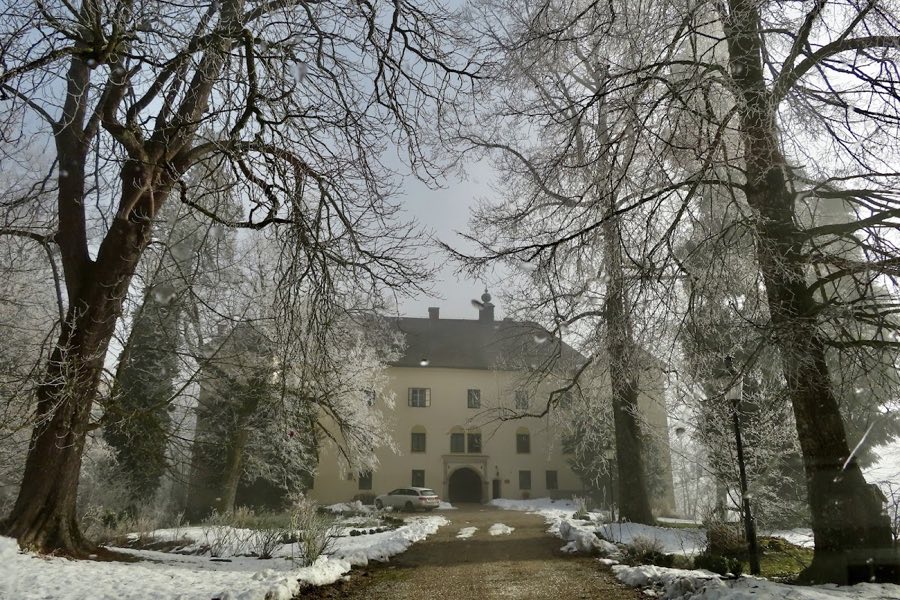
Schloss Starhemberg
Austria
CastleRestored13th century
No. 53234
Manor house · Austria
No. 53234 · 48.109 N, 13.674 E
Quick summary
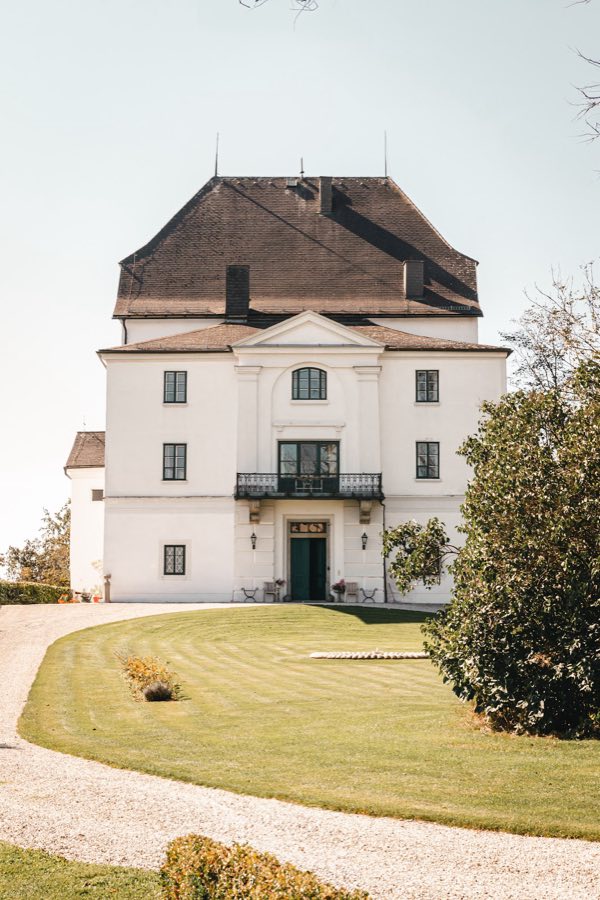
Schloss Wolfsegg is a manor house in Austria with origins associated with the 12th century.
See all castles in AustriaSchloss Wolfsegg in Wolfsegg am Hausruck, Austria, began as a medieval fortification established by the local House of Hausruck in the early 12th century and survives today largely as a 16th and 17th century palace built atop that earlier seat. The site entered regional history in the high Middle Ages as the residence of successive local lords, and later served as a feudal holding, an administered Habsburg territory, and a stage for peasant unrest and legal disputes. Its long sequence of owners and its conversion from fortress to palace mark its changing role in the region’s political and social life.
From the early 1100s a line of Hausruck and Wolfseck lords held the place, with Hadmar I named in 1120 and his son Heinrich in 1135. Other members of the family appear in 12th and 13th century records, including Helwiga and Adelhaid in 1185 and holders called Aribo and Chunradus in 1191. The last male of the original Wolfsegg family, Christian von Wolfsegg, died in 1321. He had sold one share in 1291 to Duke Albert I of Austria. After his death the estate was split between his sister, whose dowry passed through Albero von Pollheim to the Weißbergers, and the Archbishopric of Salzburg, which in 1321 placed its portion with the Schaunbergers.
Disputes over ownership continued in the 1320s when Dietrich von Weißenberg transferred his share to Duke Frederick the Fair in 1326 despite earlier dealings with the archbishopric and the Schaunbergers. An arbitration tribunal settled that conflict in 1328. In 1369 authority over Wolfsegg was definitively taken by the Habsburgs, who thereafter appointed stewards to administer the lordship while sometimes allowing the estate to be pledged to other noble families.
During the late medieval and early modern centuries the property changed hands frequently as a pledge or pawn. It was pledged to Reinprecht II von Walsee in the first decades of the 1400s. In 1455 King Ladislaus enfeoffed Jörg Perkheimer, and Duke Albert VI later converted that tenure into a formal pledge. Emperor Frederick III intervened in 1488, dissolving Kaspar Perkheim’s pledge because of problems enforcing salt trade controls and replacing him with Hilprand Jörger as steward. In 1500 Emperor Maximilian I pawned Wolfsegg to Caspar von Retschan; later pledge-holders included Johann von Senftenau. By 1566 Cosmas Gienger von Grienpichel had obtained the pledged possession and eventually became the owner.
Under the Gienger family the medieval stronghold underwent transformation into a residence. After the death of Hans Adam Gienger around 1621, his daughter Ursula inherited the estate. In the era of the Thirty Years’ War and rising rural unrest, armed peasants seized the place. On 19 November 1626 a force led by General von Pappenheim assaulted and retook a peasant-occupied castle. In 1632, during the Upper Austrian Peasants’ Uprisings, the building was again stormed and suffered severe damage before Christoph von Khevenhüller expelled the occupying peasants.
In the later seventeenth and eighteenth centuries the palace passed by marriage into new families. It entered the household of Josef Pfliegl von und zu Goldenstein as a dowry and later came by marriage to Mathias Castner von Sigmundslust. After Castner’s death his widow married Count Karl von Tige in 1721; mismanagement under that count led to insolvency proceedings after his death. Staatsminister Thaddäus Adam von Reischach acquired Wolfsegg in 1797. In 1818 ownership transferred to Ehrenreich Ritter von Schinnern and then in 1819 to eleven members of the Querer family, whose division of the estate resulted in compulsory administration.
The estate was bought in 1835 by Franz von Saint Julien, and the Saint Julien-Wallsee family retained ownership thereafter. In the twentieth century the palace entered modern cultural awareness through the Austrian writer Thomas Bernhard, who mentioned Wolfsegg in journalism in 1953 and later used the place and its surroundings as settings in several works, including the novel Frost, the screenplay Der Italiener, and the final novel Auslöschung.
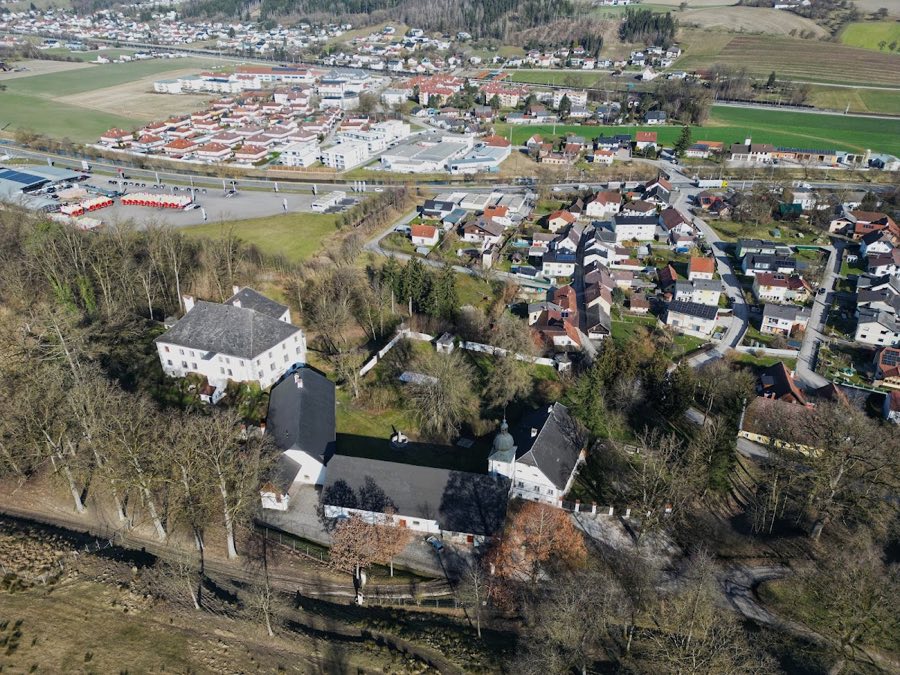
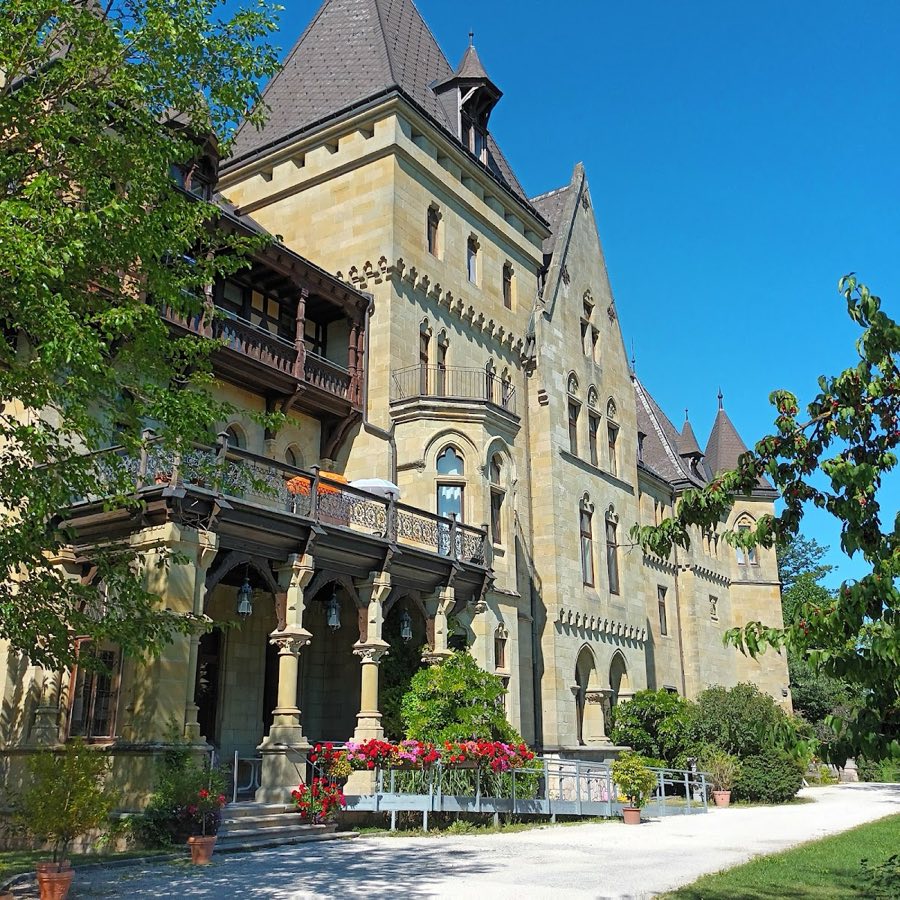
The site occupies a hill above the market town and combines fabric from the medieval castle with the later palace built in the 1500s and 1600s. The principal building is a three-storey main block formed as an irregular four-sided plan into which parts of the earlier defensive wall were incorporated. That main block serves as the core from which later wings extend and it reflects the deliberate conversion from fortress to representational residence carried out in the late sixteenth and seventeenth centuries.
A pair of deep defensive ditches once separated the hilltop stronghold from its approach. Today those earthworks survive as broad hollows cut into the slope, marking the former system of fore-ditches that protected the entrance route. Above the principal gateway an inscription in Roman numerals reads MDXCIX, the year 1599, and is associated with the building phase when the site was altered into a palace.
Two two-storey corridor wings extend from the rear of the main block and link to a parallel three-storey wing, creating an enclosed inner courtyard. Opposite the house stands a horseshoe-shaped manorial farmyard, the agricultural courtyard that served the estate. The knights’ hall contains a finely worked door surround of six columns from the later seventeenth century, a decorative element placed within the reworked interior during the palace period.
The palace chapel is dedicated to Saint Anne and dates to 1746. It is fitted with barrel vaulting and stucco ornament and contains an altarpiece painted in 1746 by Bartolomeo Altomonte. Around the ensemble lies a park recorded in the early eighteenth century, which includes a greenhouse known as the Palm House dating from the early 1800s and a simple enclosing wall that frames the grounds. These features together show how the medieval site was adapted for residence, worship, and landscaped setting across several centuries.
No. 88342
No. 18720
No. 86456
No. 43043
Comments
Comments for Schloss Wolfsegg will require a verified account before posting.
We'll send a verification link before your first comment is published.