
No. 66618
Ziegenhain Fortress
Germany
CastleRestored10th century
No. 69244
Castle · Germany
No. 69244 · 50.980 N, 9.063 E
Quick summary
Schönstein Castle is a castle in Germany with origins associated with the 12th century.
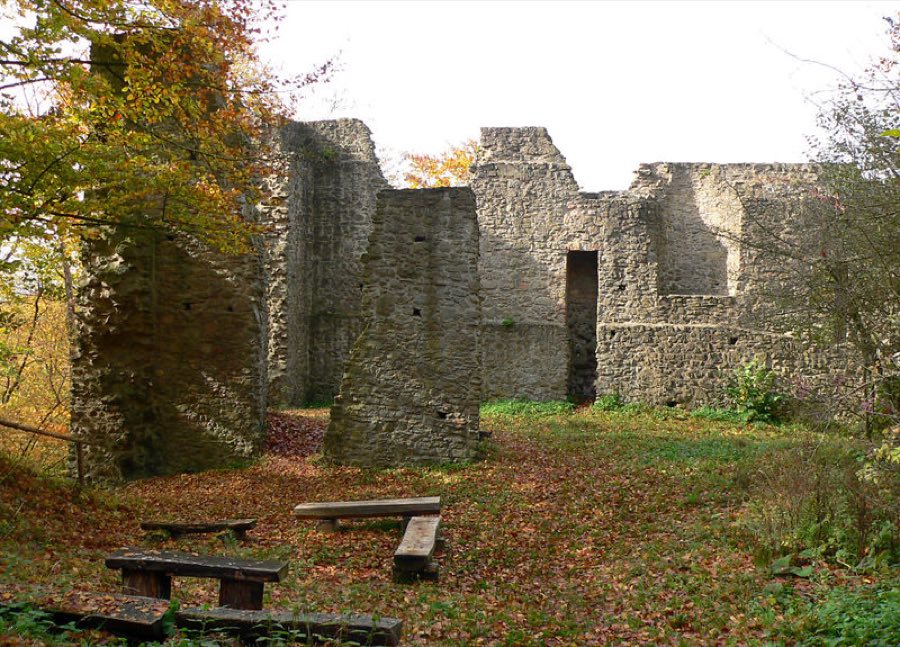
See all castles in GermanySchönstein castle ruins stand in Gilserberg, Germany. The stronghold was built by the medieval Counts of Ziegenhain.
The hilltop site probably dates to the 1100s. In 1170 and 1177 a Godebracht von Linsingen is recorded as a castellan serving Ziegenhain, and members of his family are associated with construction at nearby Jesberg. The castle occupied a commanding position to control the road through the Gilsa valley and first appears in surviving documents in 1350.
During the 1200s and 1300s Schönstein was involved in regional fighting between Hessian and Mainz interests, acting alongside the castles at Jesberg and Densberg. In 1300 Count Gottfried VI granted the castle as a fief to Hermann von Löwenstein‑Schweinsberg. In 1350 Count Johann I created a new administrative district based at Schönstein which included the villages of Lischeid, Moischeid, Winterscheid, the then inhabited settlement of Gerwigshain, Falkenhain, Frankenhain, Treisbach near Sebbeterode, Schönau and Sachsenhausen. Johann I had the castle enlarged in 1358.
In 1368 the castle and its office were pledged to Gottfried von Linsingen and to Hans and Helwig von Gilsa of Roppershausen, who received permission to improve its defenses. During the Sternerkrieg in 1371 or 1372 Landgrave Heinrich II of Hesse laid siege to the site, captured it and ordered its destruction. The castle was rebuilt after this action but in 1399 Hessian forces again took and destroyed it; the rebuild that followed was carried out without the former keep.
In 1406 Counts Gottfried IX and Johann II pawned one third of the castle and its administrative district to Ekkebrecht von Grifte. That pledge was redeemed in 1420 for 160 Gulden by Elisabeth Schenck von Schweinsberg. By an inheritance agreement of Johann II the castle and the county of Ziegenhain passed into the hands of the Landgraves of Hesse in 1450. In 1469, during the Hessian Brother War, mercenaries of Czech origin fighting for Landgrave Ludwig II of Hesse‑Kassel destroyed the castle while it belonged to Landgrave Heinrich III of Hesse‑Marburg.
The site continued to serve as the seat for Hessian administrators of the Schönstein district until 1543, with Otto Hund recorded as the final district official and court days taking place there up to the time of the castle’s ruin. From 1557 the fortress fell into progressive decay. In 1601 residents of Schönau reported that stones taken from the dilapidated castle had been used in the construction of the fortress at Ziegenhain. The remaining fabric was stabilized and secured in 1987 and 1988 by regional forestry and monument preservation authorities.
The castle occupies a roughly rectangular plateau about twenty by thirty-six metres on a western spur of the Schlossberg, at an elevation of 419 metres above sea level. The west face of the hill drops steeply into the Gilsa valley, and the plateau was cut off from the falling ground by a deep neck ditch. To the southwest defensive earthworks in the form of rampart ditches protect the site. Local greywacke was the principal building stone used in the castle’s construction.
The principal residential block, or palas, extended roughly twenty metres in length and nine metres across and rose to three storeys when intact. Surviving masonry on the plateau is likely part of this main building and includes preserved window openings and a chimney trace that attest to domestic use. These wall sections remain in situ as fragmentary ruins and were among the elements consolidated in the late twentieth century.
The castle formerly had a bergfried, a tall defensive keep that stood as a central strongpoint. That tower was destroyed on two occasions during the conflicts of the late fourteenth century and, after the 1399 attack, it was not rebuilt. Later reuse of the castle fabric is recorded in 1601 when villagers reported that stone from the decayed structure had been taken for use at the fortress in Ziegenhain. The surviving remains today are consolidated masonry and earthworks showing the plateau outline, the defensive ditch arrangements and the fragmentary walls of the former palas.
No. 66618
No. 28768
No. 42841
No. 37766
Comments
Comments for Schönstein Castle will require a verified account before posting.
We'll send a verification link before your first comment is published.