No. 80466
Schrattenstein Castle Ruins
Austria
CastleRuin12th century
No. 59598
Castle · Austria
No. 59598 · 47.746 N, 15.979 E
Quick summary
Stixenstein Castle is a castle in Austria with origins associated with the 12th century.
See all castles in AustriaStixenstein Castle stands in the village of Stixenstein, part of the municipality of Ternitz in Austria, and was built during the medieval period by European settlers in the region. Its origins trace back to the 12th century, though precise details on its initial foundation remain unclear.
In the early 14th century, the castle, originally known as Stein, came under the possession of the noble Stüechse von Trautmannsdorf family, who renamed it Stüechsenstein. While this family’s tenure is one of the earliest recorded, it is likely they took control of an already standing fortress rather than founding it themselves. A significant fire in 1347 caused considerable damage, but the Stüechse family restored the stronghold before selling it to Duke Leopold III of Austria prior to 1381.
Soon after acquisition by the ducal authority, the castle was granted to Hans von Liechtenstein, a notable noble of the period. By 1478, control returned to the imperial domain when Emperor Frederick III assumed ownership. Following his demand, substantial defensive enhancements were made to the castle to reinforce its military capabilities.
Despite these fortifications, the castle fell briefly under the control of Hungarian forces led by King Matthias Corvinus in 1488 amid regional conflicts. Their occupation lasted only until 1490, when Habsburg rule was restored. Around 1520, the castle was handed to Marx Treitzsauerwein von Ehrentreitz, marking another phase of noble stewardship. Subsequently, in 1547, ownership passed to Hans Hoyos.
Over time, the castle ceased to function as a military fortress and was transformed into a spacious noble residence reflecting Renaissance architectural influences. However, fires in 1735 and 1802 inflicted major damage, destroying much of the internal structure but leaving the outer walls mostly intact. Early in the 19th century, Count Johann Ernst Hoyos-Sprinzenstein initiated partial rebuilding efforts, adapting the castle’s outer courtyard to serve residential purposes. The Hoyos family maintained ownership for centuries, until 1937, when the city of Vienna purchased the property along with its surrounding water sources and forests to protect the municipal water supply.
During the Second World War, starting in August 1943, Stixenstein Castle was repurposed as one of sixteen depots in Lower Austria safeguarding art collections from Vienna. It remained under protection until April 2, 1945, when the site was occupied by the advancing Red Army. Following the war, efforts to return the stored artwork began, revealing that significant items had been lost or stolen due to looting by Soviet troops and local inhabitants.
In the decades after the war, the surviving structures underwent extensive conservation to stabilize and preserve the remains. Since 1996, joint initiatives by the city of Vienna and Ternitz have focused on renovating the castle. These efforts included the formation of an association dedicated to its restoration. Notably, in November 2023, two new bells were consecrated in a ceremony attended by local officials, marking a continued connection between the castle and the surrounding community.
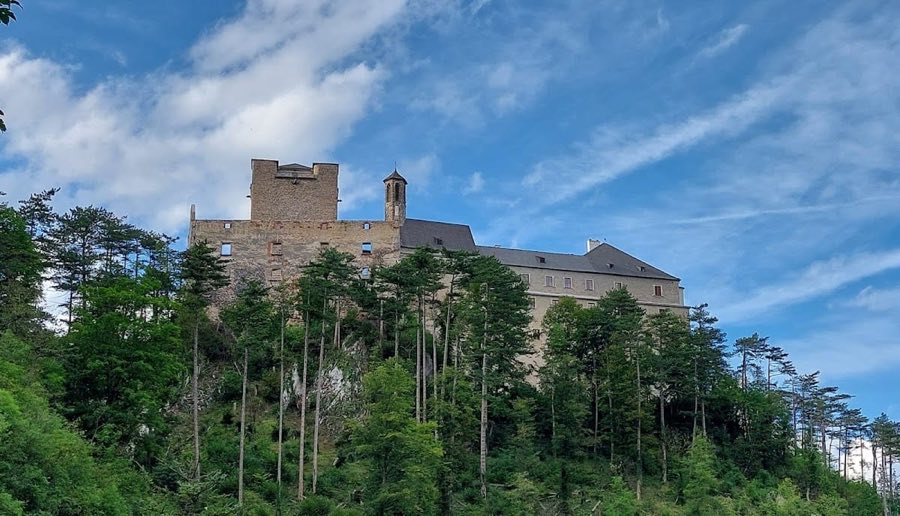
The castle is positioned atop a hill overlooking the village of Stixenstein and commands views across the Sierning valley. Its layout reflects the evolution from a medieval fortress to an enlarged noble residence, integrating elements from various historical periods with different construction techniques.
A prominent feature is the massive keep, or main tower, rising four stories high with a square base measuring 13 meters on each side. Built likely by the Stüechse family in the early 14th century and later modified during the 16th century, this keep exhibits thick stone walls with very small openings situated on its northeast face, enhancing its defensive capability. Uncommonly, the entrance is located at ground level, a rarity for medieval keeps, which typically had elevated doorways for security reasons. Instead of a pitched roof, the keep is topped by a flat platform reinforced at the corners by four robust wall blocks.
Adjacent to the keep lies the castle chapel, originally constructed in the Gothic style. Positioned immediately west of the main tower, the chapel connects directly to the residential quarters through an arched doorway, suggesting its integration into the daily life of the castle’s inhabitants. Though the chapel dates back several centuries, its stylistic elements preserve the medieval religious character despite later renovations.
The castle’s main entrance features a portal designed in the neo-Gothic style, accompanied by pointed-arch windows characteristic of that architectural revival. A steeply pitched roof with a gable shape covers parts of the residence, and near the keep stands a distinctive hexagonal bell tower, adding vertical emphasis to the complex.
Surrounding the castle is an extensive parkland sloping downhill, which would have provided both an ornamental setting and practical space for the estate. The overall construction incorporates durable stone masonry typical of the medieval and Renaissance periods.
Today, much of the interior has not survived intact, but the outer walls, keep, chapel, and associated towers remain standing due to careful restoration. The site is legally protected as a cultural heritage monument in Austria, receiving the official registration number 33623, ensuring continued preservation of its historical fabric.
No. 80466
No. 15119

No. 88132
No. 74680
Comments
Comments for Stixenstein Castle will require a verified account before posting.
We'll send a verification link before your first comment is published.