No. 97907
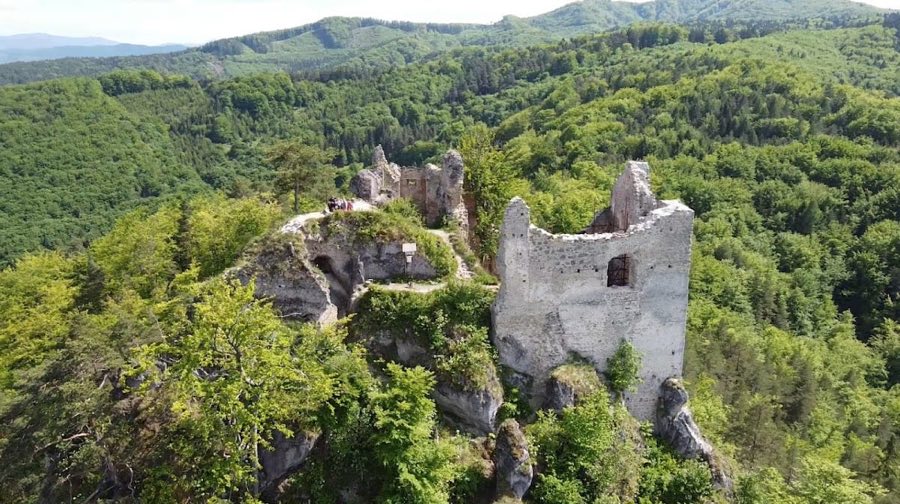
Budatín Castle
Slovakia
CastleRestored13th century
No. 87878
Castle · Slovakia
No. 87878 · 49.175 N, 18.862 E
For events
Strečno Castle is marked as a château or castle venue lead. Capacity, indoor/outdoor spaces, catering rules, and accommodation options are published only after public verification.
Event types: Private events, Cultural gatherings, Filming and photography
Quick summary
Strečno Castle is a castle in Slovakia with origins associated with the 14th century.
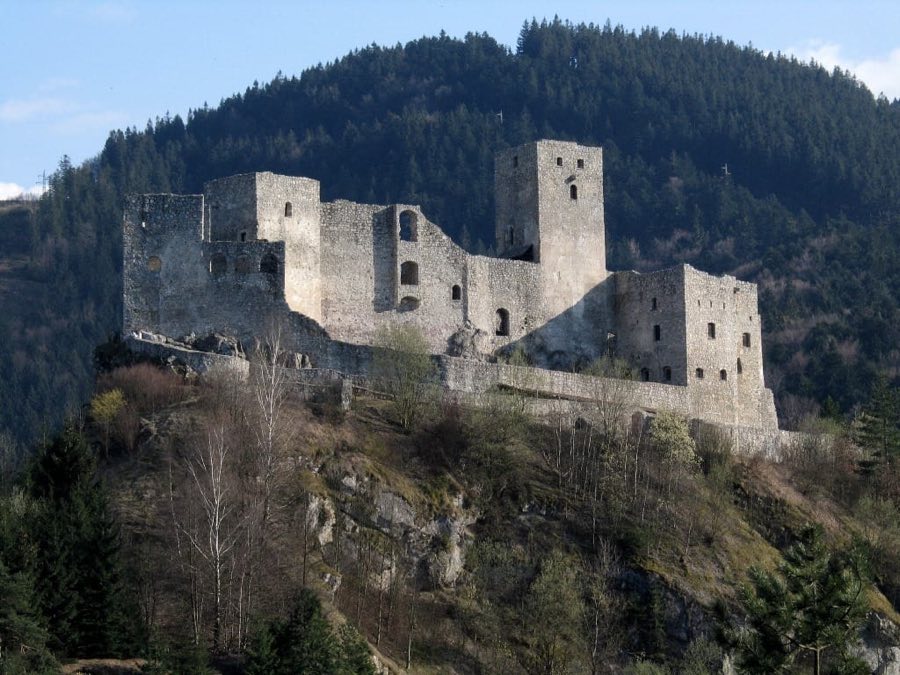
See all castles in SlovakiaStrečno Castle stands above the village of Strečno in northern Slovakia, built by medieval builders on a high cliff overlooking the Váh River. Its origins trace back to an earlier fortified settlement, likely established by Slavic peoples, with the first written record appearing in 1316.
In the early 14th century, the castle was founded by the Balaš family as a stronghold guarding a toll station where the river could be crossed. At this time, the castle’s core consisted of a polygonal structure featuring a main watchtower and residential buildings. Over the 14th and 15th centuries, the fortress expanded with a forecastle, a northern palace, and a chapel added under the patronage of Queen Barbara of Cilli. A deep well was also constructed during this period to secure the castle’s water supply.
Ownership passed through several noble families during the 15th and 16th centuries, including the Pongrác and Dersffy families. The Dersffys initiated Renaissance-style upgrades, adding new defensive bastions able to withstand artillery, as a response to evolving military technologies.
In the 17th century, the castle gained renewed military importance during Ferenc Wesselényi’s preparations for uprising against Habsburg rule. Baroque-style bastions were added in this period to reinforce the defenses. However, following the defeat of the rebellion, the castle was seized by supporters of Imre Thököly. In 1698, Emperor Leopold I ordered the fortress to be dismantled. This demolition resulted in the destruction of fortifications, the filling in of the well, and the removal of roofs, windows, and doors, leaving the castle in ruins.
The site remained largely abandoned for centuries, suffering further damage during World War II by German artillery fire. In the 20th century, part of the castle was quarried for building materials until efforts led by the Catholic Church halted its complete destruction.
Starting in 1974, a reconstruction project aimed to stabilize and restore significant sections of the castle, a process lasting over two decades. Although modern concrete was used extensively, changing some historic elements, by 1995 the castle began functioning as a museum exhibition space. Throughout its history, Strečno Castle played a key role as a regional fortress, witnessed military activity including the Slovak National Uprising of 1944, and served as the final resting place for Žofia Bosniaková, whose remarkably preserved remains were discovered in the castle chapel’s crypt.
The castle’s layout is an irregular polygon shaped to fit the rocky cliff on which it stands. The core compound, covering roughly 400 square meters, centers around a small castle with a prominent five-story stone tower known as a bergfried. This main tower, dating from the late 13th to early 14th century, measures about 8 by 8 meters. Its entrance, located on the second floor, is accessed by a wooden bridge through a Gothic pointed arch. A notable feature is the ground-floor prison cell, carved 8 meters deep into the structure.
Adjacent to the core lies the northern palace, a two-level building with a vaulted ground floor and an originally wooden-beamed upper floor. The palace incorporates a medieval garderobe, or toilet, and includes passageways connecting to wooden galleries, often called matronea, within the nearby chapel.
The castle chapel, constructed in the early 15th century during Queen Barbara of Cilli’s ownership, adjoins the northern palace. Initially built as a simple single-nave chamber with a wooden ceiling and a polygonal apse, it was later enhanced with a stellar rib vault—an architectural style featuring wedge-shaped ribs. In the 20th century, reconstruction work carefully restored the vault using a blend of original stones and new materials. The chapel is illuminated by two Gothic pointed-arch windows on its eastern wall behind the altar. Its galleries once linked to both the northern palace and the main tower, offering elevated viewing spaces.
Next to the chapel stands a small sacristy, a room previously covered by a barrel vault, used for storing liturgical items. Beneath the chapel lies a crypt where the remarkably well-preserved body of Žofia Bosniaková was found.
Water supply was a critical concern and addressed by two key installations. A deep well on the main courtyard descends 88 meters to reach water, while a nearby cistern carved into the bedrock measures about 3.5 meters deep and 2.6 meters in diameter. The cistern’s interior is lined with five layers of carefully fitted stone blocks and was likely sealed at the bottom with clay to retain water.
Defensive features reflect the castle’s evolving military role. The original 14th-century forecastle formed the initial outer fortification. Later, a second circuit of walls included three horseshoe-shaped bastions and an oval bastion at the main gate, known as the Branska tower. Renaissance improvements introduced rounded and rectangular bastions designed to resist increasingly powerful artillery weapons. In the 17th century, Baroque-style bastions were added along the north, south, and west sides.
Originally, entrance to the castle involved crossing a drawbridge spanning a ditch, passing through the gatehouse, and entering the main courtyard. The 1698 demolition dismantled much of the defensive works and removed roofs, openings, and the main well was filled in, leaving the remains exposed to natural decay.
Today, what survives is a blend of original medieval masonry and Gothic architectural details combined with later restoration efforts that included reinforced concrete elements. This combination has altered the castle’s historic appearance but has preserved key portions of its structure and overall silhouette. Strečno Castle stands as a testament to centuries of military architecture and historical events linked to the region.
No. 97907
No. 46895
No. 45711
No. 84044
Comments
Comments for Strečno Castle will require a verified account before posting.
We'll send a verification link before your first comment is published.