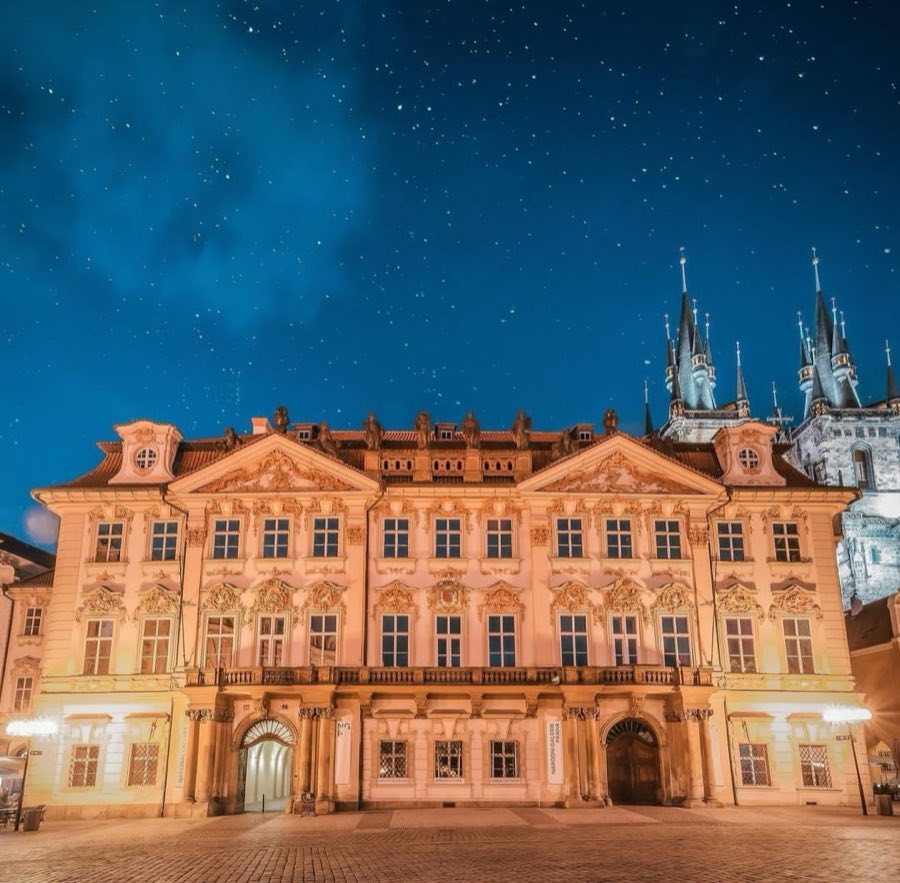
No. 98064
Kinsky Palace, Prague
Prague, Czechia
PalaceIntactFor events18th century

No. 47091
Castle · Czechia
No. 47091 · 50.064 N, 14.418 E
For events
Vyšehrad is marked as a château or castle venue lead. Capacity, indoor/outdoor spaces, catering rules, and accommodation options are published only after public verification.
Event types: Private events, Cultural gatherings, Filming and photography
Quick summary
Vyšehrad is a castle in Czechia with origins associated with the 11th century.
See all castles in CzechiaVyšehrad, located in 7V6V+VFC, 9700 Shumen, Czech Republic, was established by the Přemyslid dynasty in the first half of the tenth century. Archaeology confirms settlement and fortification there during that early medieval period, and a mint operated on the site from the late 980s or 990s, producing denars including coins issued under Boleslav II that bear the inscription VISEGRAD.
Around 1070 Vratislav II transferred his residence from Prague Castle to Vyšehrad and founded the collegiate chapter of St. Peter and Paul. The coronation evangeliary known as the Codex Wyssegradensis is dated to 1085. By the end of the eleventh century a stone princely hall, the basilica of St. Laurentius and the rotunda of St. Martin had been built, and the collegiate chapter continued to hold its immunities thereafter.
During the reign of Soběslav I, between 1123 and 1140, further construction took place at the site. Later rulers, including Vladislav II, returned the princely seat to Prague Castle and Vyšehrad declined as a principal royal residence. In the fourteenth century Charles IV undertook major rebuilding and enlargement, adding a new circuit of walls with towers, a royal palace and converting the collegiate church into a three‑aisled building between 1364 and 1369. Charles IV also designated Vyšehrad as the starting point for the Bohemian coronation procession, first used on 1 September 1347.
In 1420 the Hussites captured Vyšehrad and nearly all of its buildings were destroyed. During the fifteenth century the site developed into a crafts-inhabited free town. After the events of 1620 the chapter regained control of the hill. Swedish forces inflicted heavy damage in 1648 and the place was reshaped as a Baroque fortress between 1654 and 1680, involving the construction of large brick ramparts, strong corner bastions and the demolition of many earlier buildings together with removal of the local population.
The fortress role was ended in 1866. Vyšehrad was incorporated into the city of Prague in 1883 under the name Královský Vyšehrad, the royal prefix being dropped in 1921. Much of the fortress works were demolished in 1911. From the 1870s the burial ground on the slope was established as a national cemetery and the Slavín mausoleum was erected between 1889 and 1893. Archaeological fieldwork at the end of the nineteenth century, again between 1924 and 1935, and later in the twentieth century uncovered Romanesque and Gothic secular and religious remains of the medieval court. A short road tunnel through the rock opened on 11 December 1904 and a tram line has run through it since 1910.
Perched on a steep hill above the east bank of the Vltava at the mouth of the Botič, the site presents a compact acropolis surrounded by successive lines of fortification from different periods. The medieval and later works form terraces linked by paths and ramparts, with the central area occupied by ecclesiastical and palatial remains and lower slopes containing service buildings and funerary monuments.
The fourteenth-century town wall built under Charles IV forms a distinct Gothic circuit. It once included two formal gates and some thirteen to fifteen square towers, each roughly seven metres across and placed at intervals of about sixty metres, and the wall carried battlements and a walkway. The main eastern approach is the Špička Gate, designed with nine small turrets, where masonry of the 1348–1350 gateway survives along with a stretch of the Gothic town wall of about 140 metres where it joined the New Town defences.
Work from the Baroque refortification of 1654 to 1680 survives in large brick ramparts and heavy corner bastions. Several gate structures remain from the later phases. The Chotek, also called the Brick Gate, presents an Empire-style elevation dating to 1841 and gives access to inner casemates. The Tábor Gate dates from about 1655 and sits on the outer belt of Baroque defences. The Leopold Gate belongs to the inner ring; it was rebuilt around 1678 by Carlo Lurago, and its earlier drawbridge was replaced by a road in 1842. Much of the fortress built in the seventeenth century was altered or taken down during nineteenth- and early twentieth-century changes.
The collegiate church of St. Peter and St. Paul occupies the central plot and preserves a long sequence of medieval and modern phases. Founded in the 1070s as a burial church for Přemyslid dukes, it contains an eleventh-century stone sarcophagus known as the Tumba of St. Longinus, decorated with a band of round-arched carving. Excavations documented remnants of the original Romanesque three-aisled basilica in the southwest corner. After a fire the building was rebuilt in an early Gothic manner and later reconstructed to a three-aisled plan with side chapels in the 1364–1369 campaign. A new choir was added in 1575–1576 and a separate early Baroque bell tower rose in 1678. Between 1709 and 1729 Franz Maximilian Kaňka replaced Gothic vaulting with Baroque vaults and a wavy Baroque façade was added. In the late nineteenth century Josef Mocker carried out a dominant neo‑Gothic remodelling from 1885 to 1887 and twin towers were added to the front in 1902–1903, so much of the present decoration and interior fittings date from that neo‑Gothic phase. The church also houses a Gothic panel of the Virgin, the Vyšehrad Madonna, painted around 1360 in tempera on wood after cropping to the recorded dimensions of 58 by 43 centimetres, a painting reportedly donated either by Charles IV or by Archbishop Jan Očko of Vlašim.
A group of Romanesque ecclesiastical buildings survives on the hill. The rotunda of St. Martin, the oldest rotunda in Prague, likely dates to the eleventh century and was renovated in the nineteenth century, when wall paintings were renewed. The St. Laurentius rotunda is a Romanesque circular church from the second half of that same century, and archaeological work near it has uncovered foundations of a cruciform sacred building. A late-fourteenth-century two-aisled hall church dedicated to the Beheading of St. John once stood on the slope; documentary evidence records that its remains were removed during the later expansion of the fortress.
The palatial quarter sits at the high point of the site. The Romanesque princely residence known as the Palas and the palace erected under Charles IV occupied the central acropolis. Today the Vyšehradské sady park lies over the area where the Palas and royal court once stood. At the northern edge of the park excavators have exposed and made visible the remains of a Romanesque bridge, which formerly provided a link to the southern castle area.
At the southwest corner the Burgrave’s House forms part of Charles IV’s palace district and was rebuilt in the sixteenth century, while remaining medieval fabric to its west preserves earlier plan lines. A former castle tower here was given a Baroque superstructure and now contains an exhibition. Below the tower is the ruin of a medieval guardhouse set into the cliff edge, popularly known as Libuše’s Bath, where a narrow rock crevice passage was used historically to haul goods up from boats on the river.
The precinct of the chapter and its administration is represented by a series of later buildings that incorporate older fabric. The Old Provosty dates to the first half of the eighteenth century and contains fragments of fresco decoration. The New Provosty was rebuilt in a neo‑Gothic style in 1872. The New Deanship, built between 1877 and 1879 to designs by J. Nicklas, houses an exhibition and the chapter library and overlays archaeological remains of St. Laurentius.
The landscaped terrace of Vyšehradské sady contains nineteenth-century sculpture groups by Josef V. Myslbek, created between 1881 and 1897 for Palacký Bridge and relocated to the hill in 1948. The cemetery on the slope was laid out in the 1870s and includes the common Slavín mausoleum constructed between 1889 and 1893. A short road tunnel cut through the Vyšehrad rock opened on 11 December 1904 and has carried a tram since 1910; a paved footpath 1.30 metres wide runs along its west side, separated from the roadway.
No. 98064
No. 71414
No. 27779
No. 56491
Comments
Comments for Vyšehrad will require a verified account before posting.
We'll send a verification link before your first comment is published.