No. 33796
Winchester Castle
United Kingdom
CastleRuin12th century
No. 61735
Castle · United Kingdom
No. 61735 · 51.059 N, 1.310 W
For events
Wolvesey Castle is marked as a château or castle venue lead. Capacity, indoor/outdoor spaces, catering rules, and accommodation options are published only after public verification.
Event types: Weddings, Private events, Cultural gatherings, Filming and photography
Ceremony spaces: Ceremony setting to verify
Quick summary
Wolvesey Castle is a castle in United Kingdom with origins associated with the 12th century.
See all castles in United KingdomWolvesey Castle is located in Winchester, England, and was originally constructed by English ecclesiastical authorities. Its site, known historically as Wulveseye or Wulf’s island, features a history extending back to Roman times, when the area already contained buildings.
Around the year 970, Bishop Æthelwold of Winchester established a palace on this island site, marking the beginning of its role as the residence of the Bishop of Winchester. In the early 12th century, about 1110, Bishop William Giffard added to the complex by constructing a new hall on the southwest side. This period saw the site develop as a significant religious and administrative center under the bishop’s jurisdiction.
Between 1135 and 1138, further expansions occurred under Henry of Blois, who was Bishop of Winchester and brother to King Stephen. He built a second hall on the western side of the site and surrounded the palace with a curtain wall to fortify it. These defensive improvements reflected the turbulent times during The Anarchy, a civil war over the English crown. In 1141, Wolvesey Castle withstood a siege during the Rout of Winchester, an important conflict of that period.
The castle’s involvement in England’s military history continued into the early 13th century. In June 1216, during the First Barons’ War, it was besieged again. At that time, Oliver fitz Regis held the castle against an invading force led by Prince Louis of France. These sieges demonstrated the strategic importance of Wolvesey Castle as both a religious seat and a defensive stronghold.
In the 16th century, Wolvesey Castle also played a role in royal ceremonies. The palace was the venue for the wedding breakfast of Queen Mary I of England and Philip II of Spain in 1554, illustrating its continued use for significant state occasions.
The castle’s fortunes declined in the 17th century during the English Civil War. In 1646, Parliamentary forces largely destroyed the palace, leaving it in ruins. Since then, the remains have been preserved as a historic site. Recognized for their cultural importance, the ruins were designated as a Grade I listed site in 1950 and are currently maintained by English Heritage.
Following the medieval period, a Baroque palace was built nearby in 1684 by Thomas Finch for Bishop George Morley. Most of this later structure was demolished by 1786, except for the west wing. That surviving portion was refurbished in 1926 and has been used once again as an episcopal residence. The fifteenth-century chapel from the medieval south range remains in active use, connected to the present bishop’s palace, linking the historic ecclesiastical functions of the site into the modern era.
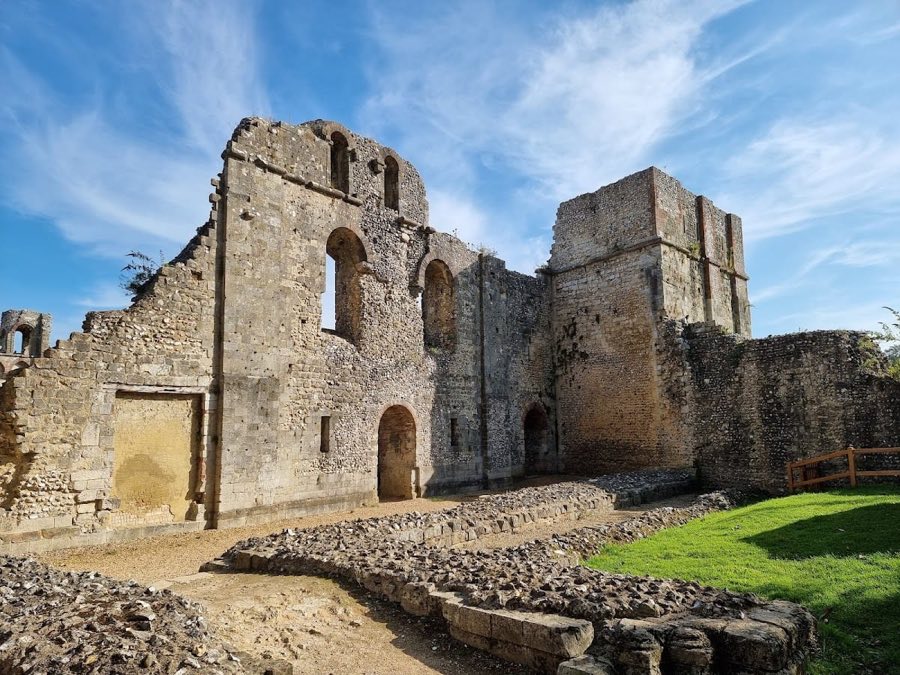
Wolvesey Castle occupies a small island, or eyot, in the River Itchen, situated about 34 meters above sea level in a generally flat valley landscape. The layout reflects its origins as a fortified episcopal palace, with defensive curtain walls arranged around the site. These substantial walls date primarily to the mid-12th century work of Henry of Blois and remain prominent today, giving the ruins their fortified character.
Within the enclosure, most of the original buildings no longer survive, but the footprint of the principal hall remains visible. Noteworthy features include a large round arch in good condition and a Norman window that has withstood the centuries. These elements offer insight into the medieval architectural style and building methods from the castle’s prime period.
The fifteenth-century chapel attached to the southern range of the palace is the only major medieval structure among the ruins still intact and in active use. This chapel is an important link to the religious heritage of the site and continues to serve the bishop’s residence. Its survival amidst the castle’s overall ruined state reflects careful preservation and ongoing ecclesiastical use.
Adjacent to Wolvesey Castle are portions of the old city walls of Winchester, which themselves bear historical significance. The castle’s immediate surroundings are primarily agricultural land, with a moderate rural population density, situating the site in a peaceful setting that contrasts with its formerly strategic and military roles.
Overall, the remains of Wolvesey Castle provide a tangible connection to its past as both a fortified palace and an episcopal seat. The combination of standing curtain walls, the hall’s outline with characteristic medieval architectural details, and the continuing use of the chapel illustrate the layered history preserved at this remarkable site.
No. 33796

No. 95442
No. 40435
No. 45334
Comments
Comments for Wolvesey Castle will require a verified account before posting.
We'll send a verification link before your first comment is published.