No. 82279
Château de Vascœuil
France
ChâteauRestoredFor sale19th century
No. 22267
Palace · France
No. 22267 · 49.440 N, 1.096 E
For events
Archiepiscopal Palace, Rouen is marked as a château or castle venue lead. Capacity, indoor/outdoor spaces, catering rules, and accommodation options are published only after public verification.
Event types: Private events, Cultural gatherings, Filming and photography
Quick summary
Archiepiscopal Palace, Rouen is a palace in Rouen, France with origins associated with the 15th century.
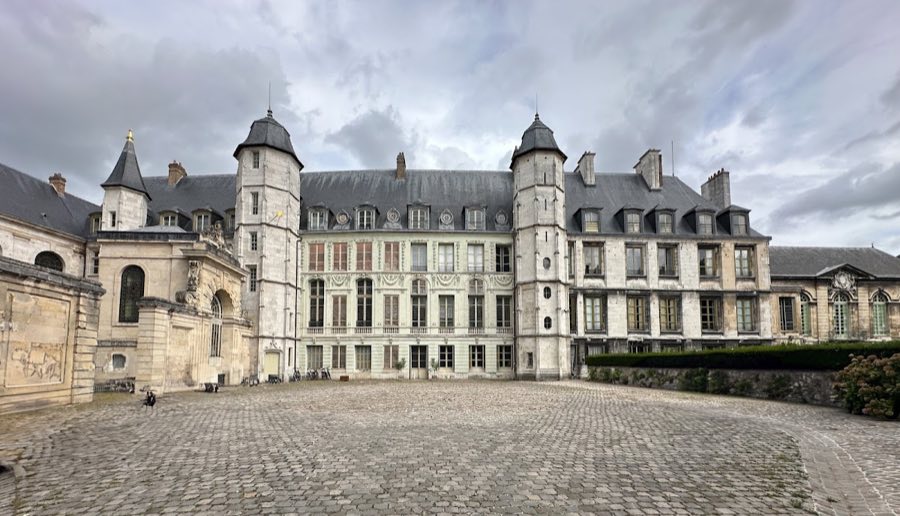
See all castles in FranceThe palace complex occupies the cathedral’s northeast side and reads as a sequence of linked courtyards, service courts and gardens. The main ceremonial courtyard opens toward the cathedral and to formal gardens that lie to the east. Construction spans medieval masonry through Renaissance and later rebuilding, so the ensemble shows successive layers of stonework, floor levels and room plans that reflect changes in use from episcopal lodging and administration to ceremonial reception and justice.
Among the earliest fabric visible is a low, vaulted basement room and the lower courses of wall between the booksellers’ portal and the corner tower on the rue Saint‑Romain, the remains of William Bona Anima’s rebuilding. From the great medieval hall of Guillaume of Flavacourt only the gable with its openwork survives. These fragments are stone-built, set directly on older foundations, and present today as partial in situ remains within the palace elevation.
The mid‑15th century reconfiguration by Estouteville produced surviving domestic and ceremonial arrangements. A suite of ground‑floor kitchens, completed by 1462, sits under the noble floor where the principal hall was completed in 1463–1464. A winding, or spiral, staircase finished in 1464 gives vertical access between service and reception levels; a second spiral stair, added under Georges d’Amboise, runs parallel to the earlier stair. The principal hall, now called the salle des États, retains its role as the main assembly room after later alterations.
Georges d’Amboise’s building phase (1495–1507) created the present corps de logis for the church courtyard, arranging service rooms on the ground floor and offices and a courtroom on the upper levels. The pavillon Saint‑Romain at the northeast and the pavillon Notre‑Dame at the southeast date to this period; they were originally provided with crenellated terraces and were later fitted with pitched roofs. The garden established then included glazed galleries around it and a marble fountain composed of two basins made between 1501 and 1507; the glazed galleries lasted a few decades and the fountain remains a documented feature of that layout.
Interior fittings and furnishings preserve a mixture of epochs. The service plan still shows three kitchens in the complex, including a 19th‑century kitchen equipped with a wood‑fired “piano” oven made by Anquetil, and a basement guard room that connects to the kitchens and displays religious objects and paintings, among them a 1453 portrait of Guillaume d’Estouteville. The noble floor contains a Renaissance dresser holding 240 Sèvres porcelain pieces, a former smoking room now used as a guest room, a library with over 12,000 volumes, and the salon des insignes with a painting of Saint John the Baptist as a child by Jules Romain.
The salle des États presents the most layered appearance: its present form reflects 18th‑century remodelling while it retains large south‑facing windows fitted with stained‑glass panels dated 1531 transferred from the garden galleries by Archbishop Thomas. Four large wall paintings by Hubert Robert, commissioned in the 1770s, decorate the room and depict the ports of Le Havre, Dieppe, Rouen and the Château de Gaillon. Eighteenth‑century remodelling elsewhere replaced earlier large Gothic openwork with regular window openings and painted false windows. The ensemble preserves fabric and fittings from medieval, early modern and later phases and has benefited from restoration work, notably at the end of the 20th century, with parts opened to house the Historial Joan of Arc since 2015.
No. 82279
No. 23562
No. 62973
No. 72037
Comments
Comments for Archiepiscopal Palace, Rouen will require a verified account before posting.
We'll send a verification link before your first comment is published.