No. 59544
Wintrange Castle
Luxembourg
CastleRestoredFor sale10th century
No. 73369
Castle · Luxembourg
No. 73369 · 49.524 N, 6.223 E
For events
Aspelt Castle is marked as a château or castle venue lead. Capacity, indoor/outdoor spaces, catering rules, and accommodation options are published only after public verification.
Event types: Private events, Cultural gatherings, Filming and photography
Quick summary
Aspelt Castle is a castle in Luxembourg with origins associated with the 11th century.
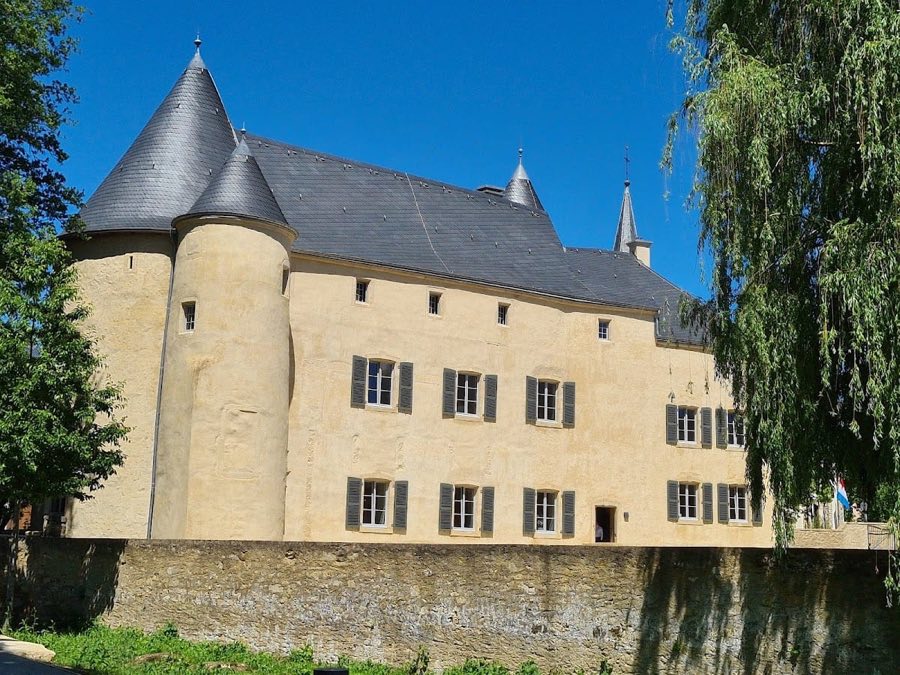
See all castles in LuxembourgAspelt Castle is situated in the village of Aspelt within the commune of Frisange, in Luxembourg. The origins of the castle trace back to the medieval period, with its earliest mention dating to the year 963, indicating a long-standing presence in the region. The site itself likely rests on even older Roman foundations, suggesting continuity of occupation and strategic importance over many centuries.
In the Middle Ages, Aspelt Castle began as a water castle, a type of fortification surrounded by moats or water defenses, characteristic of the 11th century. By the 14th century, the castle saw the construction of its distinctive round Gothic towers, reflecting the architectural influences of that era. The castle gained prominence in written records such as the Echternach Chronicle of 1132, authored by Theoderich von Wied, highlighting it within medieval historical narratives.
By the late 16th century, the castle underwent significant transformation when the Ruelle, Kempt, and Burthé families completed the current Baroque-style residence in 1590, adapting the fortress for more residential purposes. The 18th century brought further changes under the ownership of the Martiny family, who expanded the structure in 1777 and enhanced it with new Baroque windows, blending evolving architectural styles with the medieval framework.
After centuries of private ownership, the castle entered a phase of restoration and public stewardship when the commune of Frisange acquired it in 1992. Beginning in 2010, the commune undertook various renovations, focusing on preserving its historical integrity with work on the roof and surrounding outbuildings. Although ambitious plans in 2017 proposed a multi-million-euro renovation to convert the castle for administrative use, these were set aside to maintain its cultural purposes.
Between 2010 and 2024, the adaptation of the castle grounds continued with the conversion of the southern barns into a central building and a festival hall, capable of hosting events with seating for 110 people, alongside additional amenities such as a bar. The western barns were also repurposed to include a village shop and holiday apartments. In the early 2020s, a Renaissance sundial measuring more than a meter wide was discovered on the former parsonage wall within the castle grounds, adding to the site’s historical richness. It may originally have been mounted above an entrance or the doorway of a chapel built in 1514, further linking the castle to its spiritual heritage.
Aspelt Castle was officially recognized as a national monument on December 2, 2011, marking its importance in Luxembourg’s cultural and architectural history.
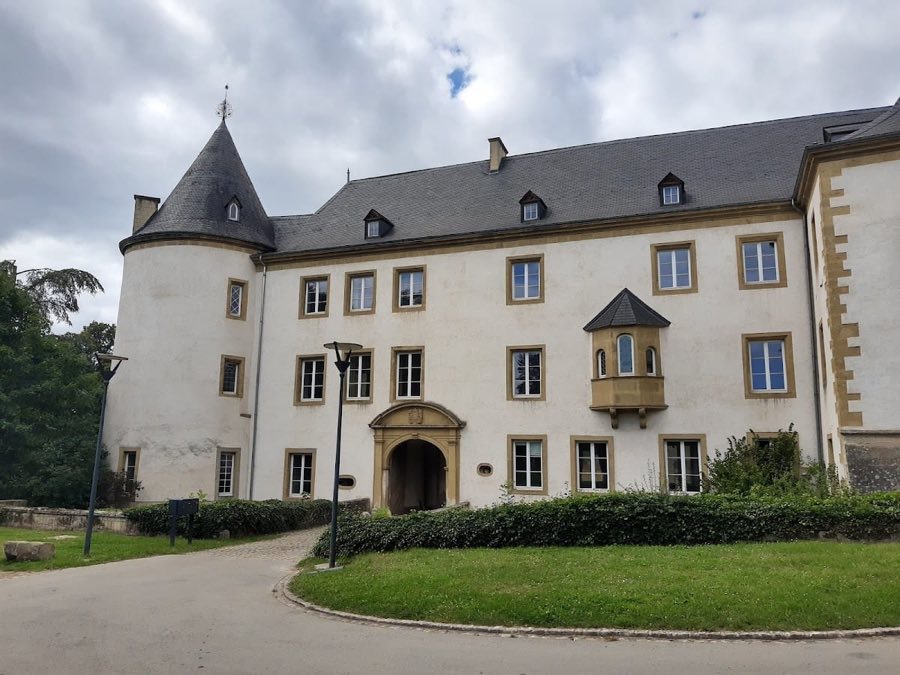
Aspelt Castle presents an architectural layering that reflects its long history, combining medieval defensive structures with Baroque residential elements. Built originally as a medieval water castle, the site likely included moats or water channels surrounding the fortification, although the visible remnants now focus on the buildings themselves. The Baroque residence constructed in 1590 stands as the central element, built upon the earlier medieval foundations.
The castle’s most prominent medieval features are its round Gothic towers, dating back to the 14th century. These towers, constructed in stone using masonry typical of Gothic military architecture, retain much of their original form. The ground floor of the southwest tower underwent restoration in 1957, helping to preserve its structural integrity while maintaining its historical character.
In 1777, the Martiny family enhanced the castle by adding a series of new Baroque-style windows. These windows introduce a stylistic contrast to the earlier medieval and Gothic elements, using larger glass panes and decorative frames typical of the Baroque period.
The castle grounds include former agricultural buildings that have been adapted to new uses in recent years. The southern barns were transformed into a central building and a festival hall, equipped with a grandstand seating 110 people and a bar area, providing spaces for community gatherings while respecting the historical setting. Meanwhile, the western barns have been converted to house a village shop as well as two holiday apartments, blending modern functionality with preserved architecture.
A vaulted cellar remains beneath the castle, representing one of the older structural elements retained through renovation. This cellar, characterized by arched stone construction, helps illustrate the castle’s use and layout during earlier periods.
The inner courtyard, once a functional part of the castle complex, has been reimagined as a village square, serving as a communal open space that connects different parts of the castle and its outbuildings.
Among the notable recent discoveries is a Renaissance sundial found on a two-meter-high wall of the former parsonage. Measuring 112 centimeters wide and about 50 centimeters high, it is believed that this sundial was originally placed either above a right-side entrance of the castle or the door of a family chapel erected in 1514. This artifact offers insight into the scientific and decorative practices associated with the castle’s inhabitants during the Renaissance era.
Together, these structural remains and finds provide a rich, tangible record of Aspelt Castle’s evolution over nearly a millennium, showcasing its adaptation from a medieval fortress to a Baroque residence and into a modern cultural heritage site.
No. 59544
No. 89627
No. 57333
No. 59123
Comments
Comments for Aspelt Castle will require a verified account before posting.
We'll send a verification link before your first comment is published.