
No. 86463
Myślewicki Palace
Poland
PalaceRuin18th century
No. 23909
Palace · Poland
No. 23909 · 52.215 N, 21.036 E
Quick summary
Łazienki Palace is a palace in Poland with origins associated with the 17th century.
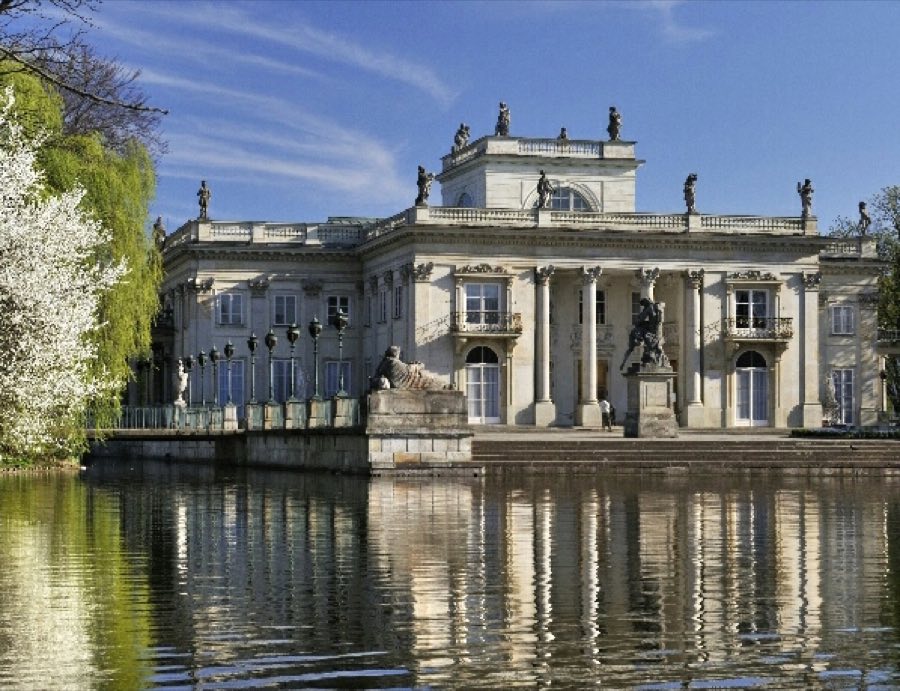
See all castles in PolandŁazienki Palace in Warsaw, Poland, is a palace set on an island in the city’s Royal Baths Park, built for Polish nobility in the late 17th century in the Baroque manner. Erected originally as a marble bath-house and habitable garden pavilion, it became a notable element of a major urban park and later a royal summer residence, giving it an ongoing role in Poland’s cultural life from the 18th century onward.
The site began its development after 1674 when a Polish nobleman commissioned a baroque bath pavilion, completed by the end of the 1680s. The structure functioned as a bathing house, a livable pavilion and a garden grotto, with richly worked interiors that included stucco, statuary, painted schemes, decorative tiles and inscriptions tied to the original owner’s family. These early features established the building’s reputation as an ornate leisure retreat.
In the late 18th century the estate was purchased by the last king of the Polish–Lithuanian Commonwealth, who transformed the pavilion into a classical summer residence surrounded by an English-style garden. Remodeling took place across the 1760s to the 1790s, with further enlargement between about 1788 and 1793. From 1775 the palace served as the king’s summer home, and from 1784 the Dining Room hosted the king’s weekly dinners for leading Freemasons and prominent figures of the Polish Enlightenment, making the palace a center of contemporary political and cultural exchange.
After the king’s death the palace passed into private hands, including ownership by a Polish marshal and a princess, and in 1817 the estate was sold to Tsar Alexander I. In the mid-19th century a western pavilion was altered to create a church dedicated to St. Alexander Nevsky, reflecting the site’s changing ownership and the political context of that era.
During the German occupation in World War II the building was used as barracks and was identified in German planning as a possible future residence for Adolf Hitler. In 1944 retreating German units severely damaged the interior, drilling roughly one thousand holes in structural walls for explosives and then burning major paintings and decorative schemes in a fire set before the palace; the building was not finally blown up. Reconstruction of the palace commenced immediately after the war and continued over two decades, with ground-floor rooms reopened in 1960 and first-floor rooms in 1965. The palace was run as part of the National Museum and became an independent institution in 1995. Major conservation and repair work, including roof and room repairs, took place between 2012 and 2015.
The palace occupies an artificial island that divides the surrounding lake into a smaller northern basin and a larger southern basin, and it is reached by two bridges crowned with rows of Ionic columns, which are classical columns with scroll-shaped capitals. The building was built on a roughly square plan and began as a marble pavilion. The façades are unified by a continuous horizontal band above the columns, supported by large Corinthian flat supports (pilasters, or flat, column-like wall supports with ornate capitals), and a low railing along the roofline made up of small posts forming a decorative barrier (a balustrade) that carries statues of mythological figures. The north side presents a central entrance porch capped by a triangular pediment, while the south front opens into a deep central recess behind a screen of Corinthian columns.
Inside, the central round hall, the Rotunda (a round central hall), stands at the heart of the plan and links the Bath Room and the Ballroom; this space was finished in yellow and white marble and carried figures of Polish kings. On the ground floor the Bacchus Room is lined with 17th-century Dutch blue tiles and formerly held a large painting by a Flemish master. A lower Picture Gallery once contained works attributed to artists such as Rubens and Rembrandt. The Dining Room retains its historical role as the site of the king’s evening gatherings, while a large ground-floor chamber known as the Solomon Room displayed a six-painting cycle narrating episodes from Solomon’s life. Many of these named canvases and painted schemes were deliberately burned during wartime sabotage in 1944, including a ceiling painting executed in 1778 and a major multi-piece cycle depicting the history of Solomon.
Postwar rebuilding reconstructed and restored the palace interiors and exterior roofscape. Elements originating from the 17th-century phase survive in places, and conservation work completed in 2012–2015 uncovered wall paintings from the 17th century in some rooms. More recent repairs included replacement of the roof covering, structural and decorative work in principal rooms such as the Ballroom, and conservation of the sculpted figures atop the attic balustrade. The palace today is a largely restored complex where original fragments coexist with reconstructed fabric and conserved decorative schemes uncovered and treated during modern renovation.
No. 86463
No. 96143
No. 80631
No. 59115
Comments
Comments for Łazienki Palace will require a verified account before posting.
We'll send a verification link before your first comment is published.