No. 23909
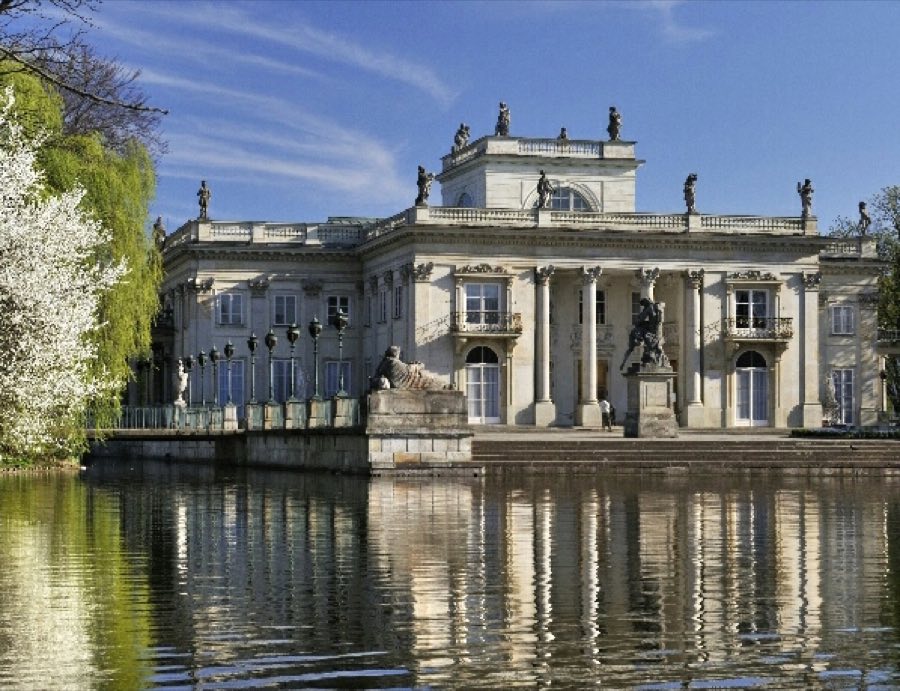
Łazienki Palace
Poland
PalaceRestored17th century

No. 86463
Palace · Poland
No. 86463 · 52.215 N, 21.038 E
Quick summary
Myślewicki Palace is a palace in Poland with origins associated with the 18th century.
See all castles in PolandMyślewicki Palace, Warsaw, Poland, is an 18th-century palace erected by the Polish–Lithuanian Commonwealth between 1774 and 1779 in an early neoclassical idiom with rococo influences. Commissioned by the reigning king, it formed part of the royal estate within what is now the Łazienki Royal Park and served as accommodation for members of the royal household and court. The building took its name from a nearby village called Myślewice, which no longer exists.
Construction and early use unfolded in the late 1770s, when the new house became a residence for royal courtiers. A substantial service wing for household staff was added in 1788. A member of the royal family later occupied the palace and his initials were placed above the entrance, marking a period when the building served both private and dynastic functions.
In the decades that followed the palace’s role shifted with the political life of the region. In November 1830 cadets from a military academy housed in the palace marched on the Belweder Palace; that attack is recorded as the opening action of the November Uprising, the 1830–1831 armed insurrection against Russian domination. During the 19th century and later under the Polish People’s Republic the palace was adapted to receive distinguished foreign guests; visitors recorded as having stayed or been received there include Napoleon I, Josip Broz Tito, Indira Gandhi, and Richard Nixon.
Between the two world wars the building provided living quarters for senior officials, including the commander of Warsaw Bolesław Wieniawa‑Długoszowski and later the Deputy Prime Minister Eugeniusz Kwiatkowski. The palace survived the Second World War with only minor damage and in the immediate postwar period portions of it were used to store furniture and architectural elements by the municipal reconstruction office. After the war it remained a government property and contained guest apartments run by the Office of the Council of Ministers, where visiting heads of state and other high-ranking visitors stayed.
From 1958 into 1970 confidential meetings between the ambassadors of the People’s Republic of China and the United States took place in the palace dining room; those talks contributed to the eventual establishment of formal diplomatic relations between the two countries, with the first meeting of the ambassadors dated 15 September 1958. In 1980 the palace was placed under the care of the Łazienki Royal Museum. A conservation phase completed in 2015 repaired the roof structure, renewed the metal roof covering, and restored the exterior face of the building. In 2019 a monument to Bolesław Wieniawa‑Długoszowski was unveiled in front of the palace.
The palace stands within the grounds of the royal park and retains the main three-storey body with a tall central entrance niche flanked by curved quarter‑circular wings. The main massing and plan date to the late 18th century and reflect the period combination of early neoclassical restraint and lingering rococo detail. A large servants’ annex built in 1788 sits to one side, reflecting the expansion of the household soon after the palace was completed.
The exterior decoration includes a prominent shell motif sculpture over the façade that depicts the wind god and the goddess of flowers, executed by a named sculptor. The rooflines are softly curved, a form noted for its reference to contemporary Chinese decorative motifs. The overall materials and workmanship of the exterior have been conserved and the façade renewed during recent restoration work.
Inside, a series of 18th‑century painted schemes survive. Original polychrome work remains in the vestibule and on the staircase, preserving decorative painting from the building’s first phase. The ground‑floor dining room contains a set of pictorial views of Italian sites by a known painter, showing the Castle and Bridge of Saint Angel in Rome, the papal villa of Pius VI in the Vatican, and two vistas of St. Mark’s Square in Venice. A separate landscape room preserves eight rococo views that place classical ruins within an Italianate countryside, executed by another named artist.
The palace contains one of only two surviving 18th‑century bathing suites in the country. The bathroom ensemble preserves stucco work, marble surfaces, and a ceiling painting titled Zephyr and Flora by the same painter who executed the dining-room vedute; this ceiling is the only palace interior painting by that artist to survive in Warsaw. A narrow stair concealed from public circulation links the bathroom with a bedroom on the floor above, and there are indications the sovereign himself may have used this private passage. Overall the interior painted decoration and principal fittings remain in place, and conservation work carried out in the 2010s repaired the roof structure, replaced the copper roof covering, and refreshed the exterior face of the building.
No. 23909
No. 96143
No. 80631
No. 11271
Comments
Comments for Myślewicki Palace will require a verified account before posting.
We'll send a verification link before your first comment is published.