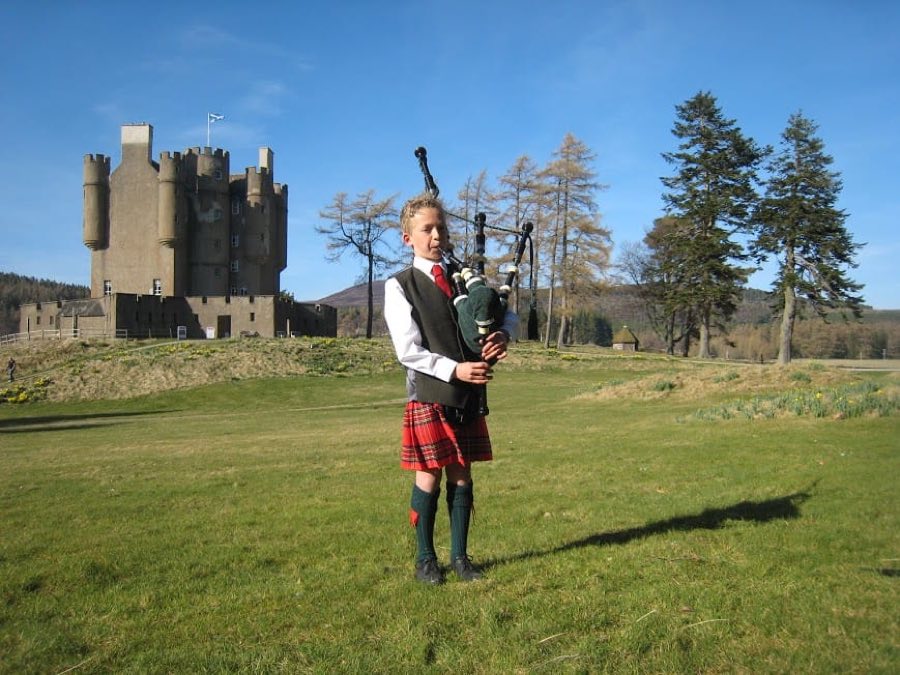
No. 20140
Braemar Castle
United Kingdom
CastleRuinFor events17th century
No. 42584
Tower house · United Kingdom
No. 42584 · 57.041 N, 3.230 W
Quick summary
Balmoral Castle is a tower house in United Kingdom with origins associated with the 7th century.
See all castles in United KingdomBalmoral Castle, Ballater, United Kingdom, is a nineteenth-century Scottish baronial country house created for the British royal family, built on land long held by Scottish landowners. The site’s origins reach back to the late medieval period, when a house was erected there in 1390 by Sir William Drummond and the place-name appears in records from 1451 as Bouchmorale. A royal hunting lodge used by King Robert II stood on the ground before later fortified and domestic houses replaced earlier buildings. The present building dates from the mid‑1800s and became central to the royal family’s private estate.
From the later Middle Ages into the early modern era the estate changed hands among Scottish families. The Gordon family constructed a tower house on the property, and in 1662 ownership passed to Charles Farquharson of Inverey. Members of the Farquharson family took part in the Jacobite uprisings of 1715 and 1745; James Farquharson of Balmoral was wounded at the Battle of Falkirk in 1746. After the middle of the eighteenth century the Farquharson lands were forfeited and were later held by the Farquharsons of Auchendryne.
At the end of the eighteenth century the estate passed into the possession of James Duff, second Earl Fife, who leased the castle. In the early nineteenth century the building was altered with baronial-style additions under new leaseholders. An arrangement in February 1848 allowed Prince Albert to take the remaining part of the lease, including furniture and staff. Queen Victoria and Prince Albert visited Balmoral for the first time on 8 September 1848.
Prince Albert purchased the estate and its existing castle privately in June 1852 for £32,000, formally taking possession that autumn and acquiring neighbouring Birkhall and the lease of Abergeldie Castle at the same time. To serve the household before the new house was ready, a prefabricated corrugated-iron building supplied by a Manchester firm was in use at Balmoral from October 1851 as a temporary ballroom and dining room. Work on the present house began in mid‑1853 to amended designs overseen by Prince Albert; Queen Victoria laid the foundation stone on 28 September 1853. The royal apartments were ready by the autumn of 1855 and the completed house was occupied in 1856, after which the older fortress-like castle was taken down.
A new bridge over the River Dee, designed by the engineer Isambard Kingdom Brunel, was finished by the autumn of 1857 to link Crathie and Balmoral. In 1861 Prince Albert established a model dairy on the estate; Queen Victoria completed that project after his death and marked his memory on the land with a stone pyramid erected a year after he died. A large statue of Prince Albert by the sculptor William Theed was unveiled on 15 October 1867.
The royal family continued to use Balmoral as a seasonal retreat into the twentieth century. A granddaughter of Queen Victoria, Victoria Eugenie, was born at Balmoral in 1887, and in September 1896 Queen Victoria entertained Emperor Nicholas II and Empress Alexandra there. During the 1910s and 1920s King George V oversaw substantial improvements to the grounds, including formal gardens to the south of the house. Visits were suspended during the Second World War; features with German associations were removed or had names changed, for example Danzig Shiel became Garbh Allt Shiel and the so‑called “King of Prussia’s Fountain” was taken away.
In the postwar decades Prince Philip introduced herbaceous borders and a water garden in the 1950s, and new staff accommodation was added close to the castle in the 1980s. Ownership of Balmoral has remained private rather than part of the Crown Estate. The property kept within the royal family since Prince Albert’s purchase passed to Edward VIII on his accession in 1936, remained with Edward after his abdication, and was bought for the Crown by King George VI under a financial settlement. It was inherited by Queen Elizabeth II and, following her death, passed in ownership to King Charles III while trustees manage the estate under formal deeds. The main house is listed as a Category A building.
The estate now extends across roughly 53,680 acres (about 21,725 hectares) and lies within the Cairngorms National Park, with part of it inside the Deeside and Lochnagar National Scenic Area. It functions as a working rural estate with managed grouse moors, forestry, farms and herds. The mountains at Lochnagar and woodlands at Ballochbuie were designated Special Protection Areas in 1998 under the European Birds Directive, and Ballochbuie is also protected as a Special Area of Conservation under the European Habitats Directive. Gardens and castle grounds were opened to the public in 1931, with daily access during the spring and early summer; until 2024 the ballroom was the only interior room normally shown to visitors, and in 2024 limited access to several rooms used by the family was made available during a month-long summer programme. Queen Elizabeth II regularly used Balmoral as a summer residence and died at the castle on 8 September 2022; her coffin lay in repose in the ballroom for three days before being taken to Holyroodhouse in Edinburgh to begin state funeral arrangements.
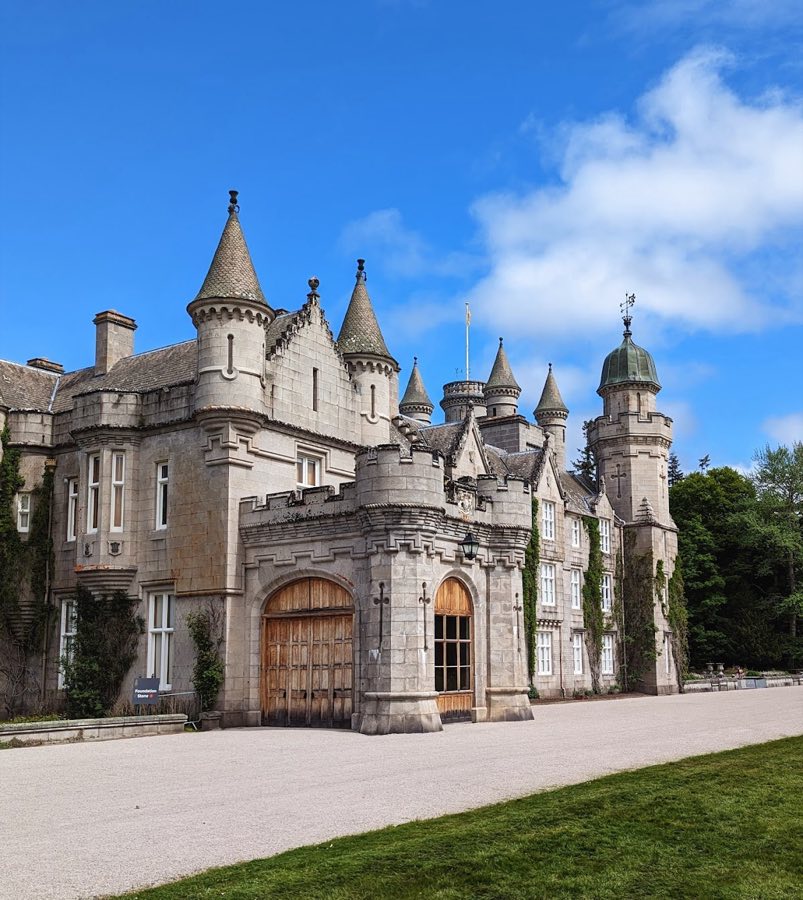
Balmoral Castle stands as a large granite country house built using stone quarried on the estate. The principal building consists of two main blocks set around separate courtyards, with the south‑western block containing the principal reception and private rooms and the north‑eastern block housing service areas and staff spaces. The exterior displays many elements drawn from the Scottish baronial tradition that were incorporated when the new house was built in the 1850s.
A tall clock tower rises at the south‑east corner of the house, reaching about eighty feet (24 metres) and finished with small turrets; one of those turrets carries a balustrade feature comparable to an element at Castle Fraser. The composition also includes a seven‑storey tower and small rounded “pepper‑pot” turrets, stepped gables that ascend in stages, dormer windows projecting from the roof, and a battlemented covered carriage entrance for arriving vehicles. The main fabric is locally quarried granite, giving the house its distinctive pale, durable appearance.
The estate retains several later buildings and landscape features connected with nineteenth‑century royal occupation. A model dairy developed under Prince Albert survives as part of the estate’s agricultural complex, completed after his death. A stone pyramid was erected on the hills to commemorate the royal purchase of the land, and a major sculptural memorial to Prince Albert by William Theed was installed in 1867. A prefabricated corrugated‑iron ballroom and dining building supplied by E. T. Bellhouse & Co. was used on site between 1851 and 1856 while the new house was being completed. The former medieval and post‑medieval castle that stood before the present house was demolished soon after the new building was ready.
Landscape and estate structures extend beyond the castle itself. The waterside house Glas‑allt‑Shiel at Loch Muick and a series of lodges and houses are part of the wider estate fabric. Conservation designations covering upland and wooded areas, including special protections established in 1998, reflect the estate’s ecological as well as built heritage. The castle and parts of its grounds are maintained within statutory protections, with the principal building recorded as a Category A listed property and the gardens and select rooms opened periodically for public viewing.
No. 20140
No. 64747
No. 61507
No. 60523
Comments
Comments for Balmoral Castle will require a verified account before posting.
We'll send a verification link before your first comment is published.