No. 64287
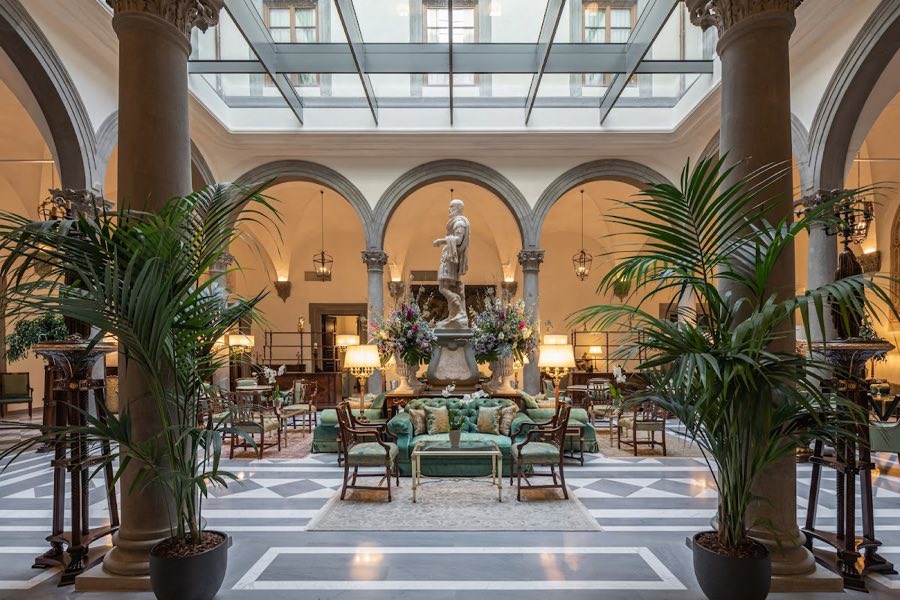
Palazzo Portinari-Salviati
Italy
PalaceRestoredFor rent15th century
No. 82464
Palace · Italy
No. 82464 · 43.770 N, 11.258 E
Quick summary
Bargello Palace is a palace in Italy with origins associated with the 14th century.
See all castles in ItalyBargello Palace in Florence, Italy, is a 13th‑century medieval civic palace erected by the municipal authorities of medieval Florence beginning in 1255. Built to house the city’s chief civic officer, the building quickly became a central seat of government and law, linking Florence’s political institutions with its judicial apparatus and public ceremonies. Its role across later centuries—administrative centre, courthouse, prison and finally a national museum—made it one of the city’s principal sites of governance and punishment.
Construction began in 1255 and early work was completed by 1261 when the complex was known as the Palazzo Pretorio. From the outset it served as the residence of the Captain of the People, then later as the seat of the podestà, the chief magistrate. Over the 13th and 14th centuries the palace expanded to accommodate growing civic needs and to host high-level deliberations and public justice. In 1298 the poet Dante Alighieri was condemned there before the sitting podestà, and the building saw repeated assaults by popular unrest: riots in 1295 after the acquittal of Corso Donati, an attack to free prisoners in 1304, a sacking in 1332, the expulsion of Walter VI of Brienne in 1343, and capture during the Ciompi revolt on 21 July 1378.
During the 14th century the palace underwent major enlargement and internal restructuring. Between 1260 and 1280 it was extended, a court with porticoes was added in 1295, and the sides were raised between 1316 and 1320. Rear construction toward the later streets took place from 1325 to 1346. Between about 1340 and 1345 the great council hall was heavily rebuilt and principal rooms were roofed with vaults and fitted with projecting wooden galleries to reduce fire risk. A new courtyard stair was inserted and dated to 1367. These works reflected the building’s continuing centrality to civic life and justice.
The palace continued to function as a focal point for law and punishment in the later medieval and early modern periods. With the growing power of the Medici in the late 15th century the complex became the seat of the Council of Justice and the judges known as the Judges of the Wheel from 1502. From 1574, under the rule of Duke Cosimo I de’ Medici, it became the official base of the bargello, the chief of the guards, and the complex was adapted to serve primarily as a prison for nearly three centuries. When the Dominican friar Girolamo Savonarola was arrested on 9 April 1498 he was taken to the building for interrogation and torture before his execution.
Legal practices affecting the palace changed in the late 18th century. In 1782 Grand Duke Leopold II abolished capital punishment and torture and ordered the instruments used for torture burned in the palace courtyard. During the French occupation in 1799 authorities installed a guillotine at the site and another at Piazza Nuova, though neither guillotine was used.
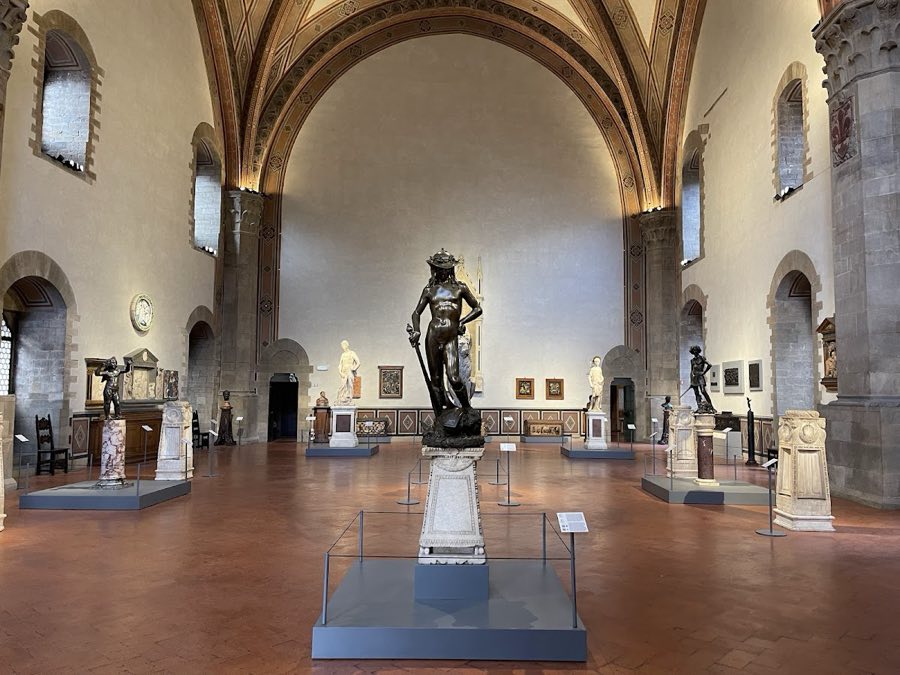
Antiquarian interest and institutional change in the 19th century transformed the former prison into a public collection. Mid‑19th‑century investigations into the chapel revealed earlier paintings and a restored portrait of Dante drew attention in 1841. In 1857 the Grand Duke ordered the palace emptied and the prisoners transferred to the Murate complex. Restoration work in a neo‑Gothic manner took place between 1859 and 1865 and parts of the building were opened to the public in 1861. A royal decree of 22 November 1859 assigned the palace to house a museum of Tuscan civilization and on 22 June 1865 it opened as the Museo Nazionale, described at the time as Italy’s first national museum while Florence served as capital. Collections were assembled from works transferred from the Uffizi and other civic holdings, along with material from suppressed institutions.
In the 20th and 21st centuries the palace has continued to require conservation and adaptation. It sustained serious damage in the 1966 flood of Florence and subsequently underwent consolidation, modernization and reorganisation. A dedicated installation for Michelangelo and other 16th‑century sculpture opened in 1975. Façade work was carried out in 2010–2011 and further façade, courtyard and heraldic conservation began in 2020. On 13 July 2006 three jewels from the Islamic collections were stolen during opening hours. The building was listed as a national monument in 1901 and, following museum reforms in 2014, the institution now has special responsibilities that also cover several other Florentine sites.
The Bargello occupies a full urban block and presents the compact massing of a medieval civic palace. The oldest part, built between 1255 and 1260, faces the principal square and the adjacent street and forms a right‑angled corner with the secondary façade. Both principal fronts are arranged in horizontal bands: a ground level with doors and windows set in framed openings topped by relieving arches, a middle zone of smooth dressed stone pierced by paired, or mullioned, windows beneath a simpler row of single openings, and a top zone of rusticated masonry capped by a projecting crenellated parapet. A large two‑light mullioned window on the square side illuminates the council chamber opened in 1345. These façades show later alteration and restoration but remain largely in situ.
The rear ranges added between 1325 and 1346 repeat the pattern of paired windows but in a slimmer proportion and culminate in large lobed windows at the high end, reflecting the later phase of expansion. The courtyard was laid out in the 13th century with arcades on three sides supported on octagonal pillars carrying round arches. In the 14th century a veranda and a high stone staircase were inserted against one wall, the staircase being dated to 1367. During the building’s period as a prison the arcade openings and veranda were partially blocked and later reopened in the 19th‑century restorations. Stone corbels and holes that held the projecting wooden galleries remain visible on internal walls.
Interior changes show the building’s long service as a seat of justice and later as a penitentiary. In the mid‑14th century principal rooms were covered with vaults to reduce fire risk and the great hall for the general council was raised. When the palace became a prison the large hall was subdivided vertically into four levels to create thirty‑two cells and a chapel. The Chapel of St Mary Magdalene was plastered over and split into two floors, used as a pantry below and as cells above during the prison phase; later conservation work revealed and restored earlier painted decoration in the chapel area.
A freestanding medieval tower, the Volognana, is incorporated at one corner of the complex and retained its original height of 57 metres. The tower was sold to the commune in 1254 and adapted as the palace tower. Its upper chamber houses a bell brought from the castle of Montale in 1302, which was broken and recast in 1381. The bell historically marked curfew, announced executions and tolled for uprisings. Under the Guelf‑type merlons on the tower and façades are civic coats of arms, including the Florentine lily, the cross of the people and Angevin arms, which survive in relief on the stonework.
Surface elements added in later centuries include a neo‑Gothic tabernacle set at a corner and dated 1859 that contains a detached fresco depicting St Bonaventure visiting prisoners, a painting commissioned in 1589 and restored in 1996. At another corner a reconstructed fountain with a well sits beneath the arcades; its herringbone paving and painted city arms combine 19th‑century pictorial work and sculpted additions modelled on older Tuscan palaces. Several dated plaques and inscriptions remain on the exterior, including a 1255 plaque on the street near the square, notices near the courtyard entrance and inscriptions close to the tower that warn against disturbing condemned prisoners in their last hours and prescribe fire precautions and civic rules.
Conservation interventions are part of the recent fabric. Nineteenth‑century restorations reopened loggias, reinstated decorative elements and introduced pictorial decoration in places. Work after the 1966 flood included consolidation of the tower and façades, the application of iron ties, repair of stone facing and replacement of roof coverings. More recent façade restorations and courtyard consolidation have continued into the 21st century, leaving the principal historic surfaces largely restored and accessible for study and display.
No. 64287
No. 55752
No. 36036
No. 23187
Comments
Comments for Bargello Palace will require a verified account before posting.
We'll send a verification link before your first comment is published.