No. 64287
Palazzo Portinari-Salviati
Italy
PalaceRestoredFor rent15th century
No. 55752
Palace · Italy
No. 55752 · 43.772 N, 11.253 E
Quick summary
Palazzo Vecchietti is a palace in Italy with origins associated with the 16th century.
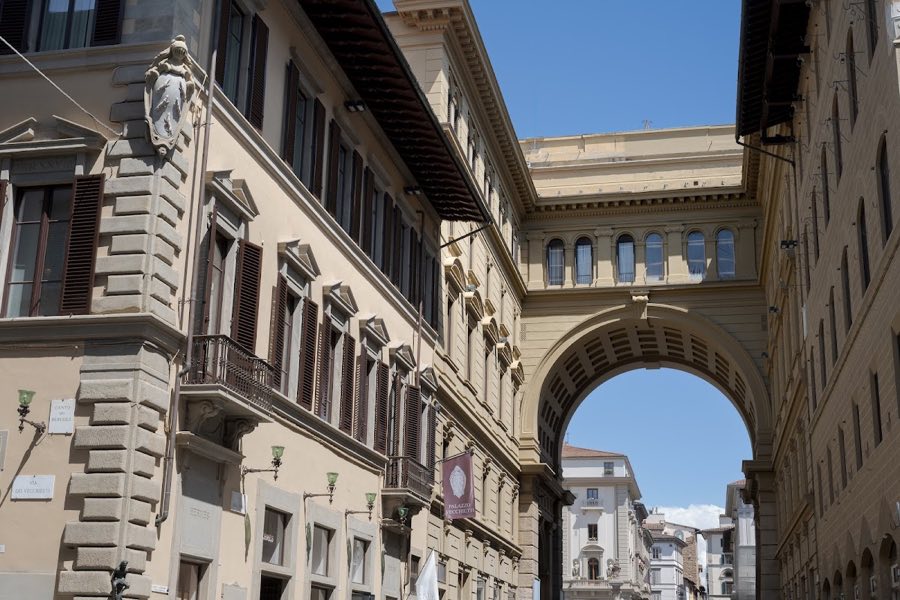
See all castles in ItalyPalazzo Vecchietti, Florence, Italy is a late Renaissance city palace created for a long-established Florentine family during the 16th century, built on medieval urban fabric and associated with the commercial life of the city. The family, historically known as Vecchietti and earlier as Del Vecchio, were important merchants in medieval Florence and receive a mention in Dante’s Paradiso (XV, 115–117). Their holdings once ran along streets that today are called via del Campidoglio, via dei Vecchietti and what was formerly via dei Ferrivecchi, now via degli Strozzi, and the palace grew from an older cluster of houses that included a corner tower and a covered exterior gallery.
The major rebuilding that gave the palace its late Renaissance character began on 9 July 1578 at the request of Bernardo Vecchietti and followed designs produced by the sculptor and architect Giambologna, who lived for a time in the house. Construction work continued until roughly 1584. Elements produced in that period survive in later settings, and a small clay model made by Giambologna for a decorative façade mask is now held by the Victoria and Albert Museum. A small bronze figure once placed on the corner of the building, known as the Diavolino, was later transferred to the Bardini Museum after a long spell on the terrace of the Palazzo Vecchio.
Ownership passed from the founding family to the Poltri and then to the Del Corona families. In 1828–1829 the palace underwent a significant remodelling commissioned by Aloisio del Corona. During the wide urban renewal of the late 19th century the building was one of the few in the area to be spared demolition, and it was restored and subsequently declared a national monument. Fragments salvaged from nearby demolitions carried out in the 1888–1890 campaigns were assembled in the courtyard to form a private lapidary collection. In 1901 the state listed the palace among monumental buildings to be regarded as part of the national artistic heritage. After the premises changed hands in 1933, conversion and modernization works were carried out to adapt the interior for banking offices. In the 21st century the ground floor has continued in banking use while the upper floors have housed a boutique residence; the building currently contains offices of Deutsche Bank and a suite-and-studio residence reached from via degli Strozzi.
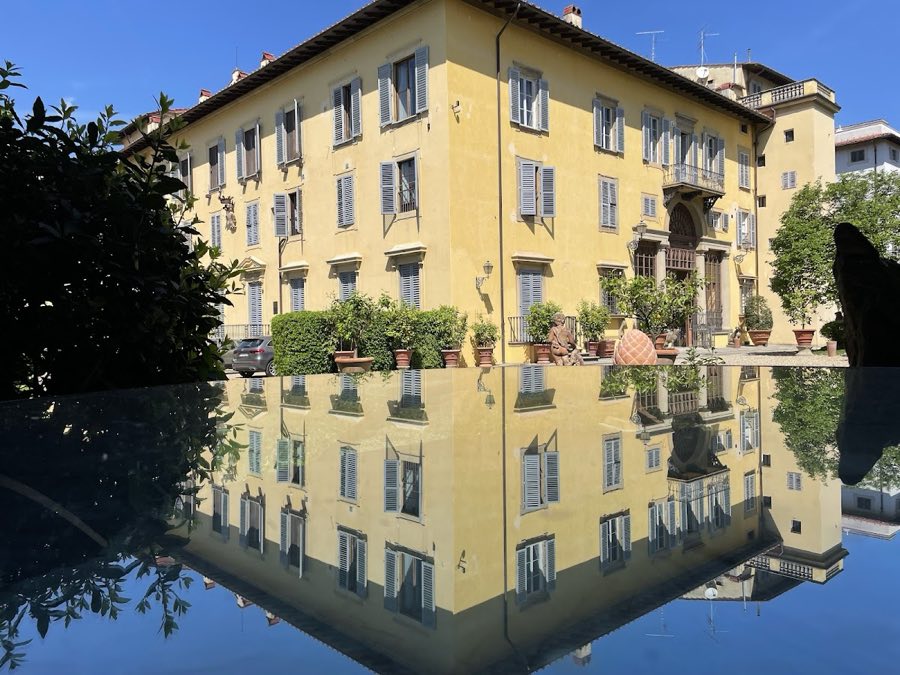
The palace occupies a compact block between via dei Vecchietti and via degli Strozzi, close to Piazza della Repubblica in Florence’s Santa Maria Novella quarter, and it preserves fabric from several historical stages. The lowest section of the exterior shows very ancient construction, reflecting the medieval origins of the site. The complex developed from contiguous family houses and retains the footprint of that older grouping, including the historic corner tower and a covered exterior gallery, called a loggia (covered exterior gallery), which link the street fronts with the interior courtyard.
The principal façade facing via dei Vecchietti shows the late Renaissance arrangement produced in the late 16th century. The main reception floor, the noble floor (main reception floor), has window architraves that bear inscriptions invoking Bernardo Vecchietti and the year 1578, repeated across the front. Above the portal at number 2 a carved shield displays the Poltri family coat of arms set on a six‑peaked mount, surmounted by a chained hunting horn with a chief bearing the symbol of Saint Stephen. The opposite elevation on via degli Strozzi presents six bays introduced during the 19th‑century intervention and is notable for two large lateral balconies; its noble-floor window surrounds also carry inscriptions recalling the 1578 rebuilding and the later 1828 commission.
The angular block known locally as the Canto dei Diavoli, or corner of the Devils, is emphasised by projecting rusticated blocks and by a high heraldic shield carved by Giambologna that carries the Vecchietti arms, blue with five ermine spots arranged two, two and one. Beneath this shield sits a bronze copy of the little Devil figure; the original bronze now rests in the Bardini Museum. Entering through the main door leads into the original 15th‑century courtyard, which preserves a sgraffito‑decorated loggia and a staircase attributed to Giambologna. The courtyard also contains the gathered stone fragments removed from buildings demolished elsewhere in the centre of the city in the late 19th century, displayed together as a private lapidary. In the short entrance passage on via degli Strozzi an early window element by Giambologna, carved with a male head, survives in contrast with later 19th‑century work nearby. All of these components remain in situ, some restored at different times, and together they display the building’s sequence of medieval origins, Renaissance reworking and 19th‑century alteration.
No. 64287
No. 36036
No. 82464
No. 23187
Comments
Comments for Palazzo Vecchietti will require a verified account before posting.
We'll send a verification link before your first comment is published.