No. 82464
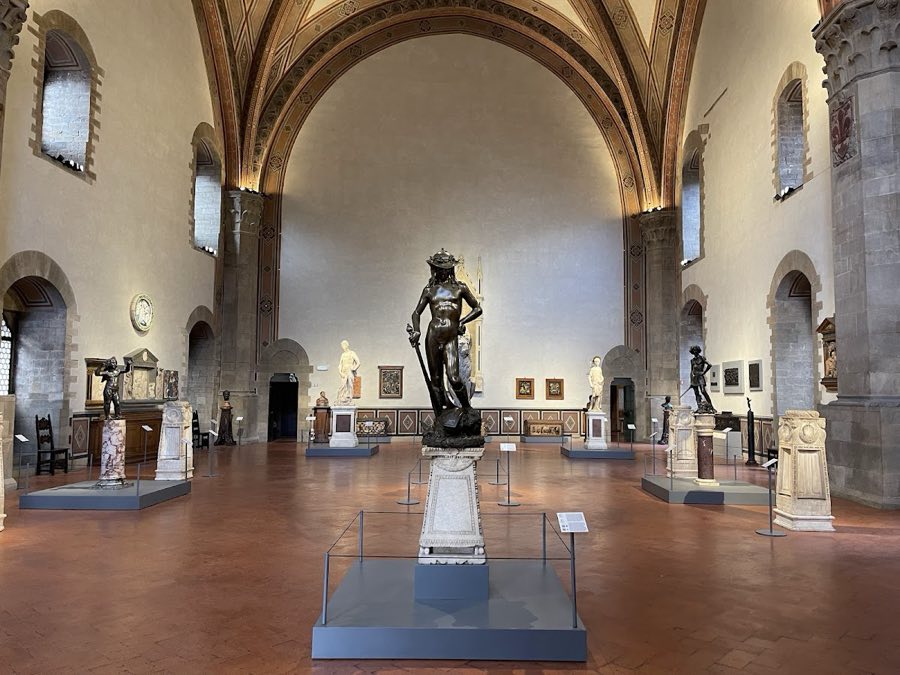
Bargello Palace
Italy
PalaceRestored14th century
No. 64287
Palace · Italy
No. 64287 · 43.772 N, 11.257 E
For rent
Palazzo Portinari-Salviati is marked for bookable castle accommodation. Nightly pricing, sleeps count, stay rules, and amenities are displayed only when public operator data is available.
Rental type: Hotel / bookable stay, Short-stay rental
Short-term availability: Bookable accommodation signal
Quick summary
Palazzo Portinari-Salviati is a palace in Italy with origins associated with the 15th century.
See all castles in ItalyPalazzo Portinari-Salviati in Florence, Italy, is a city palace that grew up under the Florentine civic and cultural world during the Renaissance, its core formed in the 15th century. The building began as houses owned by the Portinari family and, between about 1470 and 1480, those dwellings were combined and reshaped into a single palatial residence, perhaps under the hand of the architect Michelozzo. Over the following centuries the palace accumulated important works of art and served as a setting for family life, public functions and institutional uses, which together made it a recognized monument in the national heritage.
In the late medieval and Renaissance centuries the palace housed or sheltered major paintings and portraits linked to the Portinari and later the Salviati families, including the celebrated Portinari Triptych and works by northern and Italian masters. Jacopo Salviati bought the property in 1546 and the family undertook an extensive campaign of enlargement from 1572, probably finishing around 1578. From 1679 until 1698 the Salviati household bought neighbouring houses and shops and extended the front toward Via dello Studio.
Members of the Salviati household figure in wider Florentine history. Maria Salviati, who was the wife of Giovanni dalle Bande Nere and the mother of Cosimo I, lived in the palace, and a persistent legend ties Giovanni to a dramatic episode in which he allegedly tested his infant son’s courage by throwing him from a low window. In 1708 the palace received King Frederick IV of Denmark during his visit to Florence.
Ownership passed through several families and functions in the 18th and 19th centuries. The Ricciardi‑Serguidi family bought the building in 1768, and by inheritance it came in 1803 to Pietro Leopoldo di Giannozzo Da Cepparello. The municipality later acquired the property and used it for the Florentine Classical High School. When Florence served as the capital of the newly united Italy, between 1865 and 1871, the palace was designated for the Ministry of Grace and Justice and of Worship and was adapted for ministerial offices, receiving an added floor on the Via dello Studio side to create sixteen rooms, work that was completed in July 1866.
During the later nineteenth and into the twentieth century the palace accommodated banks and religious schools, including a savings bank and Piarist schools in 1881. It changed hands again after World War I, becoming the headquarters of a regional bank in the 1920s, which carried out restorations and covered one of the inner courts with a fabric roof. Further interior reworkings took place in the mid‑twentieth century and the building entered banking ownership once more later in that century. In 1901 the palace was formally listed as a monumental building to be protected as part of the national artistic heritage.
In the early twenty‑first century the palace passed to private ownership and underwent further restoration. After conservation and reconfiguration the building reopened in 2022 with mixed hospitality, residential and commercial uses. The bank’s former movable collection has been transferred into the Monte dei Paschi collections in Siena. During the most recent conservation campaign monochrome wall paintings on the main floor were brought to light, and the chapel altarpiece “Jesus between Mary and Martha” remains under the protection of the heritage authority.
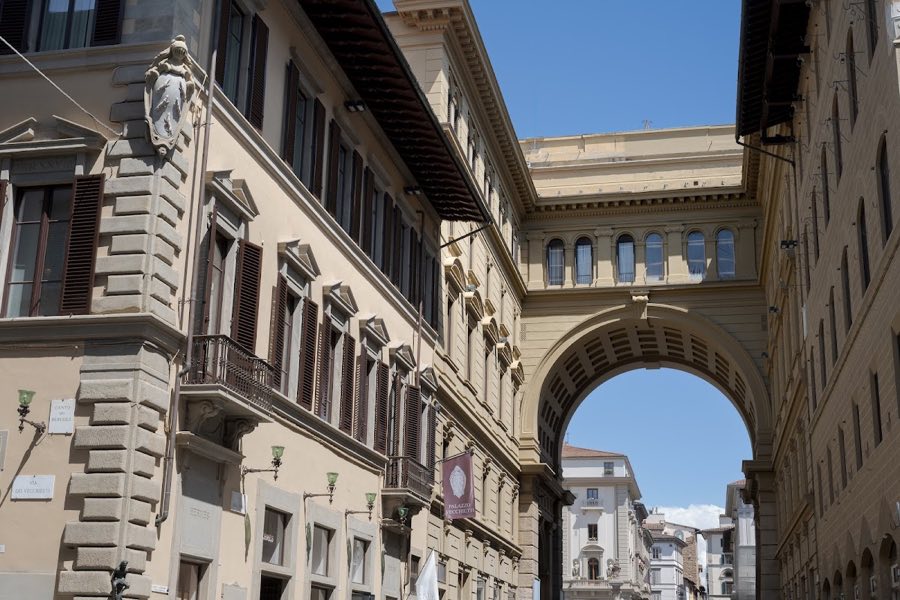
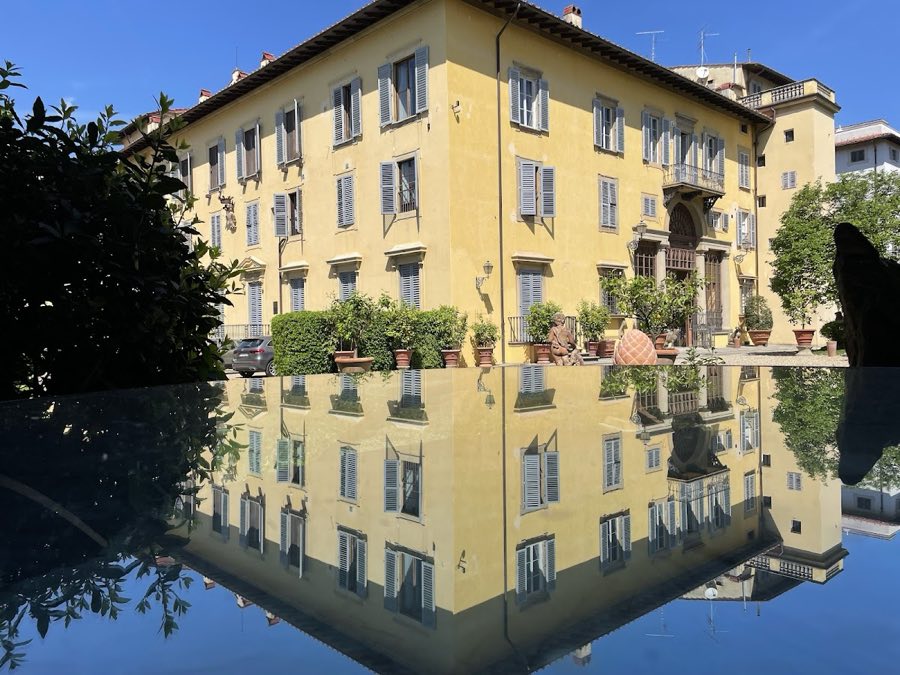
The palace presents a broad main front onto the street, marked by commemorative plaques and heraldry above the principal entrance. A plaque from 1830 recalls the presence of the Piarist fathers, while another panel is surmounted by the Portinari coat of arms over a low closed doorway reached by two steps and flanked by sculpted lions. Above this portal a verse linked to Beatrice Portinari is inscribed, connecting the façade to the family commemorations within.
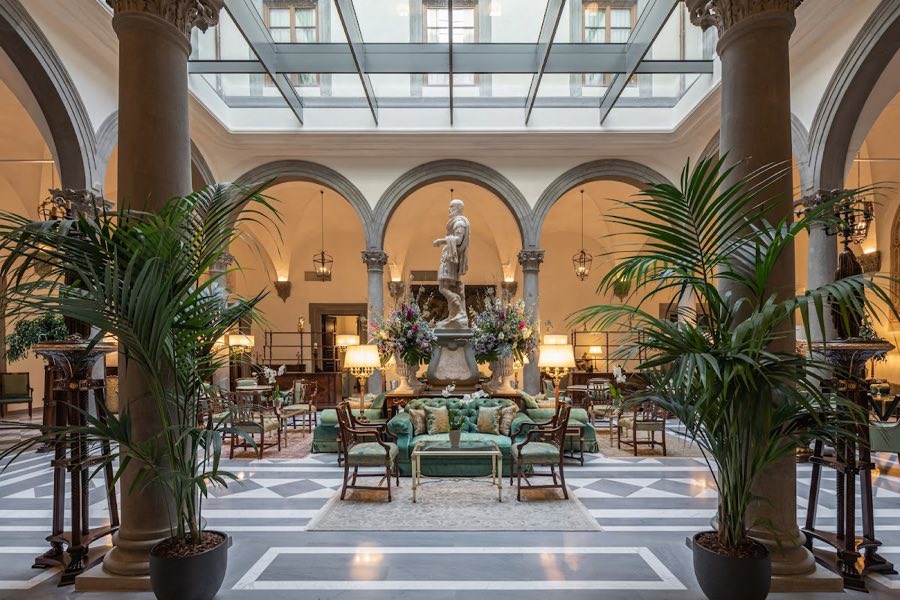
The principal courtyard is now covered and shows broad loggias on all four sides, forming an open gallery at each level. At the centre stands a statue of Cosimo I de’ Medici, executed by adapting an ancient Roman torso wearing a cuirass, the antique fragment having been reused as the figure’s core. In the courtyard also sits a detached late‑Gothic fresco depicting the Madonna and Child with Saints John the Baptist and Zenobius, a panel that can be placed to the first decade of the fifteenth century but bears heavy damage and visible reintegration from later interventions.
A smaller court known as the Court of the Emperors contains a two‑sided portico, a covered walkway with columns whose supports carry horizontal beams. That court’s paving is a pebble mosaic set with river stones and its vaults were painted with figures and ornamental grotesques. The portico once displayed a series of imperial busts by the sculptor Giambologna and, in the late sixteenth century, the vaults and adjoining rooms received a cycle of paintings narrating the Stories of the Odyssey by Alessandro Allori, dated around 1580.
Rooms adjoining the courts preserve further decorative programs from the late sixteenth and later centuries. Two rooms contain scenes drawn from the Iliad that were incorporated into an eighteenth‑century decorative scheme, and another room preserves an elaborate grotesque ensemble portraying the Labours of Hercules attributed to Allori and his workshop. On the piano nobile a long gallery contains a late‑eighteenth‑century series titled the Gods of Olympus by Tommaso Gherardini, dated 1783.
The palace chapel is dedicated to Saint Mary Magdalene and carries frescoes by Alessandro Allori together with the altarpiece “Jesus between Mary and Martha,” which remains in place under heritage protection. Over time decorative and structural elements have been reused and adapted, the most conspicuous example being the central statue reworked from an ancient Roman cuirassed torso. In the twentieth century a fabric roof, known as a velarium, was installed over the Court of the Emperors during banking‑era alterations. The most recent restorations also brought to light monochrome wall paintings on the main floor, now conserved as part of the palace’s layered decorative history.
Several important movable works once belonged to the palace collection and survive today in other institutions. Among them is Donatello’s marble relief of the Delivery of the Keys, a piece that left the building and is now held by the Victoria and Albert Museum in London.
No. 82464
No. 55752
No. 36036
No. 23187
Comments
Comments for Palazzo Portinari-Salviati will require a verified account before posting.
We'll send a verification link before your first comment is published.