No. 16460
Burg Schaumberg
Germany
CastleRuin12th century
No. 54171
Castle · Germany
No. 54171 · 50.314 N, 11.244 E
For events
Burg Neuhaus is marked as a château or castle venue lead. Capacity, indoor/outdoor spaces, catering rules, and accommodation options are published only after public verification.
Event types: Private events, Cultural gatherings, Filming and photography
Quick summary
Burg Neuhaus is a castle in Germany with origins associated with the 13th century.
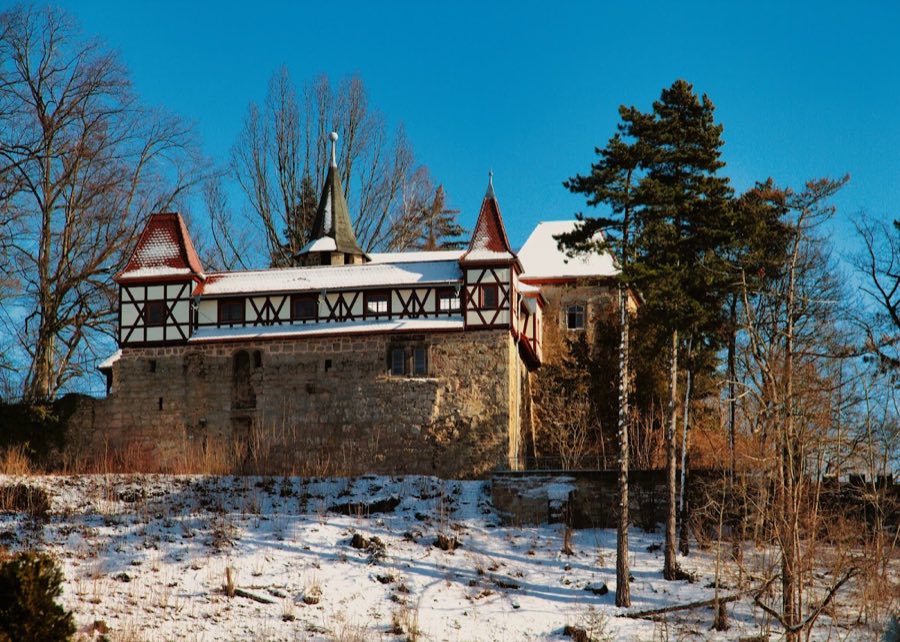
See all castles in GermanyBurg Neuhaus is a hilltop castle ruin located in the municipality of Neuhaus-Schierschnitz in modern-day Germany. It was established during the 13th century by the noble family von Schaumberg to guard their regional interests and oversee a significant military and trade route linking Leipzig to Nuremberg.
In the early 14th century, around 1310, the castle was owned outright by Eberhard von Schaumberg. By 1317, control shifted to the princely County of Henneberg, with the Schaumberg family becoming their vassals. During this period, Burg Neuhaus functioned as the administrative seat of a small jurisdiction that exercised high justice rights, meaning it held authority over serious criminal matters.
Midway through the 14th century, specifically in 1355, the castle’s role expanded after the House of Wettin gained control over the Coburg region. Burg Neuhaus then became the center for the Saxon Amt Neuhaus, serving administrative, judicial, and bailiff duties within the district. The castle remained a backdrop of regional governance and law enforcement for centuries.
The castle experienced significant architectural and functional changes in the late 15th and 16th centuries under the stewardship of the von Gottsmann family, who held it as a fief during their appointment to the Amtmannschaft, or stewardship. Figures such as Kunz Gottsmann (circa 1482–1542) and Hans Friedrich Gottsmann (1532–1611) transformed the medieval fortress into a more stately residence befitting their noble status.
After the von Gottsmann lineage ended, Burg Neuhaus passed back to the ducal court of the Duchy of Saxe-Coburg, the prevailing region’s authority. The castle’s military importance remained limited, a fact underscored during the Thirty Years’ War (1618–1648). In this conflict, it briefly functioned as the Swedish-Coburg troops’ headquarters and supply depot during their siege operations against the Catholic-controlled town of Kronach and the Rosenberg fortress. Following the conflict’s shifting fortunes, the castle suffered destruction in 1634 by imperial forces, including Croatian mercenaries, as part of retributive attacks that also affected the nearby market town.
Over the following centuries, the castle fell into decline. Stones from the ruins were repurposed for other construction, and parts of the site were adapted for agricultural uses such as tithe storage connected to the adjacent Saxon-Meiningen administrative building. After the Amt Neuhaus administration was dissolved in 1829, the ruin gradually deteriorated further.
In the early 20th century, around 1903 to 1904, Baron Hermann von Walther, a prosperous merchant and banker from Sonneberg, undertook renovations. He remodeled the neighboring Amtshaus into a Neo-Renaissance style building and added romantic half-timbered structures inspired by Nuremberg architecture atop the surviving castle walls, blending historical preservation with stylistic revival.
From the 1960s up to 1980, the castle premises housed the local history museum for Neuhaus-Schierschnitz. Today, ownership belongs to the Thuringian state branch of the German Red Cross. Due to continued deterioration and damage caused by vandalism, the ruin is in need of fundamental conservation. A preservation association was founded in 2013 to organize maintenance efforts and cultural events, including a medieval festival held in August 2018 to raise support.
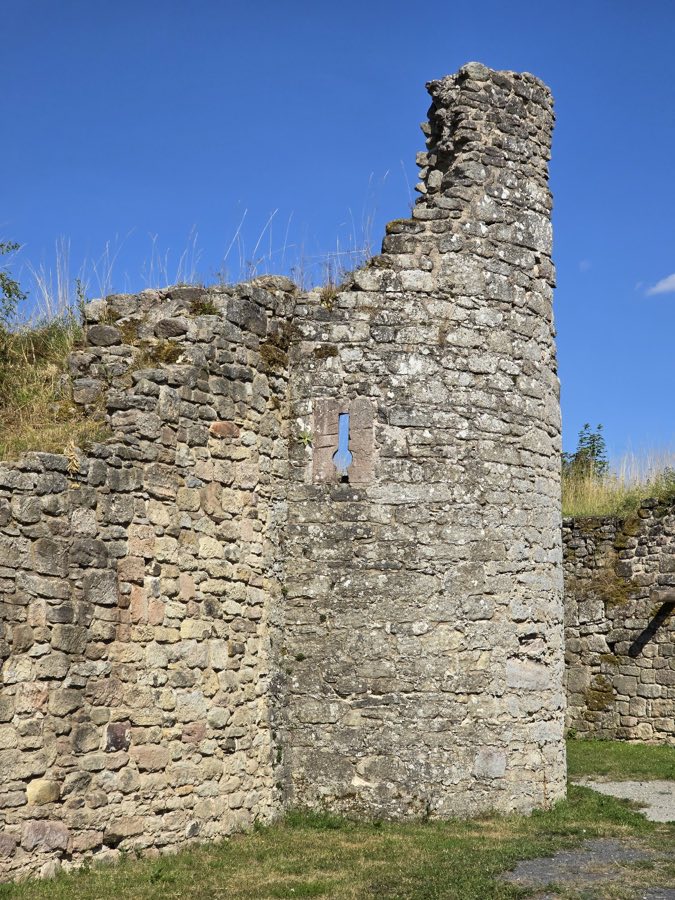
Burg Neuhaus stands as a ruin atop a hill at 365 meters above sea level, originally designed as a compact fortress guarding an important route. Its medieval core retained a relatively modest scale, reflecting its initial defensive and administrative functions during the 13th and early 14th centuries.
In the late 15th and 16th centuries, expansions altered its profile, with the von Gottsmann family enlarging and enhancing the structures to serve as a distinguished noble residence. These modifications introduced architectural elements suited more to residential comfort and status than strictly military defense.
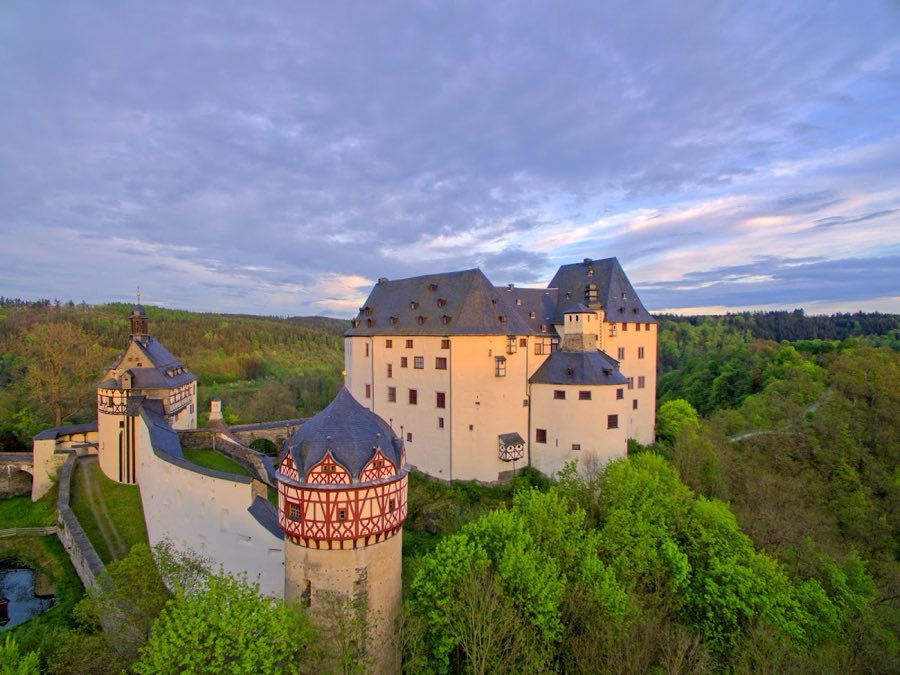
By the early 20th century, Baron Hermann von Walther introduced romantic half-timbered superstructures in the style typical of Nuremberg, placing them atop the remaining medieval walls. These additions exemplify a blend of historic conservation and stylistic reinterpretation popular in that period, adding a distinctive visual layer that contrasts with the medieval stonework.
Over time, parts of the castle site were repurposed as tithe barns and storage facilities connected to the neighboring Saxon-Meiningen administrative building. This adaptive reuse indicates how the function of the site shifted gradually from noble residence and fortress toward more practical agricultural and governance needs after its decline as a defensive structure.
Today, the ruins show clear signs of decay and damage, including vandalism. The surviving walls and timber frameworks remain standing but require urgent stabilization to prevent further loss. Although photographic records document the site, detailed architectural plans or descriptions of decoration and internal layout remain limited to what physical remains and historical records provide.
The castle’s current state reflects centuries of changing uses, destruction, and partial restoration efforts, preserving a layered narrative visible in its stone and timber fabric. Local preservation initiatives strive to maintain this historical monument for future generations, underscoring its value as a cultural and archaeological landmark.
No. 16460
No. 36771
No. 59709
No. 53982
Comments
Comments for Burg Neuhaus will require a verified account before posting.
We'll send a verification link before your first comment is published.