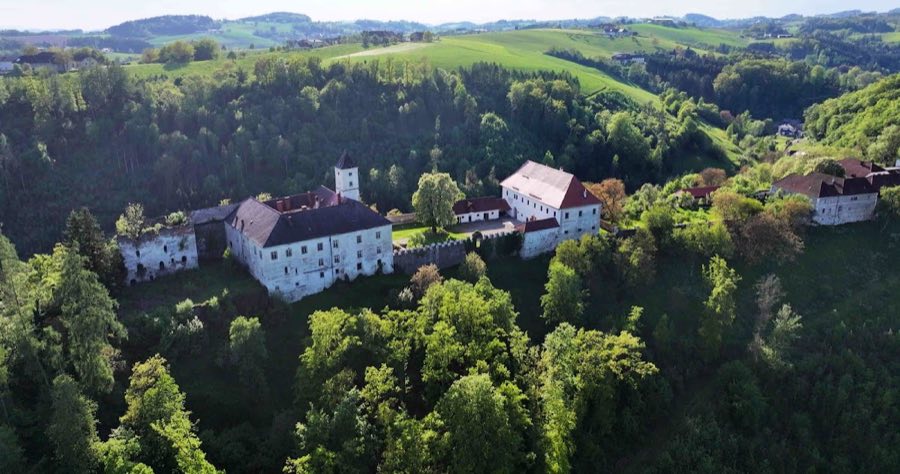
No. 43192
Eschelberg Castle
Austria
CastleRestoredFor events13th century
No. 91704
Castle · Austria
No. 91704 · 48.379 N, 14.175 E
Quick summary
Burgruine Lichtenhag is a castle in Austria with origins associated with the 15th century.
See all castles in AustriaBurgruine Lichtenhag stands above the Große Rodl valley in Gramastetten, Austria, and was built by the noble von Haag family in the medieval period.
The first documentary reference to the place appears in a 1455 fief register of King Ladislaus Postumus. The castle itself was erected in the mid-15th century by Sigismund Aspan von Haag and his wife Agnes on land that belonged to the freehold Alhartinghof, a fact recorded in a 1504 property record compiled by Jörg Aspan. The name Lichtenhaag also appears in a title associated with Martin Aspan von Haag and his brother Wolfhard, who died in 1409; documentary attributions placing the family or the site in 1167 and 1278 have been judged unreliable.
The von Haag family held the estate as a princely fief and administered a local lordship that included forest and hunting grounds, fishponds, the tenant farm known as Maier in Aspanhof, and a mixture of free and enfeoffed tenants. Members of the family occupied important regional offices and performed military service; some served as regional judge, castle governor, and steward. Around 1598 Jacob Aspan von Haag was elevated to baronial rank while serving as an imperial councillor and as a provincial councilor in Austria above the Enns.
By 1615 the property had passed from Hans Joachim von Aspan to Wolf von Gera. At the time of that sale the castle was described as badly dilapidated and scarcely fit for a lord to live in. Wolf von Gera, who lived at Waxenberg, allowed Lichtenhag to decline further. In 1654 Konrad Balthasar von Starhemberg acquired the lordships of Waxenberg, Lichtenhag and Eschelberg and placed Lichtenhag under the administration of Eschelberg; thereafter the inhabitants of Lichtenhag were governed from Eschelberg. A contemporary graphic by Georg Matthäus Vischer shows Lichtenhag already in ruin by about 1670.
Conservation work to stabilise the remaining residential tower began in 1954–1955. In 1964 Kurt Wöss bought the ruin and transformed the forebuilding into a weekend dwelling. Since 2012 Harald and Renate Kogler have been the owners. The ruin remains privately owned and may be visited only by prior arrangement. The castle’s position on a ridge above the valley, at about 470 metres above sea level, probably gave the von Haag family the ability to oversee the salt route running from Aschach on the Danube toward Bohemia.
The castle occupies a small hilltop plan that is irregularly three-sided, with the interior area enclosed by the ring wall measuring approximately 1,100 square metres. The complex retains the footprint of the enclosing wall and the arrangement of buildings that once clustered within it, forming a compact fortified residence typical of a minor medieval stronghold.
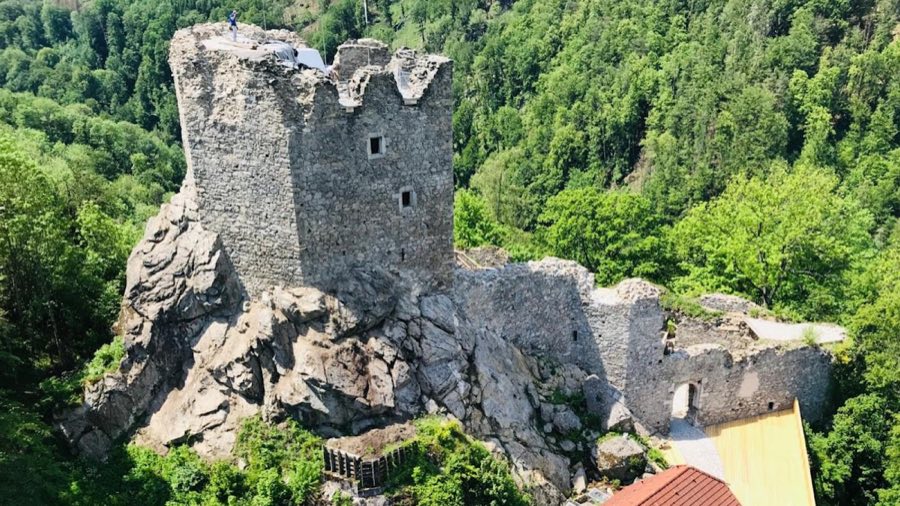
A dominant feature surviving in ruin is the large pentagonal residential and defensive tower that originally rose five storeys. Architectural details recorded on the tower include Gothic-style frames around the gate and some windows, attesting to the mid-15th century date of construction. The tower survived long enough to be conserved in the mid-1950s to prevent further collapse, and its fabric today stands as a fragmentary ruin but recognisably the central keep of the old site.
Ruins of the servants’ houses that belonged to the castle complex remain inside the former enclosure. These service buildings are preserved only as ruins, which articulate the former layout of household support rooms and workshops. A separate residential house that belonged to the castle stands in front of the ruins and remains occupied as a dwelling.
The forebuilding attached to the main ruin was adapted in 1964 into a weekend house, a documented reuse that altered that portion of the structure for habitation. Below the castle there is an additional weekend house and nearby a carved stone bearing a coat of arms, both features noted in the site record. The whole group of remains sits midway down a steep ridge that drops into the Große Rodl valley, with the ruin preserved as fragmentary masonry stabilised by mid-20th-century interventions and with later, limited conversion of the forebuilding for modern use.
No. 43192
No. 71739
No. 67930
No. 90387
Comments
Comments for Burgruine Lichtenhag will require a verified account before posting.
We'll send a verification link before your first comment is published.