No. 91704
Burgruine Lichtenhag
Austria
CastleRuin15th century
No. 43192
Castle · Austria
No. 43192 · 48.382 N, 14.118 E
For events
Eschelberg Castle is marked as a château or castle venue lead. Capacity, indoor/outdoor spaces, catering rules, and accommodation options are published only after public verification.
Event types: Private events, Cultural gatherings, Filming and photography
Quick summary
Eschelberg Castle is a castle in Austria with origins associated with the 13th century.
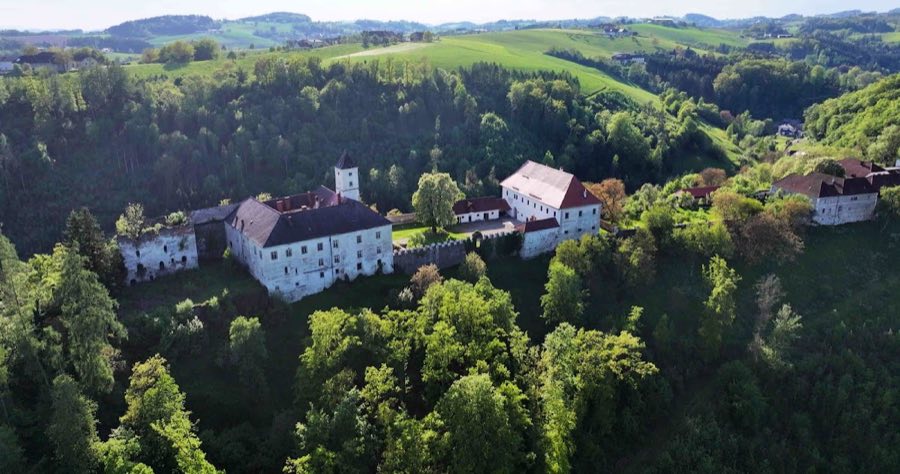
See all castles in AustriaEschelberg Castle in St. Gotthard im Mühlkreis, Austria, began as a medieval hilltop stronghold first recorded in 1209 and was transformed around 1598 into a Renaissance-style residence. Early occupants were local nobles who held the site as a feudal holding under larger regional authorities, and across the centuries the estate functioned as a local seat of lordship and judicial administration.
The earliest named owner was Hainricus de Esilberch in 1209, a member of the local noble milieu who served as a vassal to the Bavarian count of Leonberg. In 1283 the ministerial Otto von Traun received the fief, and by 1354 the lordship belonged to Hans von Traun, who later became provincial governor of Upper Austria. During the 1300s overlordship shifted away from the Leonberg counts to the Bishopric of Passau.
In 1560 the estate passed into the hands of the Lords of Gera, a family from Carinthia, after it had been taken into the holdings of the Austrian territorial prince. Members of the von Gera family rebuilt the medieval stronghold into the Renaissance castle that largely defines the present plan. Christoph von Gera died in 1609; his son Erasmus II von Gera (1588–1657) was arrested as a Protestant rebel, later converted to Catholicism, and kept Eschelberg while divesting other family properties. On 31 March 1654 Erasmus sold Eschelberg and the nearby manor of Lichtenhag to Konrad Balthasar von Starhemberg (1612–1687). Thereafter Eschelberg was managed together with Rottenegg, Oberwallsee and Lichtenhag as a single estate and counted 313 inhabitants under that administration. The castle remained in Starhemberg ownership thereafter.
Administratively, the castle’s jurisdiction extended into the surrounding countryside. Until the mid-1800s the locality of Oberwallsee, under Eschelberg’s authority, formed one of twelve district courts in the Upper Mühlviertel; Eschelberg’s jurisdiction included Feldkirchen an der Donau, Goldwörth, St. Gotthard im Mühlkreis, Herzogsdorf, St. Martin and Walding. After World War II refugees were housed in the buildings. A lightning strike in 1962 set the main tower alight and the tower burned out. The complex underwent renovation in 2010, and the grounds have since been made available for hire for events.
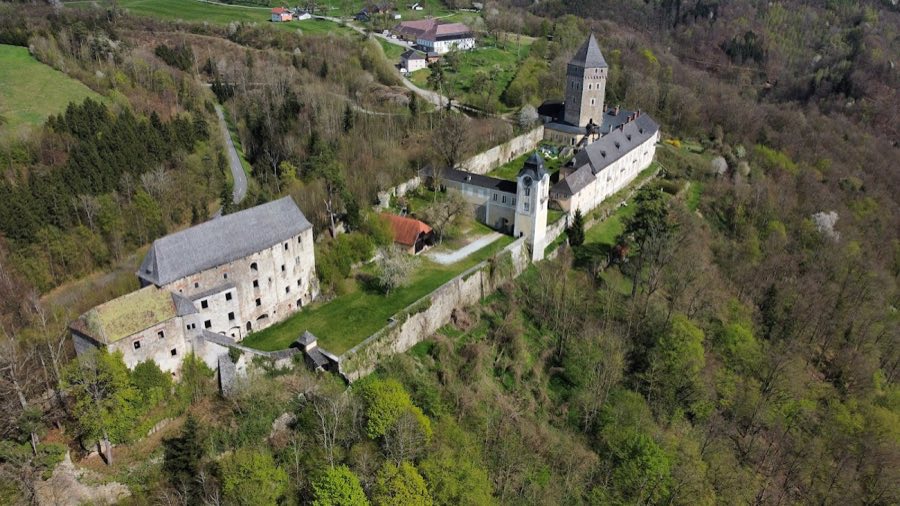
The surviving castle is a three-winged complex from the late 1500s arranged around an inner courtyard that is closed on the west side by a masonry wall. The site occupies a narrow ridge rising to about 396 meters above sea level, with steep slopes on both sides. The oldest core sits on the ridge’s southern spur and took the form of a rectangular building block around a small courtyard; high stretches of medieval curtain wall from that hilltop stronghold still rise above the later fabric.
Elements of the medieval residential hall, or palas, were incorporated into the later Renaissance fabric, so that earlier masonry appears within the 16th-century plan. The northern wing provides the main approach. Its entrance gate is a Renaissance composition built of granite ashlar blocks and set beyond a bridge; the gate carries carved coat-of-arms stones associated with the Lords of Gera. Above the gate hall rises a tower once finished with a pyramidal roof; that tower was gutted by fire after a lightning strike in 1962. The whole complex received renovation work in 2010.
On the southeast side a small castle chapel is dedicated to the Holy Spirit and rests on the foundations of an earlier tower. The chapel is covered by a segmented cap vault (a vaulted ceiling divided into curved sections). Approaching the main buildings, the former brewhouse stands to the left and is now used as the studio of the sculptor Magnus Angermeier, while the buildings of the former manorial farm lie to the right.
No. 91704
No. 67930
No. 71739
No. 54534
Comments
Comments for Eschelberg Castle will require a verified account before posting.
We'll send a verification link before your first comment is published.