No. 87592
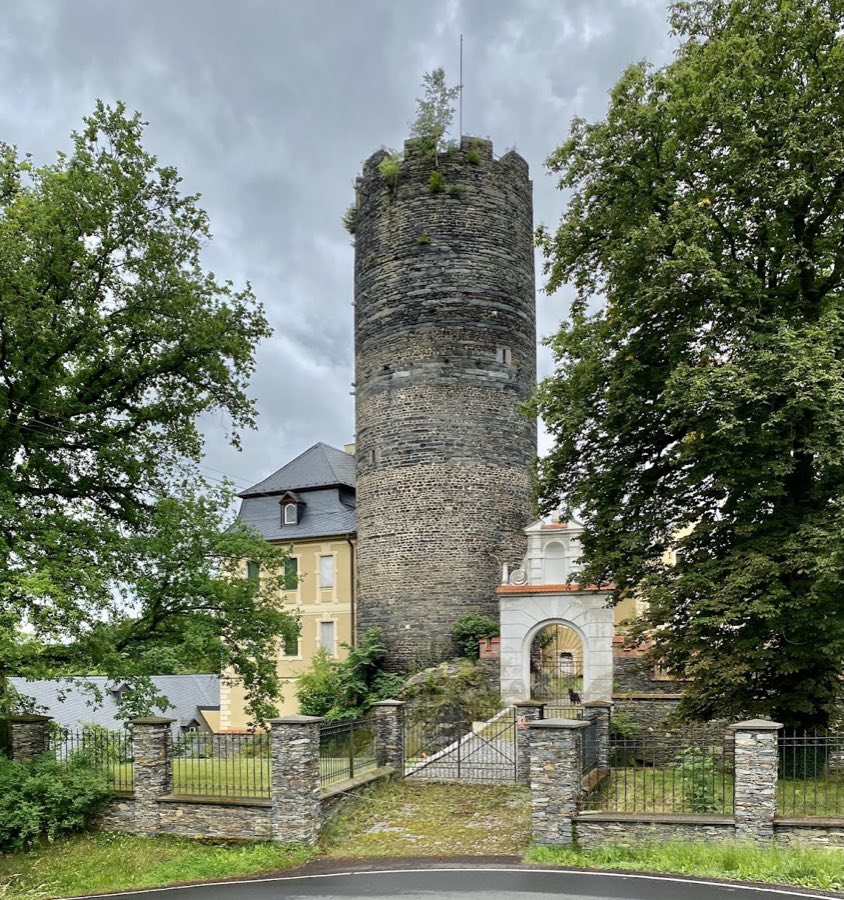
Burg Wildenau
Germany
CastleRuin12th century
No. 96263
No. 96263 · 49.839 N, 12.188 E
Quick summary
Burgstall Schwarzenschwall is a castle in Germany with origins associated with the 13th century.
See all castles in GermanyBurgstall Schwarzenschwall in Falkenberg, Germany, was established by medieval German nobility, most likely the Lords of Falkenberg.
The family that gave the site its early identity appears in documents as early as 1154, where a Pilegrin de Valkenberch is recorded. The castle itself was probably erected during the 13th century and is described in records as a spur castle that functioned as a seat for ministeriales, a class of medieval administrative and military officials.
In 1274 the estate passed through marriage to the Leuchtenberg family when Gebhardt VI of Leuchtenberg married a woman named Jutta. The name Schwarzenschwall first appears in surviving records in 1294, the same year the Leuchtenberg family sold the property to the monastery at Waldsassen.
The site is reported as already ruined in 1363. Ownership continued to change: at a later date the property belonged to Marquard von Redwitz, who pledged it to Peter Pfreimder; in 1401 Pfreimder sold the property back to the Waldsassen monastery. The place is mentioned again in 1513 under the designation Schloss Schwarzenschwall, and documentary references cease after the 17th century. The location is now registered as an archaeological monument with the Bavarian State Office for Monument Preservation, inventory number D-3-6139-0027.
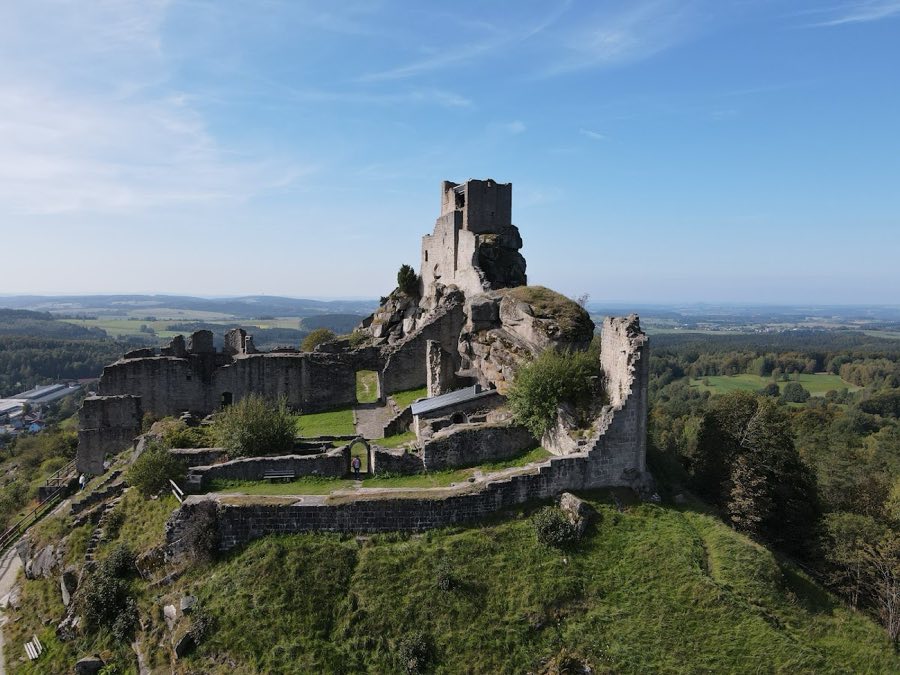
The site occupies a granite spur about 470 metres above sea level on the right bank of the Waldnaab river, in the Falkenberger Forest south of the town of Falkenberg. Its position on a projecting rocky ridge corresponds with its classification as a spur castle, where the natural slope would have formed part of the defensive arrangement.
Archaeological traces that are visible today consist of two section ditches. These earth-cut trenches are interpreted as defensive works associated with the medieval fortification, and they relate to the castle phase most plausibly dated to the 13th century. The ditches are cut into the rock and adjacent ground of the spur, forming deliberate interruptions in the approach to the ridge.
The surviving ditches remain as fragmentary landscape features. The site’s preservation status is recorded as a vanished or ruined castle, and the location is protected as an archaeological monument under inventory number D-3-6139-0027 with the Bavarian State Office for Monument Preservation.
No. 87592
No. 97529
No. 80504
No. 29617
Comments
Comments for Burgstall Schwarzenschwall will require a verified account before posting.
We'll send a verification link before your first comment is published.