No. 42582
Cambridge Castle
United Kingdom
CastleRestored12th century
No. 79280
Castle · United Kingdom
No. 79280 · 52.024 N, 0.403 W
Quick summary
Cainhoe Castle is a castle in United Kingdom with origins associated with the 14th century.
See all castles in United KingdomCainhoe Castle is located in the village of Clophill in England. It was established during the Norman period, shortly after the Norman Conquest of 1066, by a Norman knight named Nigel d’Aubigny. Following the conquest, the Normans built many castles across England to secure their control, and Cainhoe Castle was one such fortress.
Throughout the 11th and 12th centuries, Cainhoe Castle served as the administrative center of the Barony of Cainhoe, held by the d’Aubigny family. This family was notable for their involvement in the Crusades, reflecting the martial and religious commitments of Norman nobility at the time. The castle remained in their possession until 1272. After this date, ownership passed through several prominent families: first the de Lacy family, followed by the Norton family, and later the Grey family, who were Earls of Kent.
The castle was continuously occupied until the mid-14th century, when the Black Death struck England in 1348. The devastating plague caused the death of Cainhoe’s entire population, leading to the abandonment of both the castle and the surrounding village. Within a few decades, by 1374, written records indicate that Cainhoe Castle had fallen into ruin, no longer fulfilling any residential or military function.
In more recent centuries, the site drew the attention of archaeologists, who conducted excavations in the 1970s and 1980s. These investigations helped document the castle’s historical footprint, contributing to its recognition and protection as a Scheduled Monument, ensuring its preservation for future study.
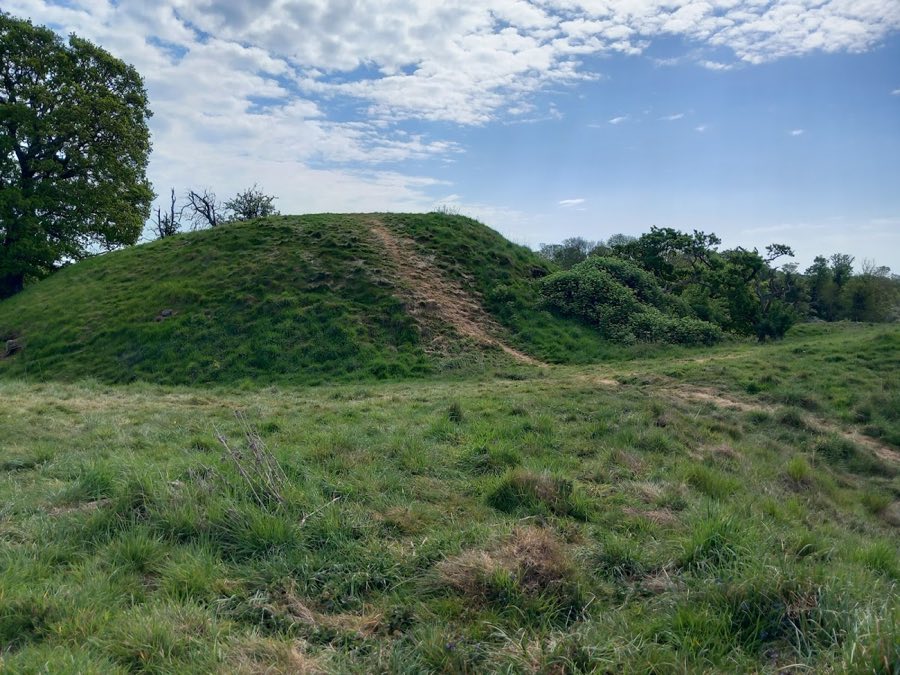
Cainhoe Castle was constructed using the motte and bailey design, a common Norman military style involving a raised earthwork called a motte and enclosed courtyard spaces known as baileys. The castle featured a prominent motte surrounded by three baileys, which would have been enclosed areas for residential, defensive, and administrative purposes.
Today, the site presents mainly as earthworks. The raised mound of the motte remains visible, outlining the original central stronghold where wooden or stone structures likely once stood. Surrounding this motte, the outlines of the three baileys can be traced in the landscape, showing the extent of the castle’s defensive enclosures.
The castle sits at 56 meters above sea level on relatively flat terrain in Central Bedfordshire. This location provided strategic oversight of the local area, which is now predominantly agricultural land with a comparatively dense population nearby. While no original buildings survive above ground, the visible earthworks reflect the layout and defensive strategy employed by the Normans during the castle’s active centuries.
Archaeological work in 1973, 1985, and 1986 helped to document these earthworks, confirming the castle’s structural design and charting the boundaries of the former baileys. The site’s landscape features remain protected to preserve this heritage. No inscriptions or decorative elements have been recorded at Cainhoe Castle, emphasizing its military and administrative rather than ceremonial role in the medieval period.
No. 42582
No. 98826
No. 94412
No. 26734
Comments
Comments for Cainhoe Castle will require a verified account before posting.
We'll send a verification link before your first comment is published.