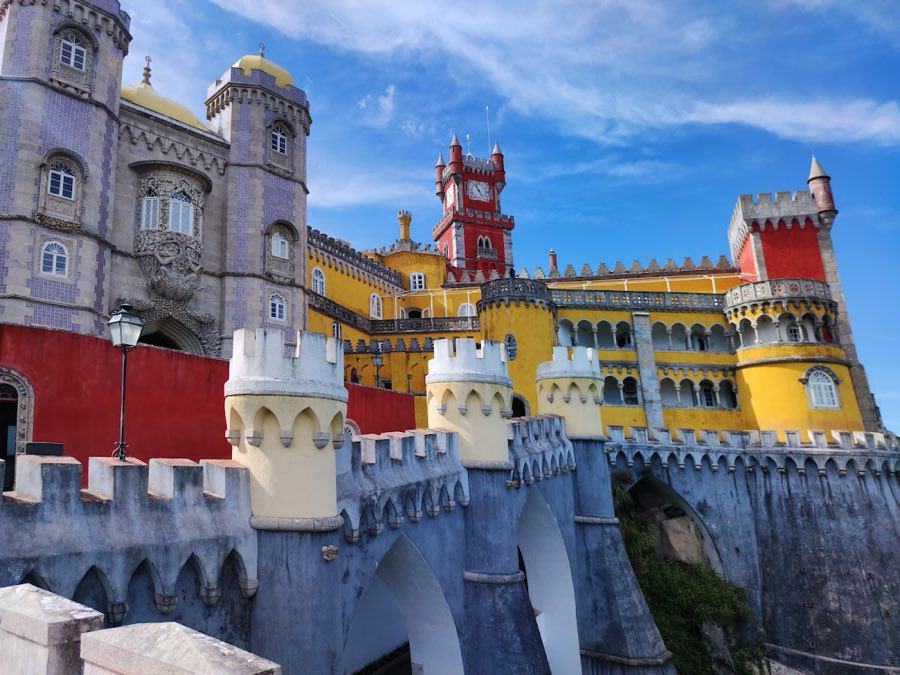
No. 64594
Pena Palace
Portugal
PalaceRuinFor events15th century
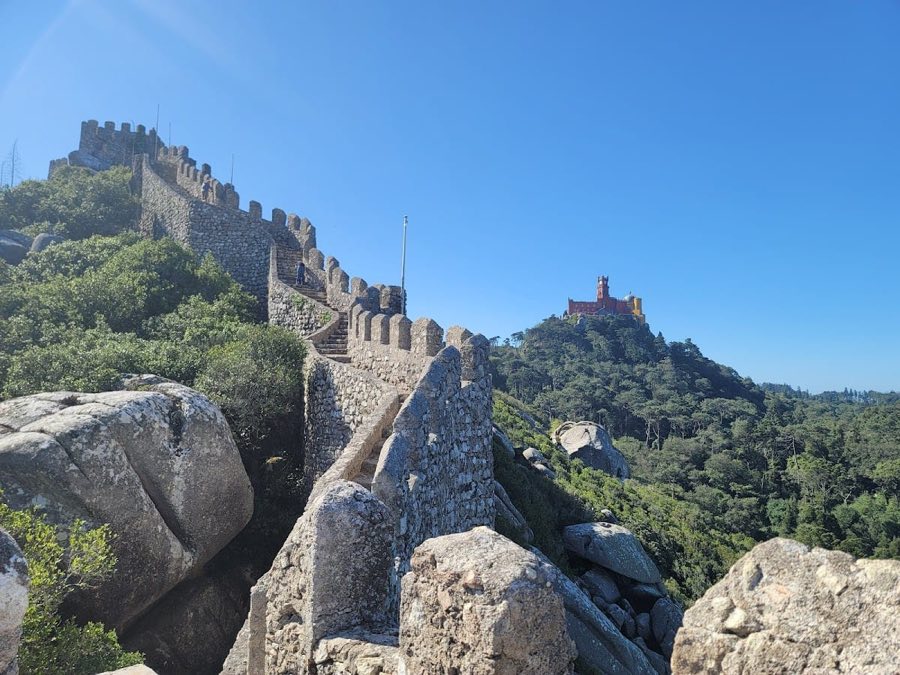
No. 97996
Castle · Portugal
No. 97996 · 38.793 N, 9.389 W
Quick summary
Castle of the Moors, Sintra is a castle in Sintra, Portugal with origins associated with the 12th century.
See all castles in PortugalThe Castle of the Moors was constructed by the Moors during the 8th and 9th centuries. It served as a military stronghold to protect the fertile lands around Sintra, located in central Portugal. Its position atop the Sintra Mountains allowed control over the surrounding agricultural territory.
In 1031, after the Almoravid dynasty seized Córdoba, the king of Badajoz transferred Sintra and other lands to Alfonso VI of León and Castile to secure an alliance. However, the castle soon fell back under Almoravid control during their invasion of the region.
Following the Christian conquest of Lisbon in 1147, the castle surrendered without resistance to the forces of Afonso Henriques, the first king of Portugal. In 1154, Afonso Henriques granted privileges to thirty residents tasked with guarding the castle. This encouraged settlement and helped stabilize the area under Christian rule.
During the late 12th century, a chapel was built within the castle walls, becoming the local parish seat. King Sancho I later initiated remodeling and construction projects to strengthen the fortress. In 1375, King Ferdinand I ordered a rebuilding of the castle, advised by João Annes de Almada. By 1383, the castle was well fortified, but its military role diminished as inhabitants moved to the nearby village of Sintra.
The chapel remained in use into the early 15th century but was abandoned by 1493. It was then used by a small Jewish community until their expulsion under King Manuel I in the 16th century. After this, the castle was completely deserted.
The 1755 Lisbon earthquake caused serious damage to the chapel and weakened the castle’s structure. In 1840, King Ferdinand II led conservation efforts, including wall repairs, reforestation, and chapel preservation. These works were overseen by Wilhelm Ludwig von Eschwege, though they may have limited archaeological study.
Additional restoration and maintenance took place in the late 19th century and throughout the 20th century. Notable interventions occurred in 1939, 1954, 1965, 1979, 1986, and 2001, including archaeological excavations that uncovered medieval tombs in the chapel. The castle is now a National Monument and part of the Sintra Cultural Landscape UNESCO World Heritage Site. Since 1996, it has been protected as a special cultural zone by the Portuguese Ministry of Culture.
The Castle of the Moors occupies a rocky promontory in the Sintra Mountains, with steep slopes up to 40 percent gradient. Its irregular layout follows a 450-metre perimeter oriented from southwest to northwest. The fortress consists of two lines of defensive walls that contour the granite and other igneous rock formations beneath.
The outer walls include a main gate near Abelheira, west of the Tapada dos Bichos area. Inside the second ring of walls are circular and square turrets, thick battlements, railings, and pyramid-shaped merlons—these are the solid upright sections atop the walls used for defense. The main entrance is guarded by two turrets and battlements.
Within the secondary walls near the entrance lie ruins of former buildings such as cellars and animal pens. A large subterranean cistern measures 18 metres long, 6 metres wide, and 6 metres high. It was accessed through a narrow passage and collected rainwater through openings in its roof.
The inner walls feature five rectangular towers and one circular tower, all topped with pyramidal merlons. The tallest tower, called the royal tower, stands in the southwest corner. A small door on the northern side, often hidden by vegetation, is known as the Traitors Gate and leads to the main military square inside the castle.
Along the castle perimeter are several bins or silos dating from the Arab occupation, many now overgrown. The chapel lies outside the secondary wall near the entrance. It has a rectangular nave and a lower, narrow presbytery, built from limestone and masonry. Access is possible from the western and southern façades.
The southern wall of the chapel features an arched doorway supported by columns with decorative capitals carved with plant motifs and fantastic animals like gryphons and basilisks. The northern façade has a primitive door elevated above ground level due to the terrain, along with a triumphal arch supported by double columns with carved capitals showing plant designs.
Inside, the chapel’s main nave has a cradle vault ceiling with traces of frescoes. These depict a haloed patron saint surrounded by floral and geometric patterns framed by a geometric border. Adjacent to the oratory is a small rectangular niche used to hold religious items.
Although tradition suggests the chapel may have served as a mosque before the Christian Reconquista, no direct evidence confirms this. However, it is likely that a Muslim place of worship existed elsewhere within the castle during Moorish occupation.
No. 64594
No. 35258
No. 53098
No. 48536
Comments
Comments for Castle of the Moors, Sintra will require a verified account before posting.
We'll send a verification link before your first comment is published.