No. 34082
Château d'Entrecasteaux
France
ChâteauRestoredFor events11th century
No. 83464
Château · France
No. 83464 · 43.433 N, 6.143 E
For events
Château de Vins sur Caramy is marked as a château or castle venue lead. Capacity, indoor/outdoor spaces, catering rules, and accommodation options are published only after public verification.
Event types: Private events, Cultural gatherings, Filming and photography
Quick summary
Château de Vins sur Caramy is a château in France with origins associated with the 16th century.
See all castles in FranceThe Château de Vins sur Caramy is situated in the municipality of Vins-sur-Caramy in modern-day France. Its origins trace back to a medieval fortress established by the local feudal society during the Middle Ages.
The earliest known construction at the site is the fortress referred to as “castrum de Vicinis” or “de Vizins,” mentioned in three charters dating from the 1060s. This original stronghold occupied a strategic position and served as a local seat of power. However, by 1471, this medieval fortress had been abandoned, marking the end of its initial military and administrative use.
In the early 1500s, a new château was built on a lower part of the hillside, replacing the earlier fortress. This residence initially belonged to the Counts of Provence and later transferred through marriage to noble families such as the Brici and then the Garde. The château became associated with Hubert de Garde, born there in 1539, who rose to prominence as a military leader in Provence during the Wars of Religion, a series of conflicts in France during the late 16th century. His family’s status grew, culminating in the elevation of Vins to a marquisate in 1641. After the death of Jean, Marquis de Vins, in 1731, the marquisate passed to the Comte du Luc.
The château’s history in the 20th century reflects decline and revival. It was abandoned and fell into significant disrepair between 1930 and 1940, with many structural elements lost by the 1950s. Beginning in 1960, private owners undertook considerable restoration efforts, aiming to stabilize and conserve the building. Such initiatives included repairing damaged arcades, restoring the chapel, and reviving the estate for cultural purposes. Recognition of its historic value was formalized when the château was listed on the Supplementary Inventory of Historic Monuments in 1965. Since the 1980s, the site has been used for cultural activities and events supported by local groups dedicated to its preservation.
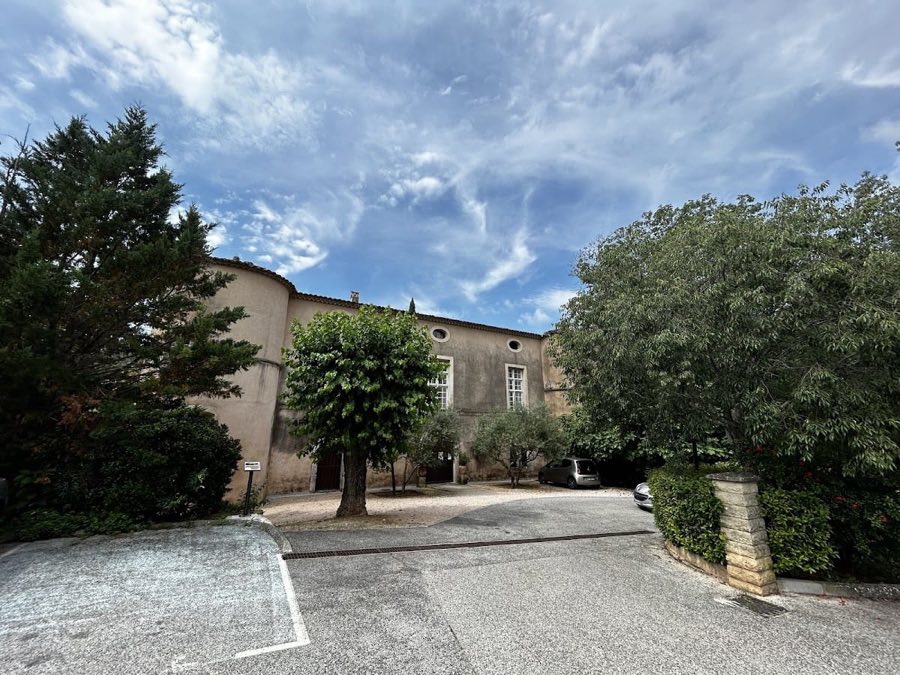
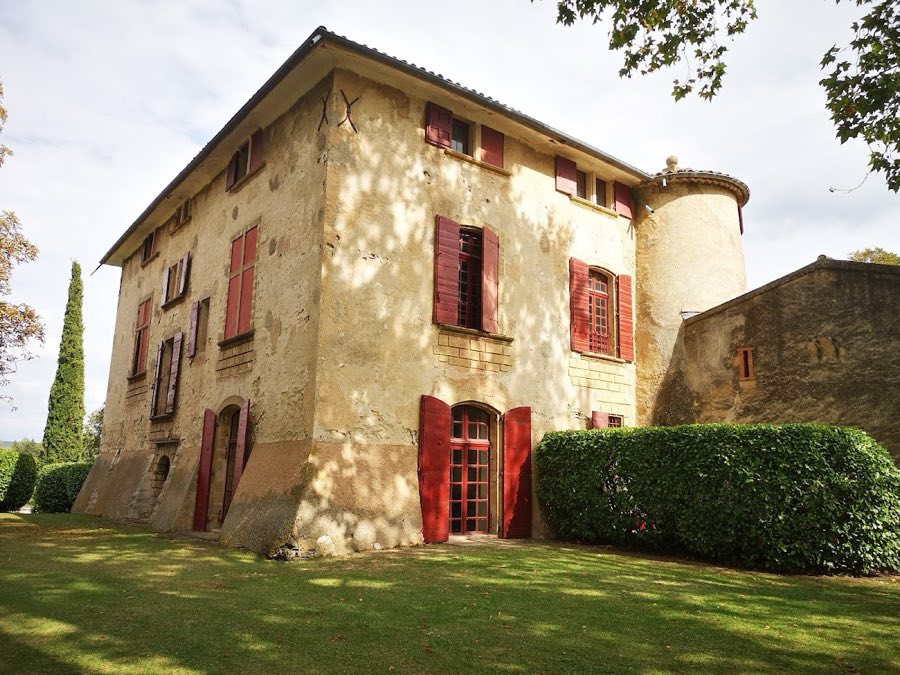
The surviving Château de Vins sur Caramy presents a late 15th-century quadrangular structure resting on a solid masonry base built with a slightly angled foundation to accommodate the slope of the hillside. Its architecture captures a transition between fortified medieval castles and more refined Renaissance residences, reflecting subsequent adaptations over the centuries, including renovations in the 18th century.
At the heart of the layout is a roughly 200-square-meter courtyard, known as the honor courtyard, which features a double arcade gallery. Above these arcades is an Italian-style loggia—a covered balcony—that provided entrance to two sizable rooms oriented southward, historically used by the château’s owners. The walls consist of small, uneven stones held together with lime plaster, a common traditional building method that adds to the structure’s period character.
An ornamental fountain is situated beneath a basket-handle arch, a type of curved arch wider than a semicircle, and decorated with a mascaron, which is a sculpted face serving as both an architectural detail and a decorative water spout. Within the château, the former common hunting room has been converted into a salon, adapting an original functional space for more domestic or social use.
One of the corner towers houses a small chapel, an ecclesiastical space that has undergone restoration to preserve its structure and significance. Over recent decades, restoration has addressed the ground-floor arcades on two occasions during the 1980s, refurbishing their stonework and supporting structures. In 1985, a balustrade with a sculpted handrail, crafted by the artist Chevênement, was installed to enhance safety and aesthetic appeal. The building’s façade was rehabilitated in 2012, and repairs took place on the roofing between 2003 and 2004, reflecting ongoing commitment to maintaining the château’s integrity.
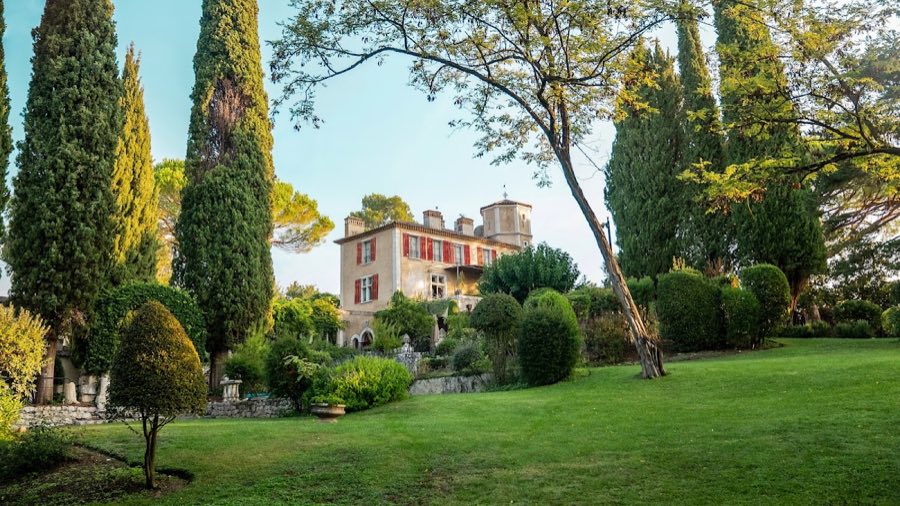
The château provides a variety of interior spaces—including a vaulted hall, the hunting salon, guardroom, chapel, terraces, and gardens—that are suitable for gatherings ranging from small to moderately sized groups. Accommodation is offered through five guest rooms and an apartment containing two additional bedrooms, suggesting its adaptation for residential or hospitality use. Situated on the summit overlooking the Caramy valley, the château resides within a protected zone, emphasizing its prominent visual presence in a preserved urban and natural environment.
No. 34082
No. 80098
No. 71313
No. 11955
Comments
Comments for Château de Vins sur Caramy will require a verified account before posting.
We'll send a verification link before your first comment is published.