No. 14091
Scheibler Palace, Łódź
Łódź, Poland
PalaceRestored19th century
No. 36406
Palace · Poland
No. 36406 · 51.754 N, 19.485 E
For events
Herbst Palace (Muzeum Pałac Herbsta) is marked as a château or castle venue lead. Capacity, indoor/outdoor spaces, catering rules, and accommodation options are published only after public verification.
Event types: Private events, Cultural gatherings, Filming and photography
Quick summary
Herbst Palace (Muzeum Pałac Herbsta) is a palace in Poland with origins associated with the 19th century.
See all castles in PolandEdward Herbst’s palace in Łódź, Poland, is a Neo‑Renaissance villa erected between 1875 and 1877 for members of Łódź’s industrial elite. Built in the late nineteenth century, the house embodied the tastes and domestic standards of the city’s wealthy manufacturing families and later served as a visible example of those household interiors from the turn of the nineteenth and twentieth centuries. Its position and style tied it to the urban growth of Łódź during that period and to the prosperous households who commissioned substantial town residences.
The villa was first occupied by Matylda Zofia Scheibler (1856–1939) and her husband Edward Herbst, and the Herbst family kept ownership until the end of 1941. Matylda and Edward left Łódź for Sopot in 1919. Their son Leon (1880–1942) then lived in the house with his wife Aleksandra (1889–1970). At the end of 1941 Leon departed for Vienna, taking the house furnishings with him; he died there on 16 January 1942 without children. Aleksandra later returned to Łódź and afterwards moved to Berlin.
The villa emerged from the Second World War largely intact, but its outbuildings and ancillary structures suffered at the hands of postwar users. In the decades after the war several service structures were entirely destroyed, including the winter garden and its connecting element. In the 1940s and 1950s the main building was repurposed for social and industrial uses: it housed a training centre for staff of children’s nurseries, later operated as a kindergarten, and accommodated a workers’ cooperative manufacturing Christmas tree baubles. From May 1950 to May 1953 the winter garden was used as storage for sailing equipment by the Maritime League in Łódź, with co‑use by a sports club sailing section; a pier was installed beside the palace, later rebuilt on the opposite bank of the Jasień stream, and the sailing operation was eventually transferred to the Stefański ponds in Ruda Pabianicka.
The Museum of Art in Łódź took the villa into its care in 1976 and carried out a comprehensive reconstruction in the 1980s. After those works the villa opened as a museum branch displaying interiors typical of Łódź’s industrial elite around 1900. For its restoration, the museum received a Europa Nostra medal in 1990. In April 2012 the former carriage house was opened as a new exhibition space called the Gallery of Old Art, showing Polish and European paintings. An extensive renovation completed on 20 September 2013 restored the garden and reconstructed the winter garden (palm house), and the museum unit adopted the official name Muzeum Pałac Herbsta (Herbst Palace Museum). In October 2013 a portrait of Aleksandra Herbst by a German impressionist painter was presented from a private Łódź collection, marked as a symbolic return of Aleksandra to the house.
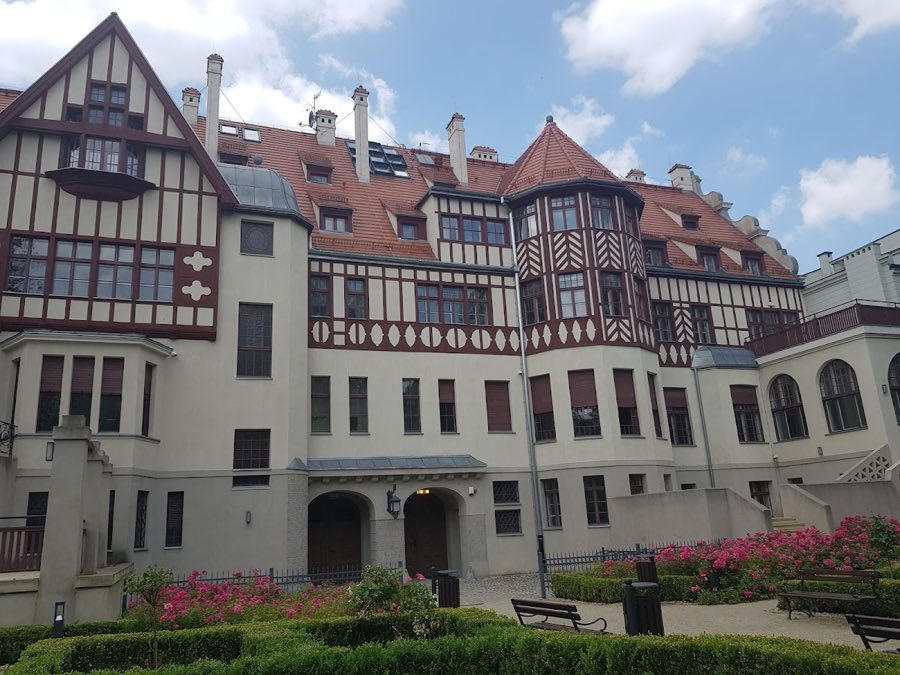
The site is dominated by a two‑storey Neo‑Renaissance villa laid out on a nearly square rectangular plan and capped by a hipped roof with a belvedere, a small rooftop viewing pavilion. The villa’s principal facade is marked by a four‑column portico at the main entrance, while the garden, or rear, elevation includes a projecting section (risalit), with a ground‑floor projection and a balcony above. These facades were composed to emphasize horizontal lines and symmetrical arrangement, and the house retains evidence of its original representative spaces.
An eastern ballroom was added very soon after construction, in 1877, and attached to that room on the north side was a rectangular service wing with lateral subsidiary wings. A separate service complex, built in 1893, served as the carriage house and stable block. That building was executed in red brick with decorative plasterwork and contained a stable with eight stalls, a carriage house, and a tower whose upper floor provided living rooms. The latter building was later adapted to museum use and now functions as an exhibition space, opened in 2012 as the Gallery of Old Art.
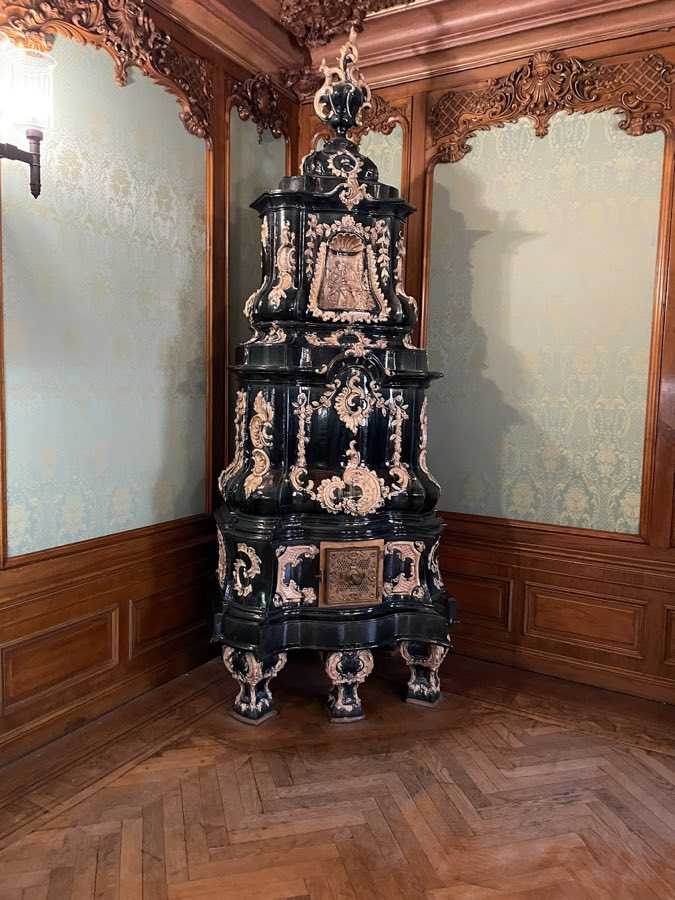
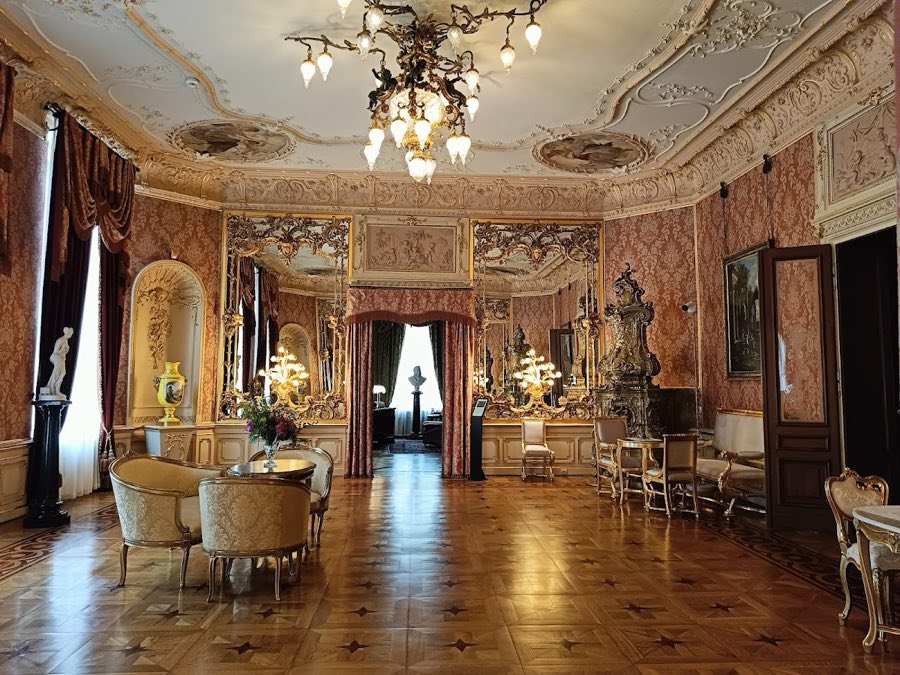
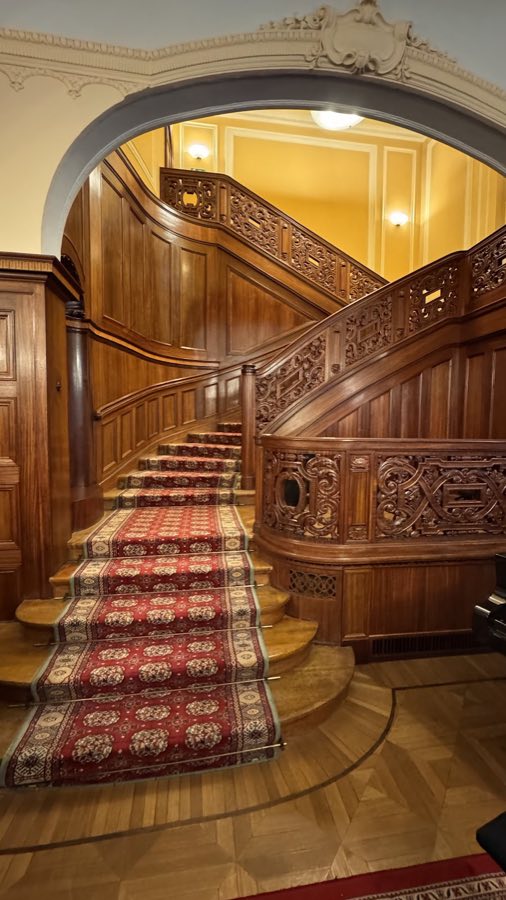
Inside the villa the ground floor originally contained larger, richly decorated reception rooms intended for formal use, while the upper floor housed the family’s domestic rooms: bedrooms, a bathroom, a lady’s room and a gentleman’s room, together with accommodations for other household members. Surviving interior fittings recorded in period photographs include a tiled stove and an ornamental glass window. The winter garden, which had been destroyed after the war, was reconstructed during the 2012–2013 restoration and the adjacent garden was restored, returning the palace grounds to a configuration close to their historic appearance.
The building fabric shows a history of change and reuse. The main house survived wartime events in good condition and benefited from a thorough reconstruction in the 1980s. Postwar alterations included conversion of service spaces for childcare training, a kindergarten, and light industrial production, and the orangery was used for storage of sailing equipment between 1950 and 1953, with a pier installed and later rebuilt nearby before sailing activity moved to the Stefański ponds. Today the villa stands as a restored historic house museum, its ancillary carriage and stable block converted for exhibition use, and the reconstructed winter garden present in situ as part of the restored ensemble.
No. 14091
No. 32428
No. 17147
No. 25432
Comments
Comments for Herbst Palace (Muzeum Pałac Herbsta) will require a verified account before posting.
We'll send a verification link before your first comment is published.