No. 14091
Scheibler Palace, Łódź
Łódź, Poland
PalaceRestored19th century
No. 17147
Palace · Poland
No. 17147 · 51.765 N, 19.458 E
Quick summary
Juliusz Heinzel Palace, Łódź is a palace in Łódź, Poland with origins associated with the 19th century.
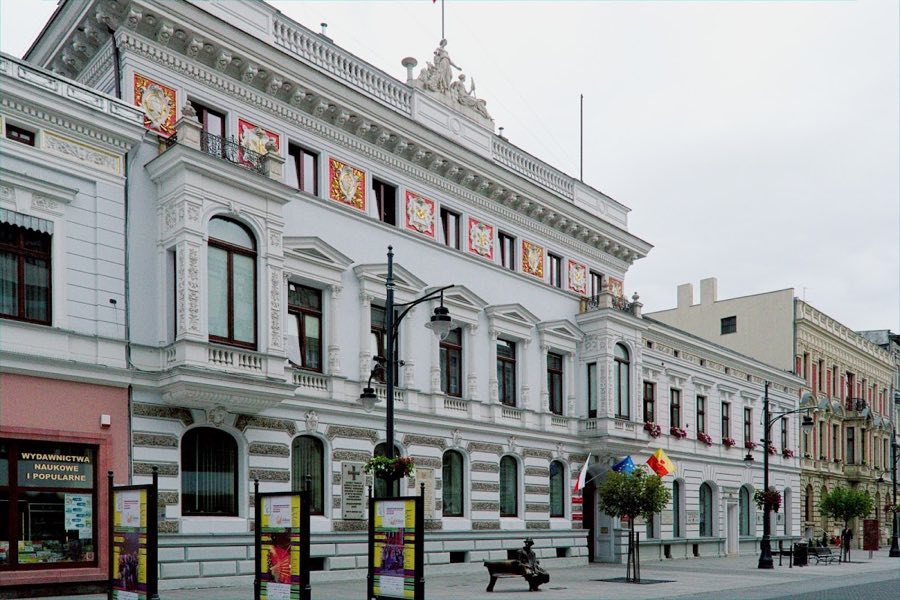
See all castles in PolandJuliusz Heinzel Palace in Łódź, Poland, is a late nineteenth-century urban residence built by the industrialist Juliusz Heinzel and completed in 1882 in an eclectic manner that draws heavily on Berlin Renaissance motifs. Erected during the city’s rapid industrial expansion, the house served as the first of Heinzel’s three private residences and stood at the heart of a major wool production complex that made his firm one of the region’s leading manufacturers of woolen and semi‑woolen goods.
The industrial roots of the site began with a mechanical weaving mill established in 1864. Within a decade the enterprise expanded to become the largest wool production complex in the Kingdom of Poland, and the palace was placed deliberately in front of the factory buildings on the same property, forming a close visual and functional relationship between the owner’s home and his workshops. A sculptural group placed on the façade during the building phase dates to 1880 and embodies the building’s connection to commerce and manufacture.
Over the following decades the residence was altered in several phases, notably with changes to its flanking wings. In the 1950s the palace and its factory buildings were physically joined as part of a mid‑century rebuilding program. At that time outbuildings, including structures that had housed weaving operations, were demolished and their street facades simplified and unified in a restrained, largely undecorated style to serve new administrative uses. The palace was adapted to provide office space and a meeting hall for the municipal council of the period.
On 20 January 1971 the building was entered in the register of monuments under the number A/41. From 29 July 1998 the city adopted the song Prząśniczka as its official bugle call, and the melody was sounded daily at noon from the palace balcony until 8 September 2011, after which the performance moved to the City Council window at the neighbouring address. In front of the palace a monument to the poet Julian Tuwim by the sculptor Wojciech Gryniewicz was unveiled in 1999. In the twenty‑first century the former residence, integrated with the former factory, has been converted into office accommodation and houses the Provincial Office and the City of Łódź administration.
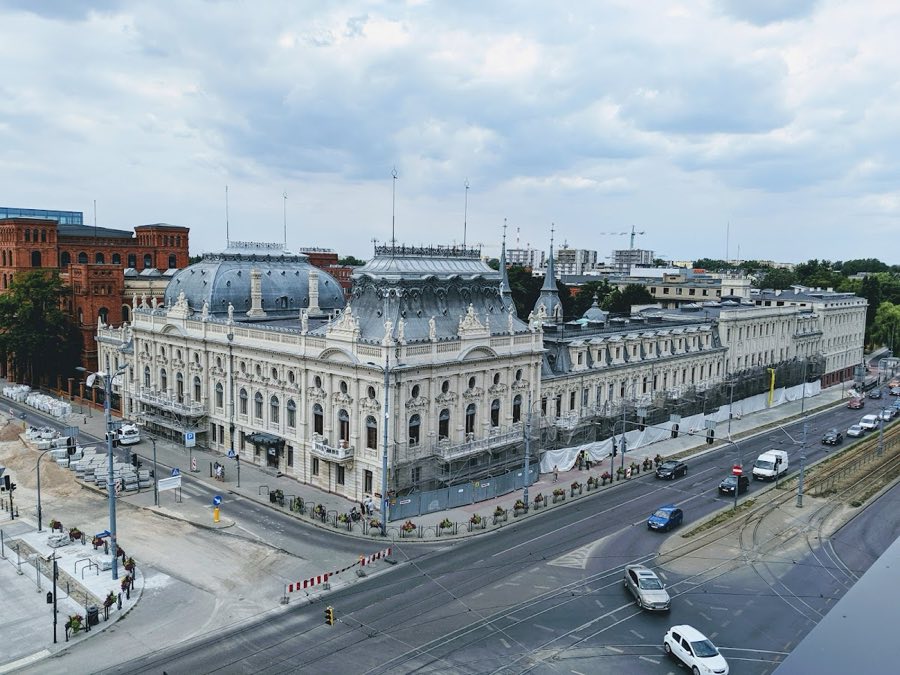
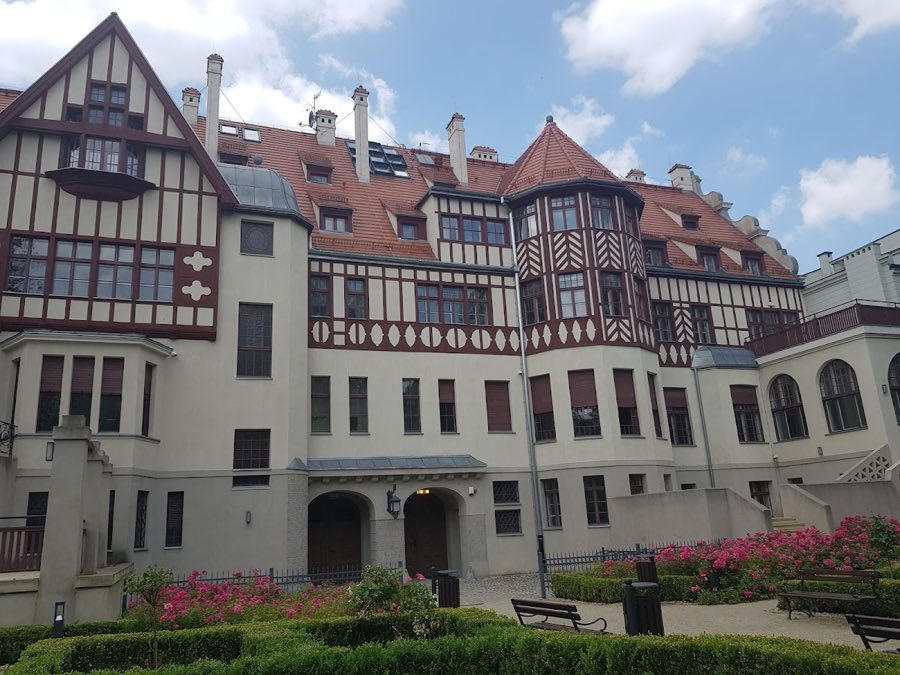
The ensemble occupies a narrow urban plot where a representative house stood directly before deep factory buildings behind it. The original plan combined a taller central block with lower lateral ranges and two end pavilions that terminate in small towers, the pavilions being screened from the street by a decorative grille. The building fabric reflects late nineteenth‑century masonry construction and an aesthetic that mixes ornamental detail with the scale of a merchant’s urban palace.
The main reception level, the piano nobile (principal reception floor), faces the street and features symmetrical projecting bay windows, known as oriels (projecting windows), finished with baluster railings. A horizontal cordon cornice separates the upper and lower wall planes and below this runs a frieze composed of cartouche‑shaped panels that carry emblems celebrating industry and trade. Crowning the façade is a figural sculptural group representing allegories of Freedom, Industry, and Trade; the composition bears a date of 1880 and the sculptor’s mark.
Changes from the mid‑twentieth century altered the setting and some subsidiary structures. Outbuildings that once stood behind and beside the palace, including those used for weaving, were removed and the formerly varied factory façades were replaced with a simplified, largely undecorated street frontage as part of a rebuilding campaign. The palace and the adjacent industrial blocks were physically combined and outfitted for administrative functions, and that integrated complex now serves as offices for provincial and municipal authorities. The monument to Julian Tuwim stands on the forecourt in front of the palace, and the building itself is recorded in the national register of monuments under the number A/41.
No. 14091
No. 36839
No. 25432
No. 32428
Comments
Comments for Juliusz Heinzel Palace, Łódź will require a verified account before posting.
We'll send a verification link before your first comment is published.