No. 77321
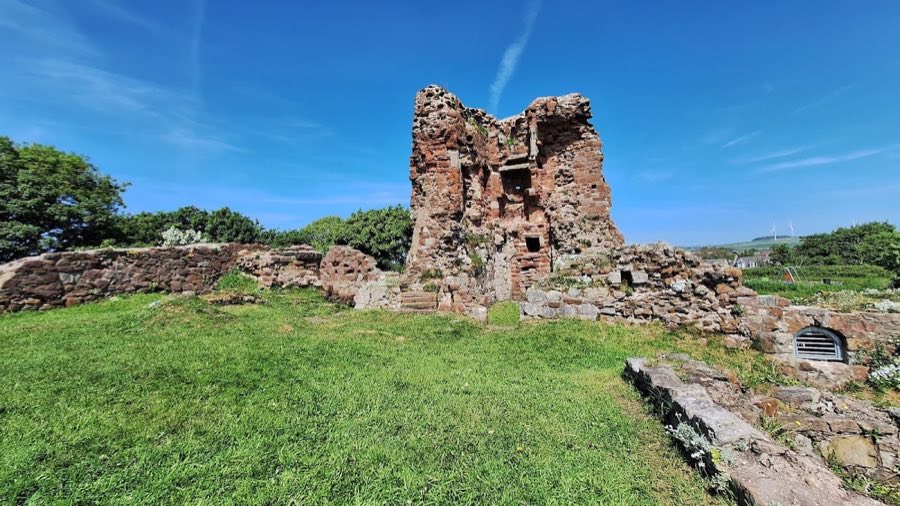
Ardrossan Castle
United Kingdom
CastleRuin12th century
No. 78027
Tower house · United Kingdom
No. 78027 · 55.720 N, 4.942 W
Quick summary
Little Cumbrae Castle is a tower house in United Kingdom with origins associated with the 13th century.
See all castles in United KingdomLittle Cumbrae Castle, Little Cumbrae, Scotland, was built and used by Scottish noble families and royal visitors during the medieval and early modern periods.
The place name appears in early records as Kumbrey around 1300, as Cumbraye about 1330, and as Litill Comeray in 1515. A hunting lodge or earlier castle may have been established on the island by Walter Stewart, who lived from 1293 to 1326. Kings of the late fourteenth century used the site during hunting expeditions, with Robert II recorded there in 1375 and 1384, and Robert III visiting the location in later years.
In the early sixteenth century the Hunters of Hunterston served for generations as hereditary foresters of the island. In 1515 Hugh, Earl of Eglinton, was appointed keeper of the island for fifteen years. In 1527 Robert Hunter obtained a royal charter for the island, after which the Crown sold the land to the Earl of Eglinton and the family’s rights were confirmed in 1555 by James V. The present small square tower house is described as having been constructed by Lord Eglinton in the sixteenth century, possibly to control poaching of deer and rabbits. In 1568 a glasswright named George Elphinstoun was employed to fit glass windows into the castle.
At the end of the sixteenth century Robert Boyd lived in the castle and sought to lay out a harbour in 1599. Local opposition led to the destruction of materials intended for the harbour and resulted in Boyd’s removal by members of the Montgomery family. During the mid seventeenth century the Earl strengthened the island’s defences and dispatched his wife with a garrison of forty men to the fortlet. In 1651 Charles II authorised that the forty men maintained by Lord Montgomerie on the isle be allowed to him. Contemporary reports record that Cromwellian forces took the castle by surprise and destroyed it, and one account gives the burning of the structure as occurring in 1653. After that action the castle appears not to have been restored or regularly occupied.
An episode of private justice is recorded when Archibald Hamilton was confined in the castle dungeon by the sixth Earl of Eglinton before being taken to Stirling and hanged. In later centuries the island served as a fenced hunting ground. The sixth Earl may have introduced deer from Ireland, and in the 1850s the fifteenth Earl, George Montgomerie, reintroduced rabbits. About 5,000 rabbits were bred annually and the island was rented to shooting parties. The site now carries legal protection as a scheduled monument, and sources record it as having been listed as Category A at one time, with one account noting Category A listing in 1971 that was withdrawn in 2018 while the site remained scheduled since 1962.
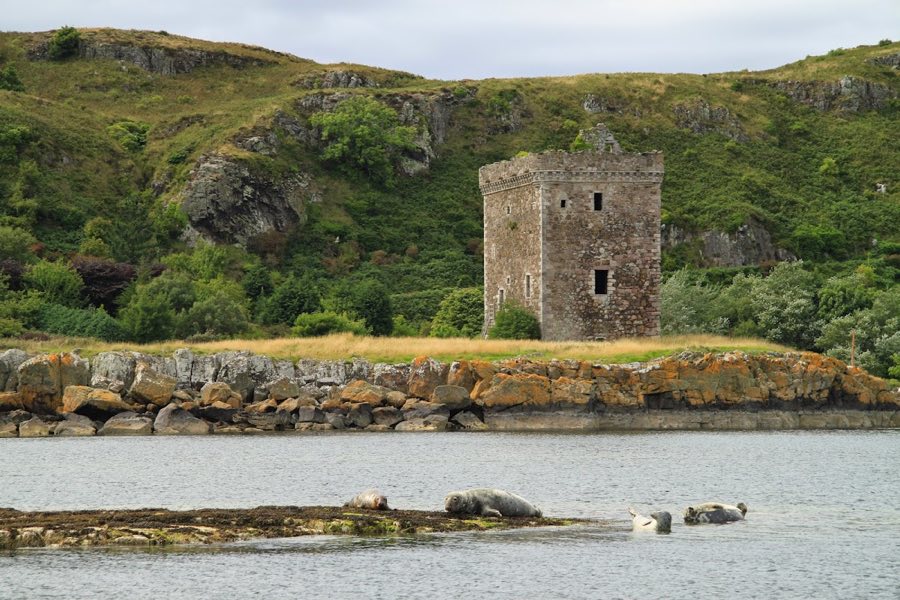
The castle occupies Castle Island, locally called Allin Tuirail, a small tidal islet off the east side of Little Cumbrae in the Firth of Clyde. The surviving building is a compact square tower house standing atop the islet. Recorded external measurements are about 12.5 metres long by 9 metres wide with a height to the wall-walk of about 13.5 metres, an alternative set of dimensions gives 12.5 metres by 8.8 metres with a height of roughly 14 metres. The tower dates to the sixteenth century in its present form.
Internally the tower was organised over three principal storeys. The first floor contained a vaulted great hall and the kitchen, while the ground floor comprised two vaulted cellars. The vaulted spaces indicate stone construction and load-bearing masonry. The original main entrance was at first-floor level and was reached by a removable timber ladder, and a ground-floor doorway was later inserted and appears to be an afterthought in the building sequence. A stone external stair provides access in later or modern times.
Exterior defensive and decorative masonry survives, including a continuous band of chequered corbelling and round turrets at three of the four corners. Small original windows, narrow arrow slits, and gunloops are present in the walls, and a wall-walk with a watch-house was once carried above the storeys. Contemporary descriptions attest to a surrounding rampart and ditch that defended the site. In 1568 a glassworker was recorded as fitting glass windows into the castle. The structure is described in most accounts as a ruin following its capture and destruction by Cromwellian forces, with one source giving the date of burning as 1653, though another assessment records the ruin as being in relatively good condition. The site is legally protected as a scheduled monument and has been recorded under national building-listing arrangements.
No. 77321
No. 31797

No. 92451
No. 76326
Comments
Comments for Little Cumbrae Castle will require a verified account before posting.
We'll send a verification link before your first comment is published.