
No. 92451
Ardgowan Castle
United Kingdom
Tower houseRuin14th century
No. 31797
Castle · United Kingdom
No. 31797 · 55.836 N, 5.055 W
Quick summary
Rothesay Castle is a castle in United Kingdom with origins associated with the 13th century.
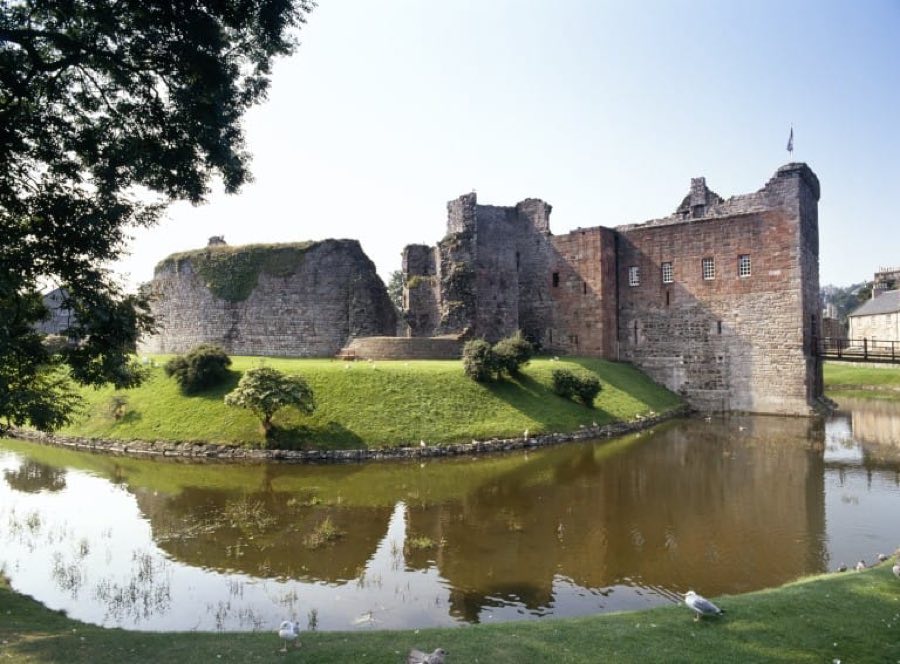
See all castles in United KingdomRothesay Castle, situated in the town of Rothesay on the Isle of Bute, Scotland, was established in the early 13th century by the Stewart family, a prominent Scottish lineage. Its origins trace back to a wooden fortification that was soon replaced by a substantial stone curtain wall during the 1230s, a testament to the Stewarts’ rising influence in the region.
Throughout the 13th century, the castle stood as a pivotal defensive structure amidst ongoing conflicts between the Scots and the Norse. Notably, it suffered two attacks led by Norwegian forces in 1230 and again in 1263. According to the Saga of Hakon Hakonson, the earlier siege involved Norwegian troops employing axes to breach the relatively soft sandstone walls, highlighting both the strategic importance of Rothesay and the resilience of its defenders. After the Treaty of Perth in 1266, which formally brought the Isle of Bute under Scottish rule, the castle underwent significant fortification, including the addition of four round towers and a fortified northern gatehouse to strengthen its defenses.
During the Wars of Scottish Independence in the early 14th century, Rothesay Castle changed ownership multiple times. It was captured by Robert the Bruce in 1311 but fell briefly under English control in 1334. Later, the castle served as a favored royal residence for Stewart monarchs, including Robert II and Robert III. Robert III notably passed away within its walls in 1406. From 1469 onward, the governance of Bute was entrusted to the Scottish crown prince, reinforcing the castle’s role in royal administration and residence.
In the early 16th century, the castle saw further military and residential enhancements under the reigns of James IV and James V. These included raising the height of the curtain wall and transforming the gatehouse into a royal living quarters. A chapel dedicated to St. Michael was also established around 1500, reflecting the religious presence within the castle grounds.
The mid-17th century brought military occupation by Oliver Cromwell’s forces, who partially dismantled the structure upon their withdrawal. Later, during Archibald Campbell’s 1685 rebellion against King James VII, Rothesay Castle was set on fire, leaving it uninhabitable. Restoration efforts began in the 19th century under John Crichton Stuart, 2nd Marquess of Bute, and continued into the early 20th century, aided by the expertise of the 3rd Marquess of Bute and architect William Burges. Since 1961, stewardship of Rothesay Castle has been maintained by Historic Environment Scotland, preserving its historic significance.
Rothesay Castle commands attention with its distinctive roughly circular layout, spanning about 42 meters across. This unique form includes a curtain wall originally built from yellow and red sandstone blocks known as ashlar, with walls initially reaching nearly eight meters high and later heightened to around ten meters. Constructed atop a low earth mound, these walls were thick and sturdy, designed to provide defense while encircling the inner courtyard. Originally, the curtain wall featured wide gaps at the top, called crenellations, for archers to defend the castle, and holes that supported a timber walkway, called a bretasche, over the walls.
Four large round towers punctuate the wall at the northwest, northeast, southeast, and southwest points. Among them, the northwest tower was the largest and housed private chambers. In the 17th century, this tower was repurposed to serve as a pigeon tower, or dovecote, and after partially collapsing in 1937, it was rebuilt. The northeast tower remains the best preserved, while the southeast tower survives primarily as a wall base, and much of the southwest tower has been lost over time. These towers rest on splayed, or angled, bases, which help deflect attacks, and contain arrow slits shaped somewhat like shovels, an unusual design allowing defenders to shoot while protected.
Extending northwards from the main enclosure is the castle’s gatehouse, constructed in the early 1500s. This forework occupies a rectangular space with an L-shaped design, featuring a vaulted entrance tunnel through which a drawbridge once allowed controlled access over the broad moat. The gatehouse also contains four stories of royal apartments, identifiable by the carved royal coat of arms positioned above the main door. Below the entrance passage lies a porter’s lodge and a prison cell fitted with a latrine, underlining the building’s function in both defense and administration.
Inside the courtyard, the footprints of former wooden buildings, such as stables and a smithy, have been archaeologically identified, indicating the range of daily activities that took place within the castle walls. On the eastern side, a chapel dedicated to St. Michael was added around the year 1500. Measuring approximately 7 by 14 meters, its interior once featured a piscina—a basin used for washing sacred vessels—and a wall cupboard, both situated on the eastern wall. The chapel’s ground floor served practical purposes, being used for storage.
Surrounding the entire structure is a wide moat, historically linked to the nearby sea to provide a natural barrier. Today, a modern bridge crosses the moat on the northern approach. Restoration efforts over the past two centuries have involved reconstructing the great hall located on the first floor of the gatehouse, repairing sections of the curtain wall and towers, clearing and reshaping the moat, and rebuilding the pigeon tower that had suffered considerable damage.
Together, these surviving features demonstrate Rothesay Castle’s evolution as a military stronghold, royal residence, and administrative center spanning several centuries of Scottish history.
No. 92451
No. 78027
No. 11415
No. 77321
Comments
Comments for Rothesay Castle will require a verified account before posting.
We'll send a verification link before your first comment is published.