No. 73300
Wesslow Palace
Poland
PalaceRestored18th century
No. 11271
Palace · Poland
No. 11271 · 52.237 N, 21.018 E
Quick summary
Staszic Palace, Warsaw is a palace in Warsaw, Poland with origins associated with the 17th century.
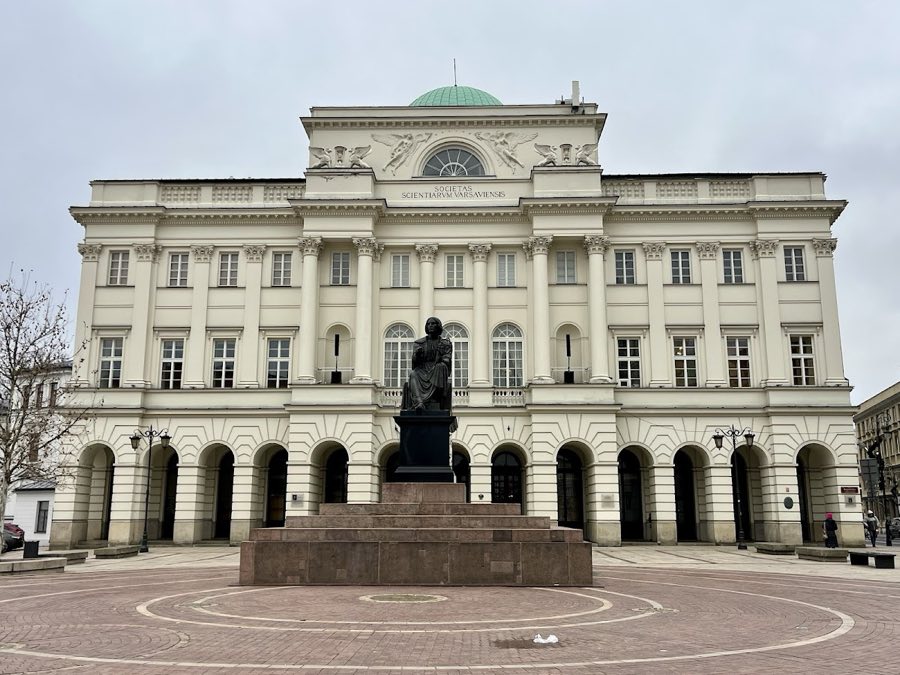
See all castles in PolandStaszic Palace in Warsaw, Poland, is a mature neoclassical building erected in 1820–1823 through Polish initiative for a learned society, and it occupies a site with earlier sacred and civic uses. The location first hosted a small Eastern Orthodox chapel established in 1620 by the Polish king as a burial place for the former Russian tsar Vasili IV and his brother Dmitry Shuisky. In 1668 the chapel was handed to the Dominican Order, which administered it until 1808.
The present palace was raised in the early decades of the nineteenth century to house the Royal Society of Friends of Sciences and was named for its patron. Shortly after the new building opened, on 11 May 1830 a public unveiling placed a monument to Nicolaus Copernicus before its façade. The Society was suppressed after the November 1830 Uprising and the building passed into government hands, accommodating the Lottery Directorate until 1862 and, between 1857 and 1862, an Academy of Medical Science, which was later closed after the January 1863–64 Uprising.
In the late nineteenth century the palace’s functions changed under Russian influence. It contained a boys’ gymnasium with boarding for Orthodox pupils and, from about 1890, an Orthodox church. The exterior was remodeled in 1892–1893 in a Russian-Byzantine manner and the work was followed by an imperial visit on 22 August 1897. In October 1897 construction began on a bell tower fitted with ten bells.
During World War I, after German forces occupied Warsaw in 1915, the building served as a German soldiers’ club. Following Poland’s restoration of independence in 1918 it became the seat of the Warsaw Scientific Society and hosted several scientific and cultural institutes, including a temporary home for the State Geological Institute in 1919. Work undertaken in 1924–1926 restored the exterior toward a classical appearance, though the earlier nineteenth-century composition was not fully reconstructed.
The palace suffered damage in Luftwaffe air raids in September 1939 and was garrisoned and defended during the Warsaw Uprising, being occupied on 9 August 1944 and held until the fall of the Powiśle quarter. The building was almost completely destroyed in 1944, with wartime losses assessed at about sixty percent. Reconstruction took place between 1946/1947 and 1950; the structure was enlarged toward the south, given a new façade facing an extended street, and the dome’s form was altered. After rebuilding the palace returned to the Warsaw Scientific Society and later became the headquarters of the Polish Academy of Sciences, which it continues to house.
The palace occupies a prominent corner position where Krakowskie Przedmieście meets Nowy Świat, terminating the approach along the older street. A small square in front preserves the public setting for the Copernicus statue. To the rear the palace borders a large children’s hospital. The overall plan is irregular and rises three storeys, with an enclosed central yard formed by later southern wings added during postwar rebuilding.
The original nineteenth-century exterior presented a rusticated ground floor arcade and a façade articulated by projecting end sections and a pronounced projecting central section topped by a dome. That central block originally contained the building’s great assembly hall, an amphitheatre-style meeting space with tiered seating, Corinthian-columned galleries, portrait paintings, bas-reliefs, stucco work, and busts; this principal interior was removed during later alterations and no longer survives.
Late nineteenth-century remodelling introduced glazed majolica brickwork and carved sculptural ornament to the exterior, and added a gilded onion-shaped dome above the roof with small corner turrets capped by pointed helmets. After 1897 a bell tower carrying ten bells stood beside the palace, reflecting its use by the Orthodox community at that time. The shell and decorative surface from this phase were substantially altered in the mid-twentieth century.
Postwar reconstruction rebuilt the exterior between 1946 and 1950, enlarged the building with significant southern extensions that enclose a large inner court, and created a new façade facing the extended street. The dome’s silhouette was changed and the inner courtyard elevation was executed as a replica of an earlier urban house façade. Materials recorded for the nineteenth-century treatment include glazed clay facing tiles and carefully carved stone-like elements, while the later work reproduces classical portico and stone façade motifs derived from earlier local buildings. Today the reconstructed palace stands in use as the seat of the Polish Academy of Sciences, with the nineteenth-century assembly hall no longer extant and the later courtyard and street façades reflecting the postwar rebuilding.
No. 73300
No. 59115
No. 48392
No. 86817
Comments
Comments for Staszic Palace, Warsaw will require a verified account before posting.
We'll send a verification link before your first comment is published.