No. 85870
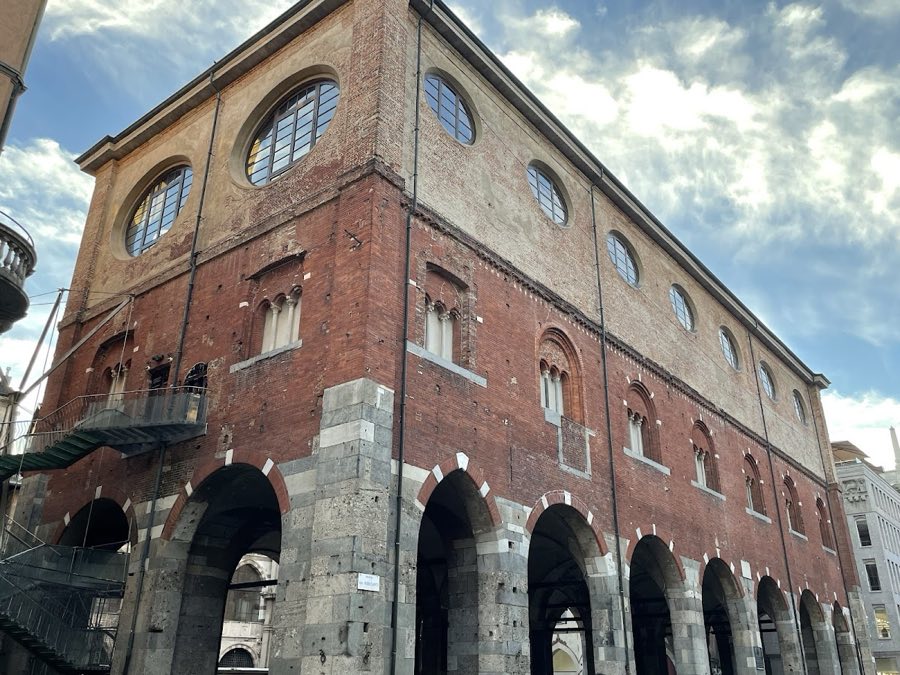
Palazzo della Ragione, Milan
Milan, Italy
PalaceRestored13th century
No. 77282
No. 77282 · 45.464 N, 9.182 E
Quick summary
Palazzo Brera is a palace in Italy with origins associated with the 12th century.
See all castles in ItalyPalazzo Brera in Milan, Italy began as a medieval monastic complex established on land owned by the consul Guercio da Baggio in the 12th century and came under the Humiliati around 1178; its long development spans medieval ecclesiastical uses, a major early modern rebuilding campaign begun in the early 1600s, and a later transformation into a centre for culture and science. The site first acquired a church, Santa Maria in Brera, built between 1180 and 1229, and that church received Gothic decoration in the mid-14th century, underlining its importance to the city in the later Middle Ages.
In the late 16th century the religious community that occupied the complex was dissolved by papal decision on 7 February 1571, and at the request of Charles Borromeo with papal approval the monastery was converted into a college of the Society of Jesus. The Jesuit school expanded rapidly, reaching about 3,000 students and prompting plans for a much larger building. A major construction campaign for the present palace began in 1627, was interrupted by the plague of 1630, resumed in 1651, and continued after the original planner’s death until the later 17th century.
The suppression of the Society of Jesus by Pope Clement XIV on 21 July 1773 transferred the palace into Habsburg hands. Empress Maria Theresa of Austria established several cultural and scientific institutions here: she founded the Brera Library in 1773, ordered the former Jesuit herb garden to be enlarged into the Brera Botanical Garden in 1774, and created the Royal Academy of Fine Arts in 1776. The Jesuit observatory had already been established at the site around 1764. Late-18th-century completion work finished the inner courtyard and the entrance on Via Brera by about 1780.
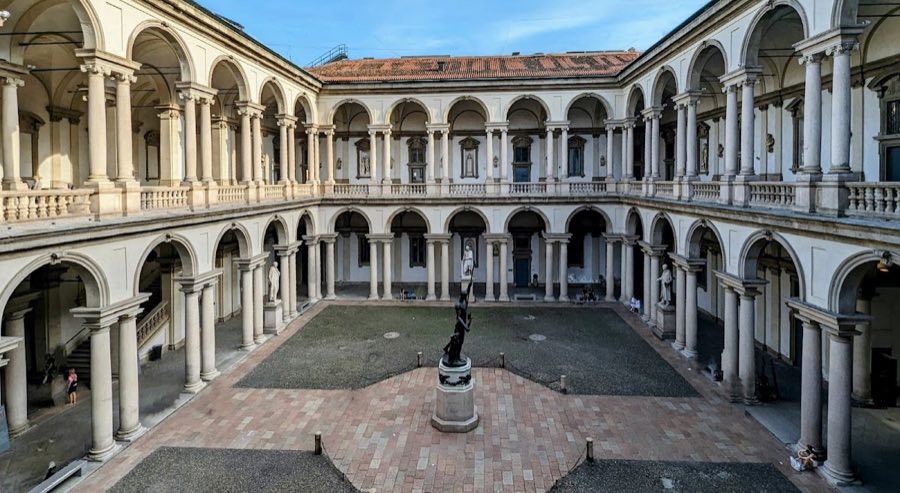
During the Napoleonic reorganization of northern Italy the church of Santa Maria in Brera was closed in 1806, its façade removed, and the church interior reconfigured so that the upper level housed the new picture gallery and the lower level held a collection of ancient sculpture; the Pinacoteca di Brera was formally established in that year. In 1810 Napoleon’s Istituto Nazionale was relocated to the palace as an Institute of Sciences, Letters and Arts, a body that later became the Lombard Institute of Sciences and Letters. A bronze cast of Antonio Canova’s Napoleon as Mars the Peacemaker was placed in the principal courtyard in 1859.
In the 20th century the palace suffered the disruptions of both world wars: its rooms were closed during World War I and artworks were moved after the 1917 Italian defeat at Caporetto; paintings were again evacuated at the outset of World War II. The building was struck by bombing on 7–8 August 1943, then rebuilt after the conflict and reopened in 1950. Since 1773 the complex has hosted a concentration of libraries, academies, gardens, an observatory and laboratories; from 2013 the Lombard Historical Society has its seat within the Brera Library.
The complex presents as a large brick palace with a regular classical rhythm and a central two-storey courtyard. The exterior is notable for its dark red brick walls with strengthened corners, regularly spaced pilasters articulated in a rough, ashlar-like manner, and horizontal stringcourses that mark the storeys. Windows are finished with stone pediments above their openings. These elements reflect the major 17th-century building campaign and later 18th-century completions.
The main courtyard, or courtyard of honour, is enclosed by a two-storey portico. The ground-floor arches are arranged as serlianas (a three-part arch with a central arched bay flanked by rectangular openings), mounted on columns in the Doric order (simple classical column style). The first-floor gallery repeats the serliana arrangement within a loggia (covered open gallery) supported on columns in the Ionic order (classical column with scroll-like capitals). The inner courtyard and its two-storey gallery were finished in the late 18th century, around 1780, completing the palace’s principal ceremonial spaces.
Traces in the building fabric record multiple construction phases. There are elements linked to a late-16th-century project, to a large early-17th-century campaign begun in 1627 that was stopped by the 1630 plague and then resumed in the mid-17th century, and to later 17th- and 18th-century continuations and completions. The earlier church of Santa Maria in Brera received a carved Gothic marble portal in 1346–1348 and wall paintings by artists active in later centuries, and the church interior was physically transformed in 1806 when the façade was removed and the nave was divided horizontally into two floors to house the newly arranged picture gallery above and the sculpture collection below.
Sculptural and material features are preserved in situ. A bronze version of Canova’s depiction of Napoleon as Mars the Peacemaker stands at the courtyard centre, cast in 1859 by Francesco Righetti and his son Luigi, while the original marble model is dated 1811. The palace also bears the signs of 20th-century damage and repair: the bombing of 7–8 August 1943 and the subsequent postwar reconstruction, after which principal rooms reopened in 1950. Overall the complex combines medieval remnants, later stone and marble ornament, extensive brickwork, classical porticos and a central landscaped courtyard, reflecting its long sequence of reuse and adaptation.
No. 85870
No. 79019
No. 49682
No. 49673
Comments
Comments for Palazzo Brera will require a verified account before posting.
We'll send a verification link before your first comment is published.