No. 86912
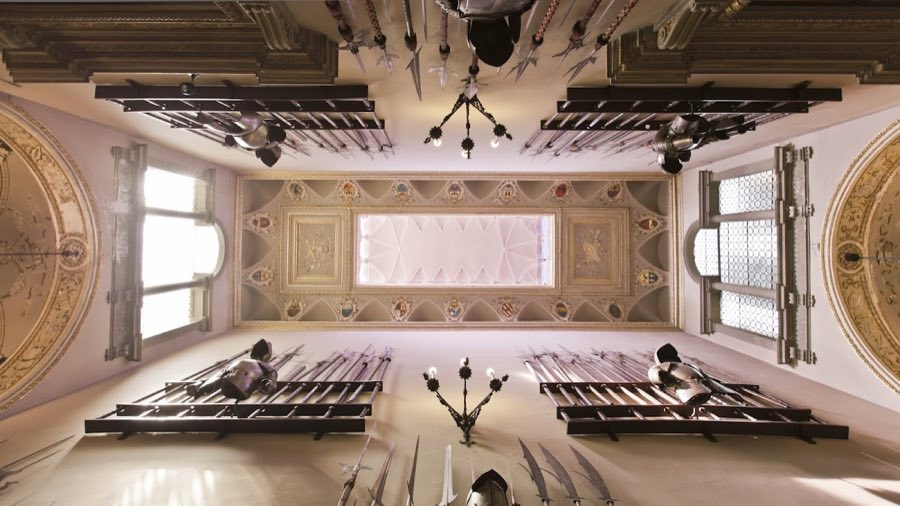
Bagatti Valsecchi Museum
Italy
Manor houseIntact19th century
No. 18435
Palace · Italy
No. 18435 · 45.470 N, 9.199 E
For events
Palazzo del Senato, Milan is marked as a château or castle venue lead. Capacity, indoor/outdoor spaces, catering rules, and accommodation options are published only after public verification.
Event types: Private events, Cultural gatherings, Filming and photography
Quick summary
Palazzo del Senato, Milan is a palace in Milan, Italy with origins associated with the 18th century.
See all castles in ItalyPalazzo del Senato in Milan, Italy, began life as a Catholic seminary known as the Swiss College, built for the training of Swiss clergy in the late 16th and early 17th centuries and executed in a Baroque manner. From its foundation the site played a religious and later a civic role, first serving the Church and then hosting successive government bodies and, eventually, the city’s state archive.
Work on the site began in the 1580s, with a formal plan produced in 1582 and the seminary placed on land belonging to older monastic houses in 1583. Construction proceeded through the early 1600s, with major building phases beginning around 1613 and continuing into the middle decades of the century. In 1664 the complex expanded through the acquisition of the neighbouring monastery of San Primo and the adjacent church was enlarged and redecorated.
Life at the seminary could be turbulent. In 1621 students rose in a marked riot in response to disciplinary rules and problems with provisioning, an episode that entered contemporary records. The institution remained fundamentally ecclesiastical until imperial reforms at the end of the 18th century altered its role.
Emperor Joseph II’s suppression of many religious foundations transformed the palace’s purpose in 1786, when it became the seat of the Supreme Council of Government (Supremo consiglio di governo) and housed the reorganised civic administration. During the Napoleonic period the building accommodated several political bodies: in 1797 it held the lower chamber of the Cisalpine Republic, known as the Council of the Young (Consiglio de’ Juniori), and later hosted ministries for the Italian Republic and the Kingdom of Italy, including the Ministry of War. From 1809 the complex was commonly referred to as the Palace of the Senate, a name that endured.
The Napoleonic years left distinct traces inside and outside the palace. A large sculptural group by Antonio Canova representing Mars with Napoleon’s features was intended for the principal courtyard, but this work was later moved to the Brera. In April 1814 a crowd entered the building, destroyed official papers and furniture, and tore down an official portrait of Napoleon painted by Andrea Appiani; municipal authorities then abolished the former Senate. After Napoleon’s fall, returning Austrian authorities installed the Imperial Army Chancellery in the palace, and from 1817 the State Accounting office occupied the premises until 1859.
Mid-19th century administrative reform shifted the building again. Efforts to concentrate state records led to the placement of the archive’s direction in the palace from 1873, and by 1886 all archival holdings had been moved there, establishing the site as the State Archive of Milan. In the 20th century the complex suffered a severe blow in the aerial bombing of 12–13 July 1943, with loss of archival material and heavy damage to the western side. Earlier incompatible additions were removed in 1915, and extensive post-war reconstruction and conservation during the 1950s repaired and restored much of the fabric. Since the mid-20th century the restored palace has housed the State Archive and the regional archival superintendency for Lombardy.
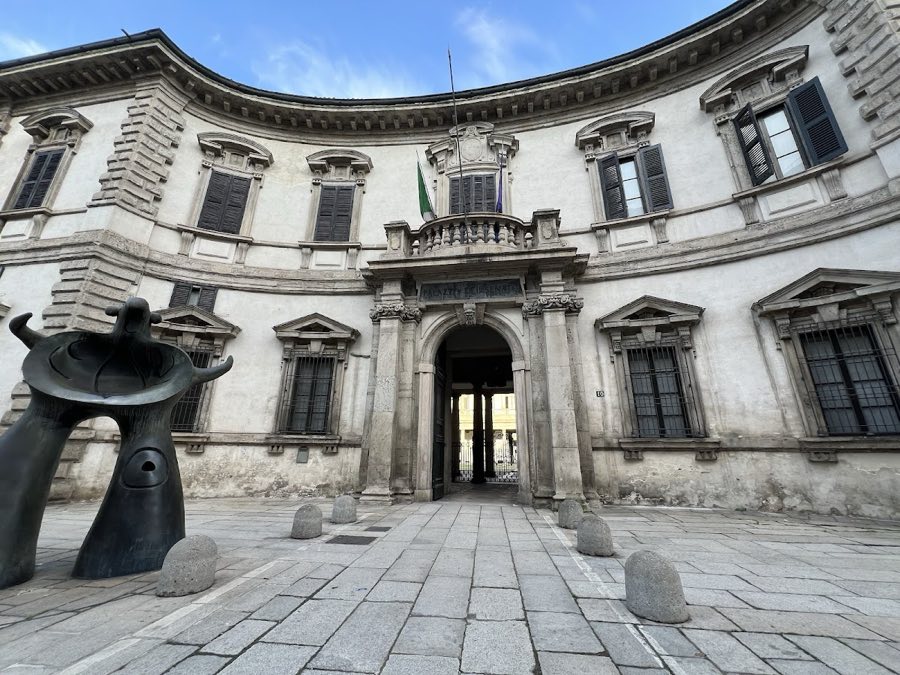
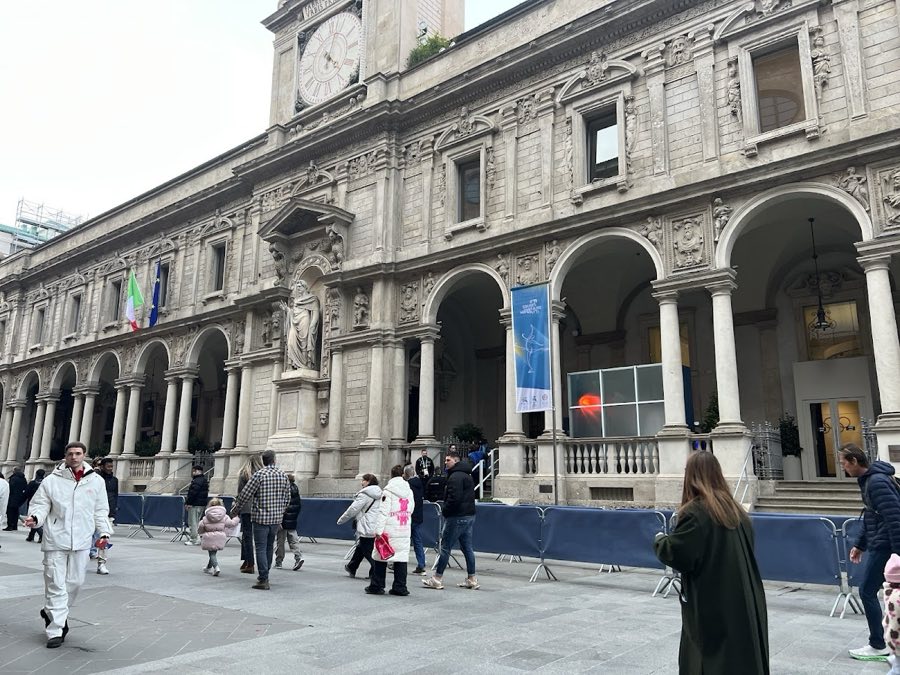
The palace presents a compact Baroque composition organized around two large internal courts and a principal street façade that emphasizes a broad, centred elliptical section. The street front brings together an oval projection and adjacent rectangular volumes, with a formal ground-level entrance and a piano nobile marked by a row of palace-type windows linked by a continuous cornice band. Window heads on the principal storeys alternate triangular pediments on the lower level and curved pediments on the upper level, creating a layered classical rhythm across the façade.
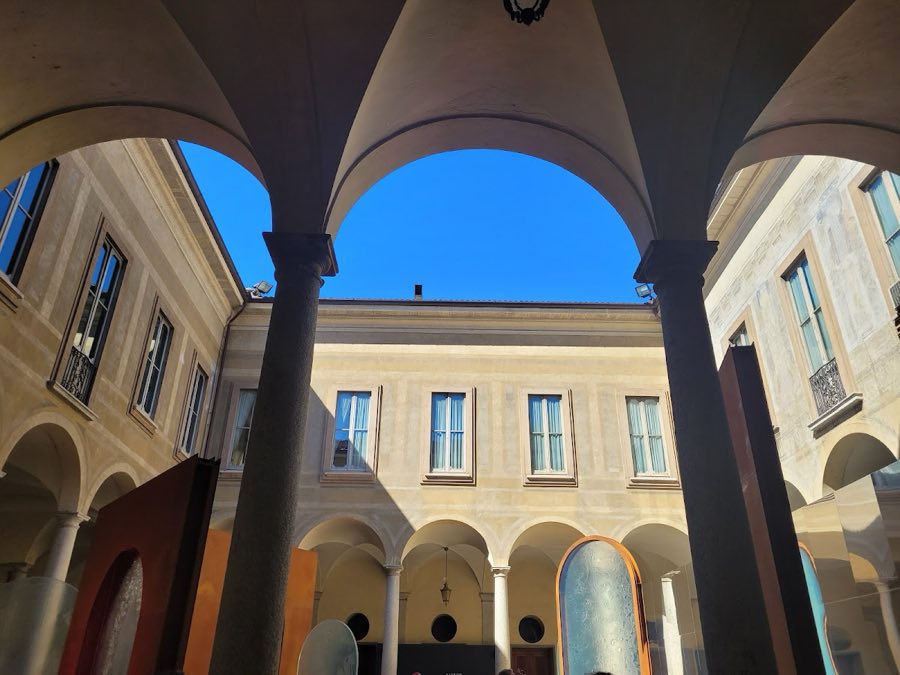
Inside, two spacious courtyards form the building’s heart. Each court is edged by a double order of open loggias built without rounded arches, instead supported by horizontal entablatures; these architraved (loggias with entablature support rather than arches) galleries run for two storeys and give the courts a strongly classical appearance. The first inner courtyard in particular has been praised as an unusually antique-minded and classically ordered space for Milan, noted for its measured proportions and colonnaded galleries.
The volume that formerly contained the monastic church of San Carlo al Collegio Elvetico survives in part. The church façade remains in place along the left side of the complex, while the space once occupied by the body of the church now serves as the State Archive’s conference hall. Historical drawings from the late 18th century allow reconstruction of the church’s original plan and relation to the palace fabric.
Construction throughout the complex relies on the long, horizontal lines of classical masonry and the use of colonnaded galleries rather than arched arcades. The western side of the palace bears signs of wartime destruction from the 1943 bombing and today shows areas that were reconstructed or carefully remade during post-war repairs. Restoration work in the mid-20th century renewed the courtyards’ colonnades and roofs, and later maintenance projects addressed the second courtyard, with repairs recorded in the early 21st century. The complex now functions as the home of the State Archive of Milan, with its restored courts, galleries, and former church façade integrated into the building’s present archival use.
No. 86912
No. 18123
No. 49673
No. 79019
Comments
Comments for Palazzo del Senato, Milan will require a verified account before posting.
We'll send a verification link before your first comment is published.