No. 32902
Natoli Palace
Italy
PalaceRestoredFor rent18th century
No. 61819
Palace · Italy
No. 61819 · 38.115 N, 13.359 E
Quick summary
Palazzo Drago Ajroldi is a palace in Italy with origins associated with the 18th century.
See all castles in ItalyPalazzo Drago Ajroldi in Palermo, Italy, is an urban palace that began as an Arab garrison along the medieval Cassaro route. The building took its final historic shape in the opening years of the eighteenth century and exhibits layers of Baroque form later mixed with Neoclassical ordering and, eventually, Liberty, or Art Nouveau, touches. Its position on the old Cassaro and its changing ownership across noble families made the palace a visible participant in Palermo’s civic and cultural life.
The site served first as a military presidio established by Arab rulers when the Cassaro was the main thoroughfare. Over several centuries the structure was rebuilt and added onto repeatedly, each generation leaving masonry and layout traces until the large-scale remodelling that produced the eighteenth-century appearance.
In 1714 the residence entered the hands of Casimiro Drago during the reign of Victor Amadeus II of Savoy, when the property was tied to an important judicial-administrative office in the kingdom. In 1724 the title of marquis was conferred on the family by Emperor Charles VI. Casimiro’s son, Biagio II Drago, then directed a comprehensive pictorial decoration of the main reception rooms. Among these commissions is Olivio Sozzi’s signed and dated fresco The Judgment of Paris, completed in 1745, a notable non-religious composition within the palace.
The nineteenth century brought a change of owners. The Ajroldi family, originally from Lombardy and later styled Marquises of Santa Colomba, acquired the property; Giovanbattista Ajroldi purchased the marquisate title from Gaspare di Santa Colomba. Under the Ajroldi line the interiors and façades were reworked so that Baroque richness met Neoclassical restraint, and later decorative phases introduced Liberty motifs.
In 1872 an architect undertook refinement works that adjusted the palace’s décor and finishes. During the early decades of the twentieth century principal salons were redecorated following the Art Nouveau taste prevailing in Palermo, with interventions by a prominent local painter and his workshop while other rooms preserved their earlier schemes and Sozzi’s eighteenth-century fresco. In recent years the Bertolino family, represented by Giovanni Bertolino, has carried out restorations and adapted the residence to function as a house-museum, with spaces set aside for contemporary painters and a small group of canvases by Francesco Lojacono kept within the principal rooms.
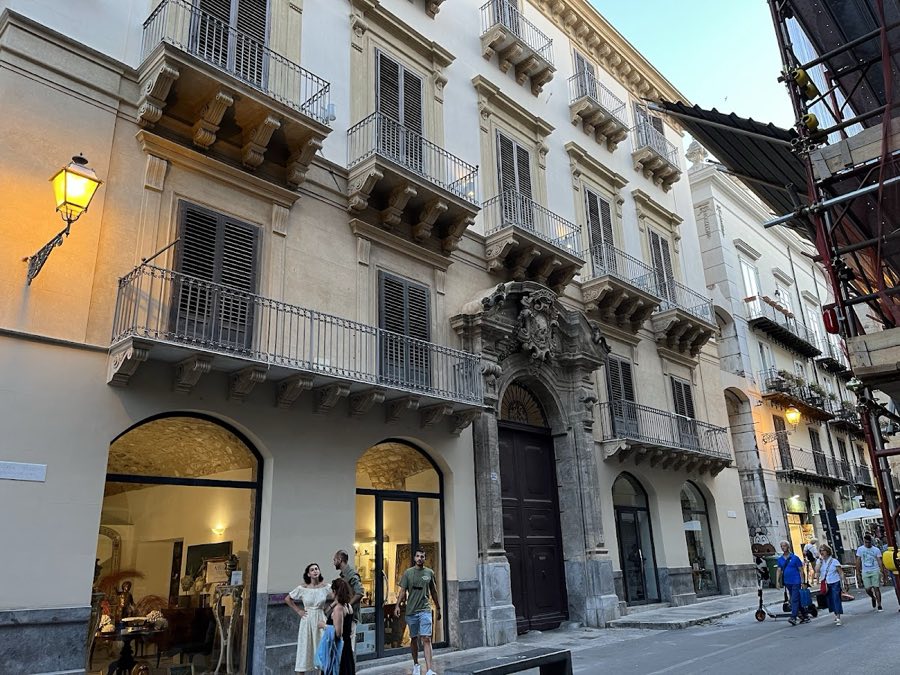
The palace occupies a corner plot and rises over four levels above street level, forming a compact urban block. The ground storey presents a large central portal that faces north. Above the entrance is a broken-arch pediment which bears the original marquisal coat of arms, a garland enclosing a winged dragon and surmounted by a noble crown. The level above the ground floor reads as a mezzanine with pairs of openings on each side, while the main floor, or piano nobile, and the uppermost storey each display a row of five balconies that mark the principal façade rhythm.
Inside, the piano nobile unfolds as an enfilade of reception rooms aligned along the building’s main axis. The room known as the Hall of the Apple of Discord features a vaulted ceiling fresco that centers on the Apple of Discord theme. A nearby chamber uses painted balconies to create a trompe-l’œil effect, a decorative illusion achieved by the early twentieth-century workshop. The Neoclassical Room, originally the main salon on the long axis, is ornamented with medallions and a central ceiling view of sky populated by a female figure and putti holding flowers; this salon contains canvases by Francesco Lojacono.
Another suite, the Coral Room, is treated in a Pompeian manner and includes painted female figures among which the actress Eleonora Duse appears; a display case in this room holds personal objects associated with her. The Plate Room is decorated with an Allegory of Spring populated by flying putti. A smaller chamber called the Little Pages’ Room preserves a group of colonial-era memorabilia. On the ground floor an internal courtyard survives with a fountain anchoring the open space.
The principal salon contains Olivio Sozzi’s signed 1745 fresco The Judgment of Paris. The scene shows Paris standing between Hera and Athena as he hands the fatal apple to Aphrodite while shepherds look on, and Zeus appears above with Hermes indicating his presence. The painted composition is bordered by friezes and cartouches and is complemented by stucco musician-angels in the manner of the Serpotta workshop hovering above the family arms topped by a noble crown. These decorative and pictorial elements remain integral to the reception suite and exemplify one of the artist’s uncommon mythological works within a private palace.
No. 32902
No. 56032
No. 15901
No. 24838
Comments
Comments for Palazzo Drago Ajroldi will require a verified account before posting.
We'll send a verification link before your first comment is published.