No. 26379
Palazzo Chigi
Italy
PalaceRestored16th century
No. 43966
Palace · Italy
No. 43966 · 41.902 N, 12.480 E
Quick summary
Palazzo Marignoli is a palace in Italy with origins associated with the 19th century.
See all castles in ItalyPalazzo Marignoli in Rome, Italy, is an eclectic urban palace erected in the late 19th century (1878–1883) by Italian patrons for Marquis Filippo Marignoli, who served as a deputy and later as a senator. Built on land long associated with religious houses, the palace reflects a phase in the city when older monastic plots were redeveloped to meet modern urban needs. Its location and successive uses tied the site to charitable, civic, and media functions across several centuries.
The site’s documented history begins in the early 16th century, when the Confraternity of Saint Jerome of Charity, prompted by Cardinal Giulio de’ Medici, founded a monastery in 1520 to shelter women seeking reform. Pope Leo X formally inaugurated the house on 19 May 1520, assigning it to a cloister observing the Rule of Saint Augustine. Pope Clement VII confirmed the foundation in 1525 and established a fixed dowry of 50 scudi per month. By the middle of the 16th century the confraternity’s funds had grown substantially; records show large sums raised from donors and from alms placed in a donation box beneath a Marian shrine at Ponte Milvio labeled “For the poor converts.”
A major fire in 1617 led to rebuilding under the patronage of Cardinal Pietro Aldobrandini and Pope Paul V. Over the 17th and 18th centuries some women moved to other religious houses, including San Giacomo alla Lungara in 1628, and the monastic community on the Corso underwent further dispersals in 1798 when the monastery there was suppressed. The older Augustinian complex appears partly in an engraving of the city made in 1758 by Giuseppe Vasi; by the 19th century that convent and the adjacent church had been cleared to make way for new development.
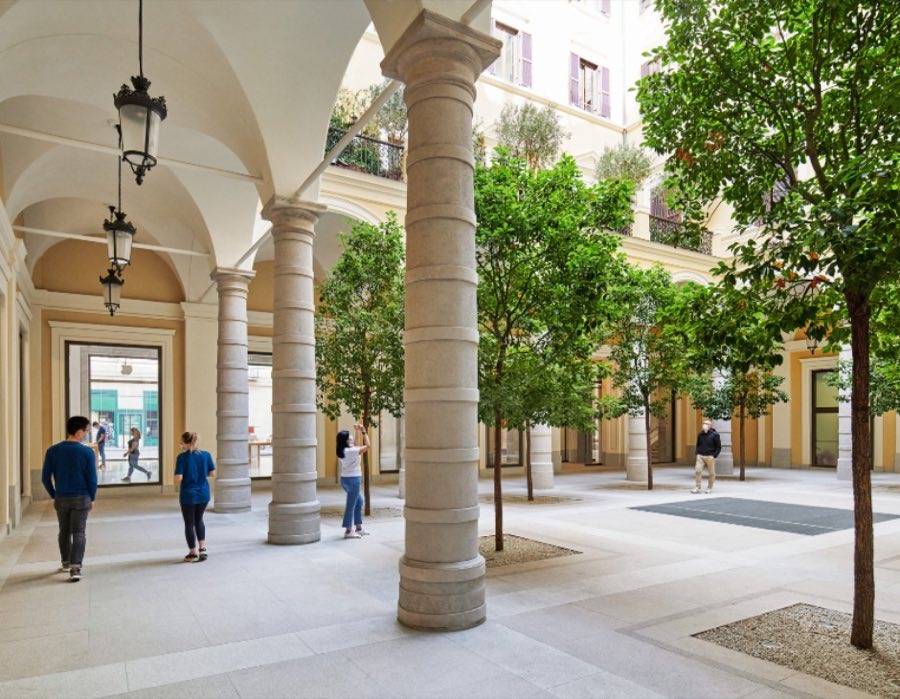
Between 1878 and 1883 the present palace rose on the cleared site to house the Marignoli family and their enterprises. Later in the 19th century the widening of Via del Corso required demolition of the original front and the construction of a replacement façade aligned to the enlarged street. Over the 20th century the building accommodated a longstanding café on its ground floor and, from 1935 until 2014, offered space for the Italian press room, a government-provided facility for journalists without a permanent editorial office in the capital. Ownership passed from the Marignoli family to an insurance company, and the current owner, Allianz, initiated redevelopment work between 2016 and 2020. The retail frontage that once housed the historic café became an Apple Store on 27 May 2021.
The palace occupies a substantial block between Piazza di San Silvestro and Via del Corso, bounded by Via delle Convertite and Via di San Claudio in the rione Colonna. The building presents the later 19th-century façade that was put up when Via del Corso was widened; that front defines the street elevation and contains the principal decorative elements visible today.
On the main, or noble, floor three prominent balconies mark the street face: paired corner balconies and a larger central balcony set in front of three broad arched windows. Those central openings are framed by columns that rise to support the balcony on the floor above, forming the most visually distinctive group on the façade. At street level the stone facing retains an engraved inscription reading ARAGNO on the side facing Via del Corso and the doorway at civic number 180 served the historic café that occupied the shopfront for much of the 20th century. These exterior elements, including the inscription and the balcony arrangement, survive in situ.
Evidence of the earlier religious complex survives in the visual record rather than in standing fabric on site; an engraving produced in 1758 by Giuseppe Vasi shows the Augustinian convent that once occupied this parcel. The ground-floor retail unit that long fronted Via del Corso has been adapted for contemporary commercial use and reopened as an Apple Store on 27 May 2021, while the main elevations continue to display the altered 19th-century composition created to meet the geometric demands of the widened street.
No. 26379
No. 90590
No. 26381
No. 95986
Comments
Comments for Palazzo Marignoli will require a verified account before posting.
We'll send a verification link before your first comment is published.