No. 61214
Stockholm Palace
Sweden
PalaceRuin16th century

No. 24249
Palace · Sweden
No. 24249 · 59.326 N, 18.066 E
Quick summary
Riddarhuset, Stockholm is a palace in Stockholm, Sweden with origins associated with the 17th century.
See all castles in SwedenThe Swedish House of Nobility in Stockholm, Sweden, was erected by the Swedish state in the 17th century as a purpose-built meeting place for the country’s noble estate, and it combines late Renaissance and French classical influences with strong Dutch architectural models. Approved by King Gustav II Adolf in 1626, the building came to matter as the formal home of the organized nobility and as the chamber where noble representatives met within Sweden’s estate-based parliament. Its construction and later institutional role placed it at the center of aristocratic public life for more than two centuries.
Planning and building progressed in stages. Groundworks for the main block began in 1641, and the principal construction campaign ran from 1641 until completion in 1674. During this period the unfinished palace already served important ceremonial functions: in 1650 the nobility gathered there for Queen Christina’s coronation. The original conception envisaged an extended complex with two wings framing the site to east and west and greatly expanded noble holdings on the square now called Riddarhustorget; the north entrance follows a design drawn in 1660.
From the later 17th century until the parliamentary reform of 1866 the palace functioned as the institutional seat for the nobility, and the Great Hall (Riddarhussalen) was the venue for meetings of the noble chamber in the Riksdag of the Estates. The reform of 1866 replaced the estates system with a modern bicameral parliament, and after that date the House continued in a regulated representative role before evolving into a private body responsible for noble registers and advocacy. The land on which the building stands was bought by Axel Oxenstierna and given to the nobility, and a monument to Gustav Vasa was placed in front of the palace on 24 June 1774, later moved closer to the façade in the early 20th century. A statue of Chancellor Axel Oxenstierna stood before the north façade in 1890, and a park north of the building also contains a memorial to him.
The palace has undergone several major repairs and alterations across centuries, with large-scale work carried out in 1815–1817, again in 1847, and in 1903–1904. In 1870 freestanding side pavilions were added to the complex, and the southern esplanade received plantings in the 1910s. Public concerts have taken place in the building since the 18th century, beginning in 1731 under the Royal Court Orchestra, and the side pavilions have been adapted for office use. The House of Nobility is governed by legislation that dates back to the original 1626 act, with the current statute established in 1866, and the institution joined the international assembly CILANE in 1990. Since 2003 the body has operated as a private institution maintaining noble records and representing noble interests.
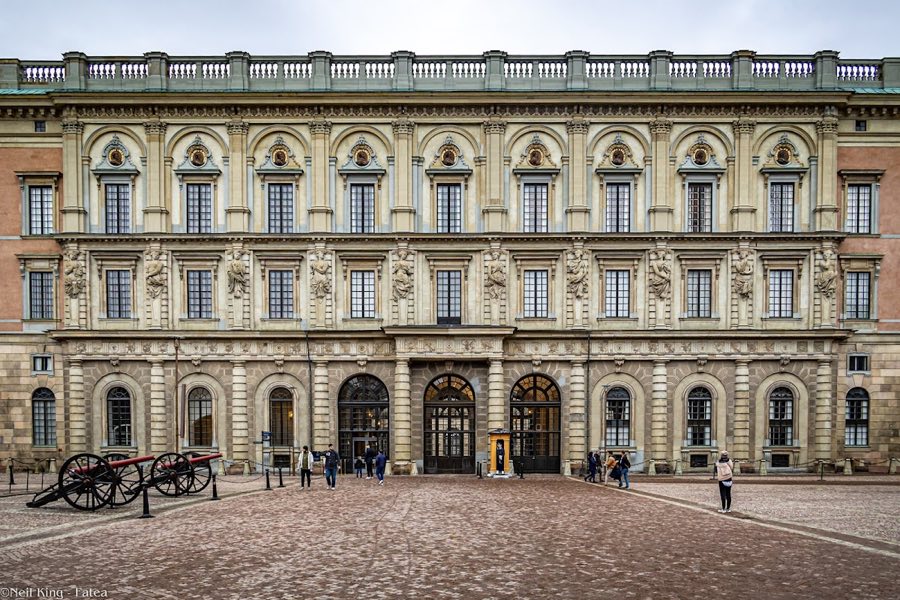
The palace stands as a two-storey rectangular block built mainly in the years 1641–1674, with an internal usable floor area of about 1,700 square metres. Its elevations combine light-red local brick with pale Gotland sandstone for the vertical elements, where pilasters and engaged columns in the Corinthian manner articulate the façades. The north entrance was executed to a mid-17th-century design and serves as the principal formal approach.
The roof is a distinctive two-part profile, with a curved lower pitch introduced in later design drawings and a steeper upper section; four obelisk-like projections at the corners of the upper roof act as chimney terminals. Central projecting sections on the north and south façades carry sandstone statues set beneath pediments; on the north a warrior figure wearing a knight’s chain is flanked by personifications of Prudence and Hercules, while the south shows a female figure labeled Nobilitas between male and female figures interpreted as military and civil study. Lead figures of Minerva and a Knight bearing the motto Arte et Marte decorate the east and west roof zones.
Inside, the main staircase occupies roughly one quarter of the interior, about 450 square metres, and presents wide limestone treads reputedly from Öland; lantern fittings were added in 1765, modeled on bronze examples from the royal castle. The Great Hall (Riddarhussalen) measures just over 300 square metres and is crowned by the ceiling painting titled Glorification of Sweden, executed in the 1670s. The interior preserves important 17th-century furnishings and an extensive heraldic display: the hall is hung with more than two thousand noble coats of arms, one count lists 2,331, another 2,337, while only 603 families are listed as living.
The complex has been repeatedly restored and altered, with significant repair campaigns in the early 19th and early 20th centuries and the addition of side pavilions in 1870. The immediate setting includes commemorative sculpture placed across the 19th and 20th centuries, most notably the Gustav Vasa statue installed in 1774 and repositioned closer to the façade in the early 1900s, and memorials to Axel Oxenstierna located before the north front and in the park to the north. Overall the building survives as a well-maintained historic palace combining masonry brickwork, cut sandstone ornament, and a roofline that influenced later Swedish two-pitched designs.
No. 61214
No. 36578
No. 70406
No. 44606
Comments
Comments for Riddarhuset, Stockholm will require a verified account before posting.
We'll send a verification link before your first comment is published.