No. 21386
Burgruine Araburg
Austria
CastleRuinFor events12th century
No. 12902
No. 12902 · 47.905 N, 15.623 E
Quick summary
Ruine Hohenberg is a castle in Austria with origins associated with the 13th century.
See all castles in AustriaRuine Hohenberg is located in the municipality of Hinterberg, Austria. This medieval castle was built in the 13th century by the noble Dietrich von Hohenberg, a member of the ministerial family originally known as von Hohenstaff (later von Altenburg). Dietrich and his brother Heinrich were founders of the Hohenberger line, which formed part of the broader Hohenstaff-Altenburg-Hohenberg dynasty.
During the early 15th century, the castle played a role in regional power struggles. In 1407, amidst a civil war in Austria over the guardianship of the young Duke Albrecht V, Hans I. von Hohenberg supported Duke Ernst the Iron against Duke Leopold the Fat. Hans I. managed to pressure Lilienfeld Abbey into backing Ernst. However, when Leopold responded with a military campaign led by the Moravian knight Sokol, Hans I fled the castle and later retaliated by looting the abbey, frustrated by its limited support.
By the late 15th century, the castle continued to be significant in military affairs. In 1482, Hans III. von Hohenberg aligned with King Matthias Corvinus of Hungary during his conflict with Emperor Frederick III. As part of this alliance, Hans III. offered the castles of Merkenstein, Hohenberg, and Kreisbach to Matthias. Despite imperial efforts, the siege of Hohenberg failed to capture the stronghold.
Following the death of Erasmus von Hohenberg in 1529, the castle passed through marriage to Wilhelm von Roggendorf. Ownership changed hands frequently in the following decades. In 1535, Sebald Pögl the Younger acquired the site. Then, in 1589, Baron Bernhard V. von Jörger, a member of a Protestant noble family from Upper Austria, purchased the lordship and undertook expansions of the castle. The growing influence of the Jörger family alarmed local authorities, including Lilienfeld Abbey, which eventually led to imperial intervention.
During the Counter-Reformation in 1619, the properties of the Protestant Jörgers, including Hohenberg, were confiscated by imperial decree. Military forces under Hans Balthasar von Hoyos captured the castle, and it experienced substantial damage caused by fires during the fighting. Von Hoyos received the castle as a fief and formally acquired it in 1627. However, the Hoyos family’s infrequent presence in the Traisen valley contributed to the castle’s decline over the following decades.
By 1672, the ruin was recorded as partially standing, featuring intact outbuildings, round towers, and defensive walls, though it had largely lost its former strength. In the late 19th century, specifically in 1892, a prominent square tower known as the “Hungerturm” located near the Traisen River was demolished to make way for railway construction. Subsequent centuries saw the castle largely fall into ruin, with only limited restoration efforts occurring throughout the 20th century.
Ruine Hohenberg’s original design included a fortified layout characterized by a double defensive wall and a moat encircling the castle. The site featured a gate tower that controlled access, a zwinger (a narrow enclosed area between walls used for defense), a forecourt, and a triangular-shaped courtyard that formed the heart of the castle complex.
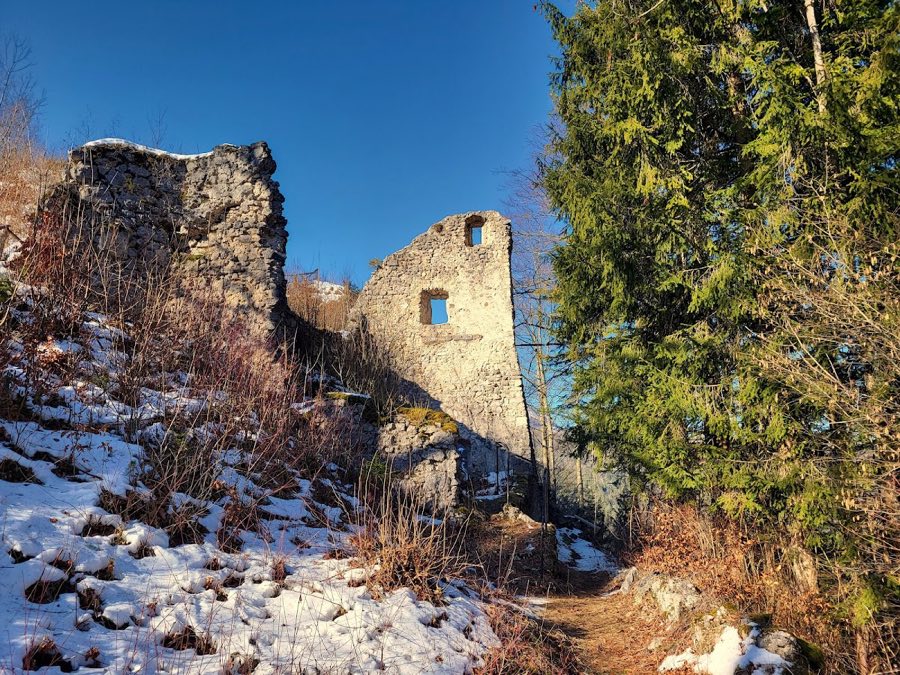
At present, the most visible remains include sections of the outer defensive wall. These substantial masonry walls once served as a protective barrier for the fortress. Remnants of a chimney flue are also preserved, offering evidence of domestic structures within the castle grounds.
The triangular courtyard was historically enclosed by sturdy curtain walls and complemented by round towers positioned for defense. These walls and towers were substantial enough to be depicted intact in a 1672 record, although they have since deteriorated further. The defensive elements showcased medieval military architecture, providing multiple layers of protection around the living and operational spaces inside.
One notable feature, the square tower called the “Hungerturm,” stood on the right bank of the Traisen River as part of a broader fortification system between the Schlossberg and Rierkogel hills. This tower served as a component of a valley block, reinforcing control over the surrounding landscape. The Hungerturm was removed in 1892 during construction of the nearby railway line, which altered the site’s historical profile.
The remaining walls and structural traces at Ruine Hohenberg speak to the castle’s layered history of construction, military engagement, expansion, and decline from its medieval origins through the early modern period. The surviving elements reflect the castle’s defensive purpose and its adaptation over centuries of conflict and shifting ownership.
No. 21386
No. 56851
No. 15119
No. 74680
Comments
Comments for Ruine Hohenberg will require a verified account before posting.
We'll send a verification link before your first comment is published.