No. 48392
Copper-Roof Palace, Warsaw
Warsaw, Poland
PalaceRestoredFor events17th century
No. 73300
No. 73300 · 52.244 N, 21.014 E
Quick summary
Wesslow Palace is a palace in Poland with origins associated with the 18th century.
See all castles in PolandWesslow Palace in Warsaw, Poland, is a late Baroque magnate residence erected between 1746 and 1752. Built in the mid-eighteenth century, the house became a notable address along the Royal Route and later played a sustained role in the city’s postal and administrative life. Its changing ownership and functions across the nineteenth and twentieth centuries linked the building to both civic communication and public administration.
The palace first appears in a city plan of 1762. Early recorded owners included General Franciszek Jan Załuski, who sold the property in 1761, and a sequence of private proprietors who held the house through the 1760s. By 1780 the building belonged to Ignacy Franciszek Przebendowski, who moved the royal post office into the premises. Because it maintained postal links with Saxony, the site became popularly known as the “Saxon Post”.
At the end of the eighteenth century the palace was described as royal private property and passed by inheritance to Józef Antoni Poniatowski. In 1805 a later owner sold the building to the Berlin General Post Office, and between that sale and 1874 the premises served as postal offices and postal stables. On 2 November 1830 Frédéric Chopin stopped at the post office here to check his luggage and say farewell to his family before leaving Warsaw for good.
City works in the early 1880s changed the palace’s street-facing form. During rebuilding in 1882–1884 the structure was altered to suit a widened road and a removed neighbouring tenement. After these changes the property accommodated newspaper editorial rooms from 1887 and housed commercial tenants such as a tailor and a cabinet of wax figures. In the years between the world wars the building hosted antiquarian activities associated with a “Palace of Art” use.
The palace burned in 1944, an event that left only outer walls and some fittings standing. Reconstruction took place in 1947–1948, returning the exterior to the appearance it had adopted after the 1882–1884 alterations. After the postwar rebuilding the premises were used by provincial and then national prosecutor’s offices. Today the building contains the General Prosecutor’s Office and the Institute of Justice.
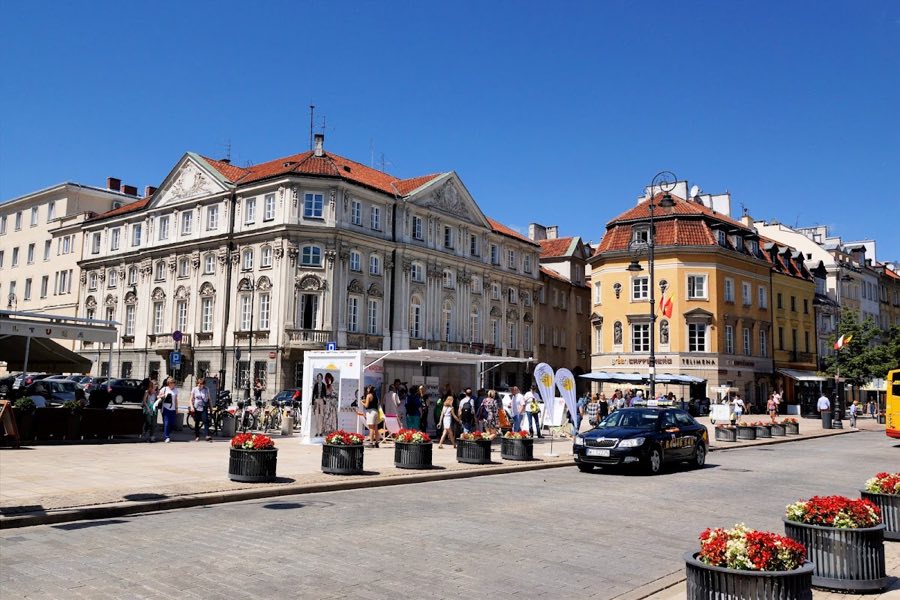
The building occupies a prominent site on Krakowskie Przedmieście at the start of Kozia Street and at the mouth of Trębacka Street. Its plan and surviving form reflect an eighteenth-century noble residence later adapted to civic and commercial functions, and its present exterior follows the late-nineteenth-century street-facing arrangement that was reinstated after postwar reconstruction.
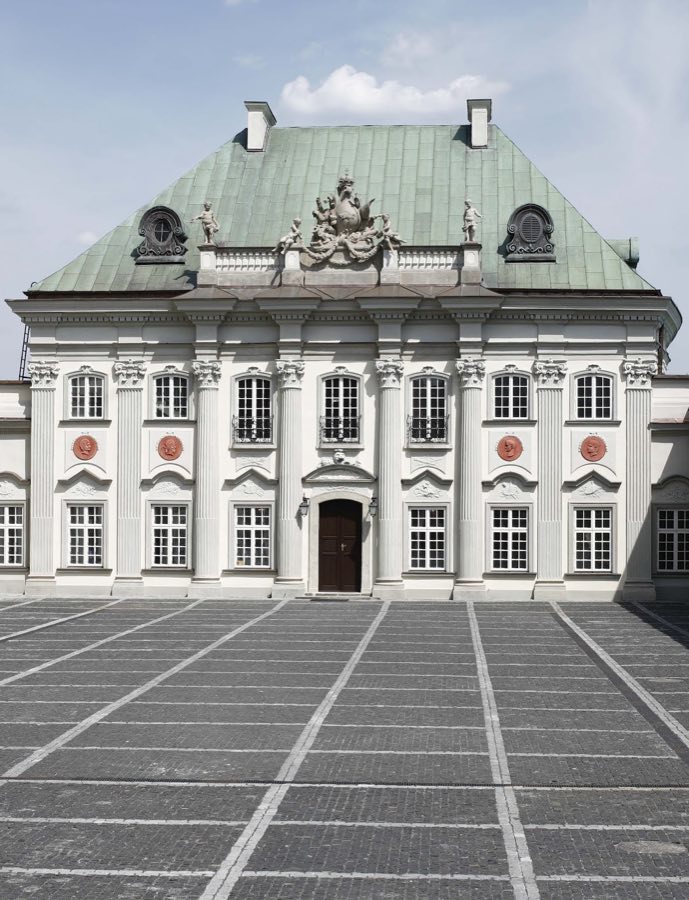
Originally the façade featured a central projecting bay articulated with flat columns (pilasters) and a gable extension above it. Two ornate Baroque dormer windows once looked toward Krakowskie Przedmieście; these decorative roof elements were removed in the late nineteenth-century rebuilding and replaced by an extended gable that emphasized the renovated elevation.
Major works carried out in 1882–1884 altered the building’s footprint and silhouette. The corner toward the widened street was cut back by about one metre, an additional story was inserted, and a new southern façade was composed to face the enlarged thoroughfare. The shortening at the corner was visually concealed by arranging the corner windows on an oblique axis, creating a slanted visual line that masks the reduced depth.
The wartime fire of 1944 left the outer walls standing, and the reconstruction of 1947–1948 repaired and reassembled the surviving fabric so the palace once again presented the post-1880s appearance. The restored exterior, including the arranged corner windows and the later gable, remains in situ today as the visible result of those successive building phases.
No. 48392
No. 86817
No. 11271
No. 59115
Comments
Comments for Wesslow Palace will require a verified account before posting.
We'll send a verification link before your first comment is published.